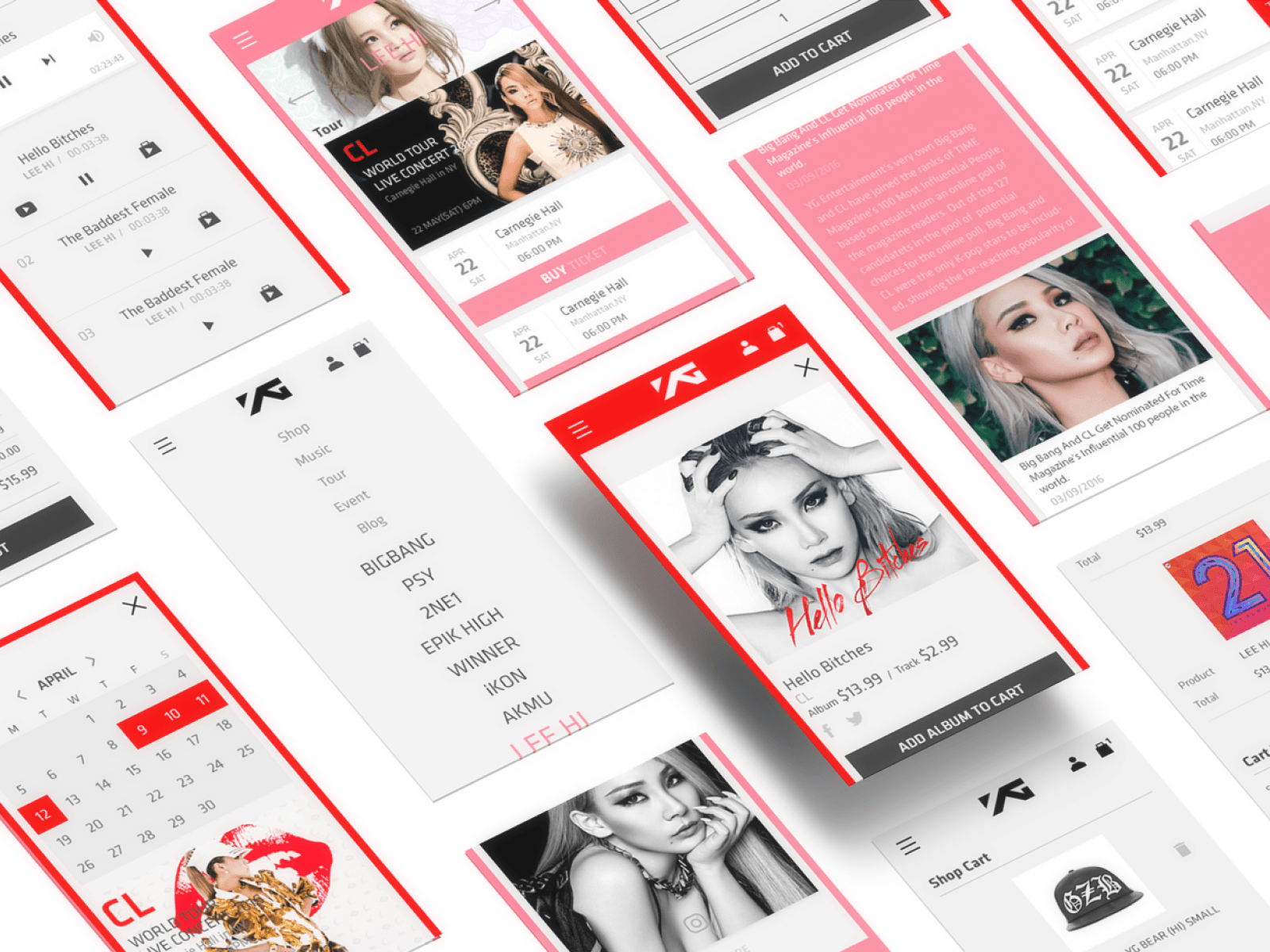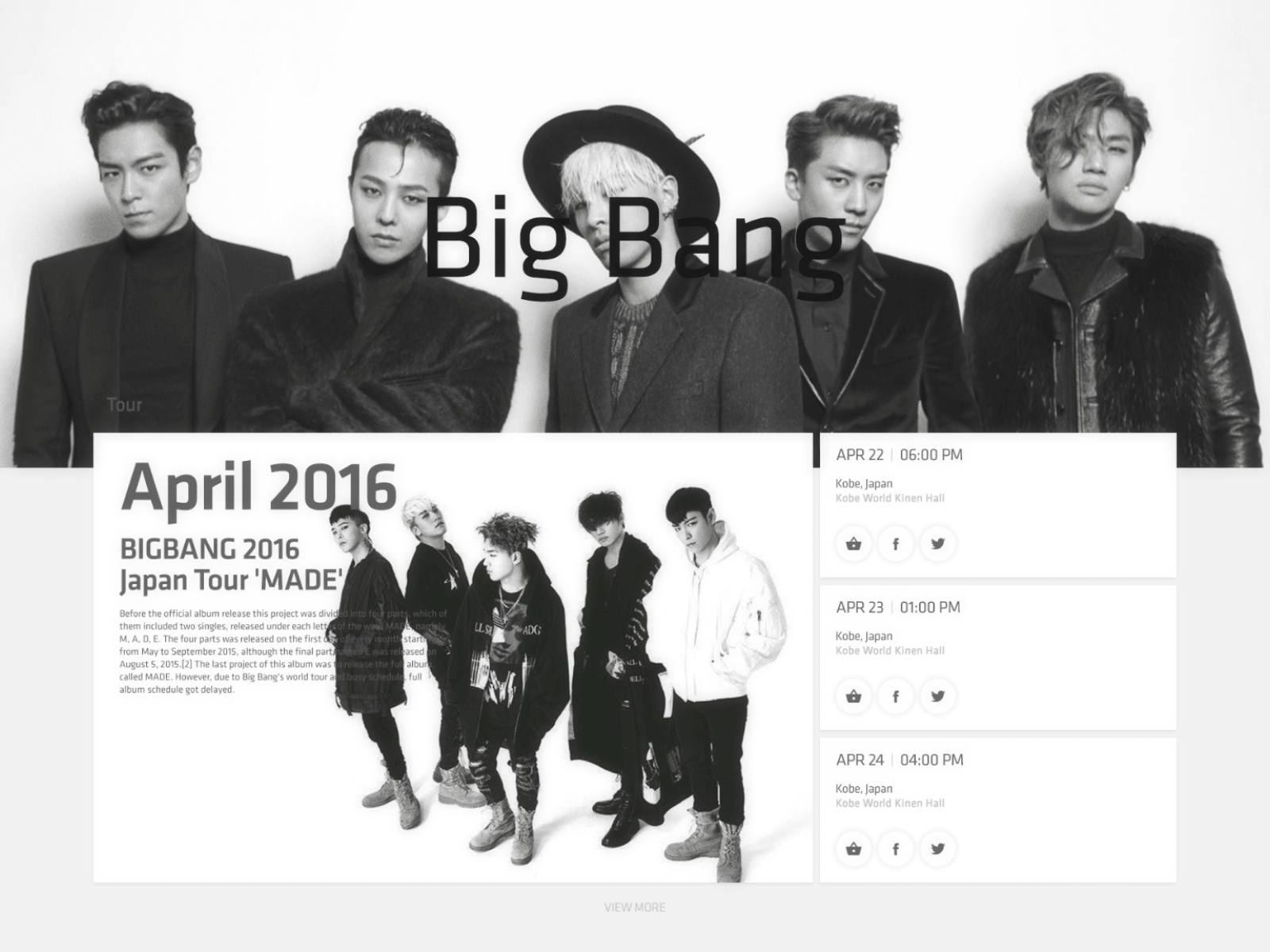
Selected Work

9 Projects
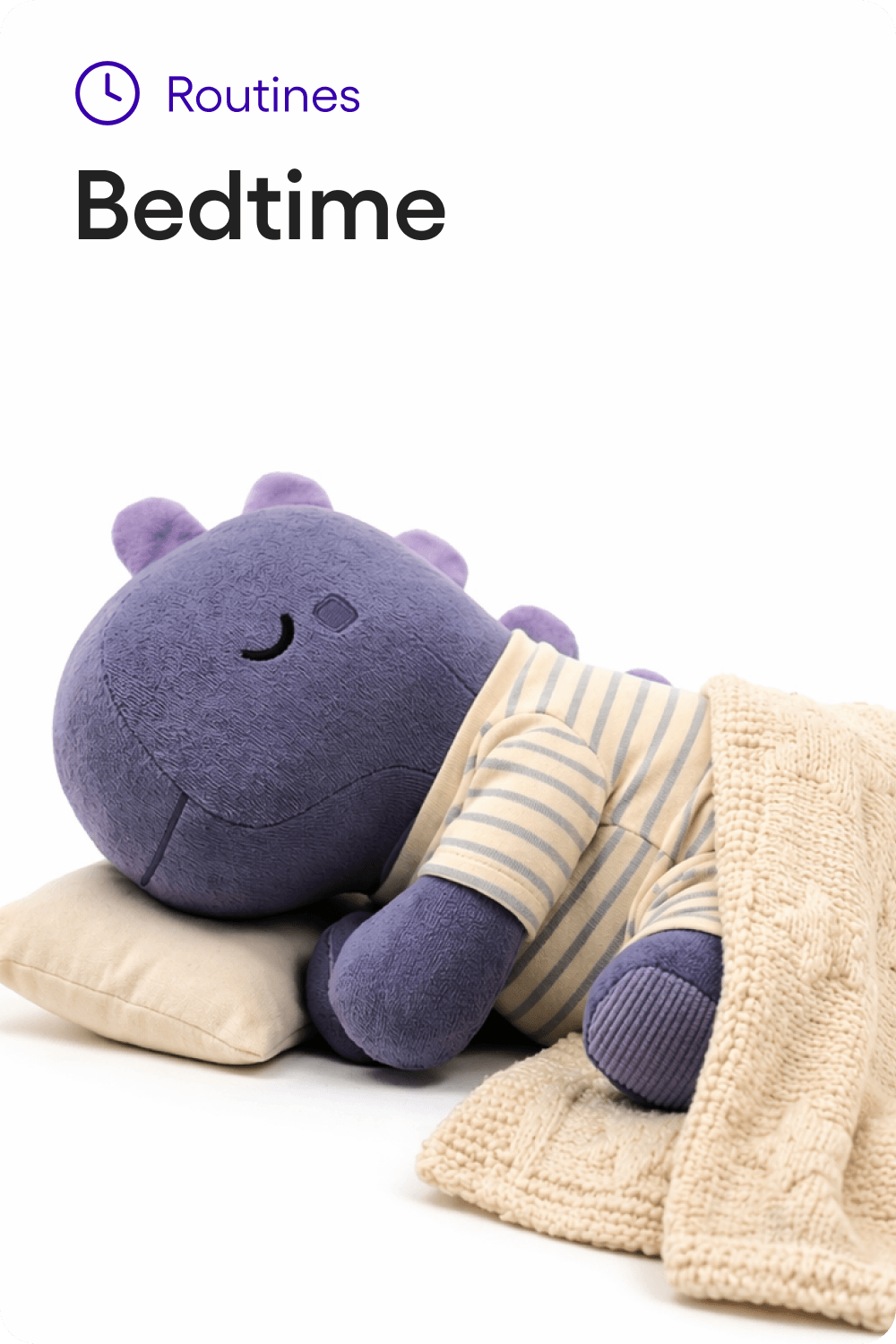
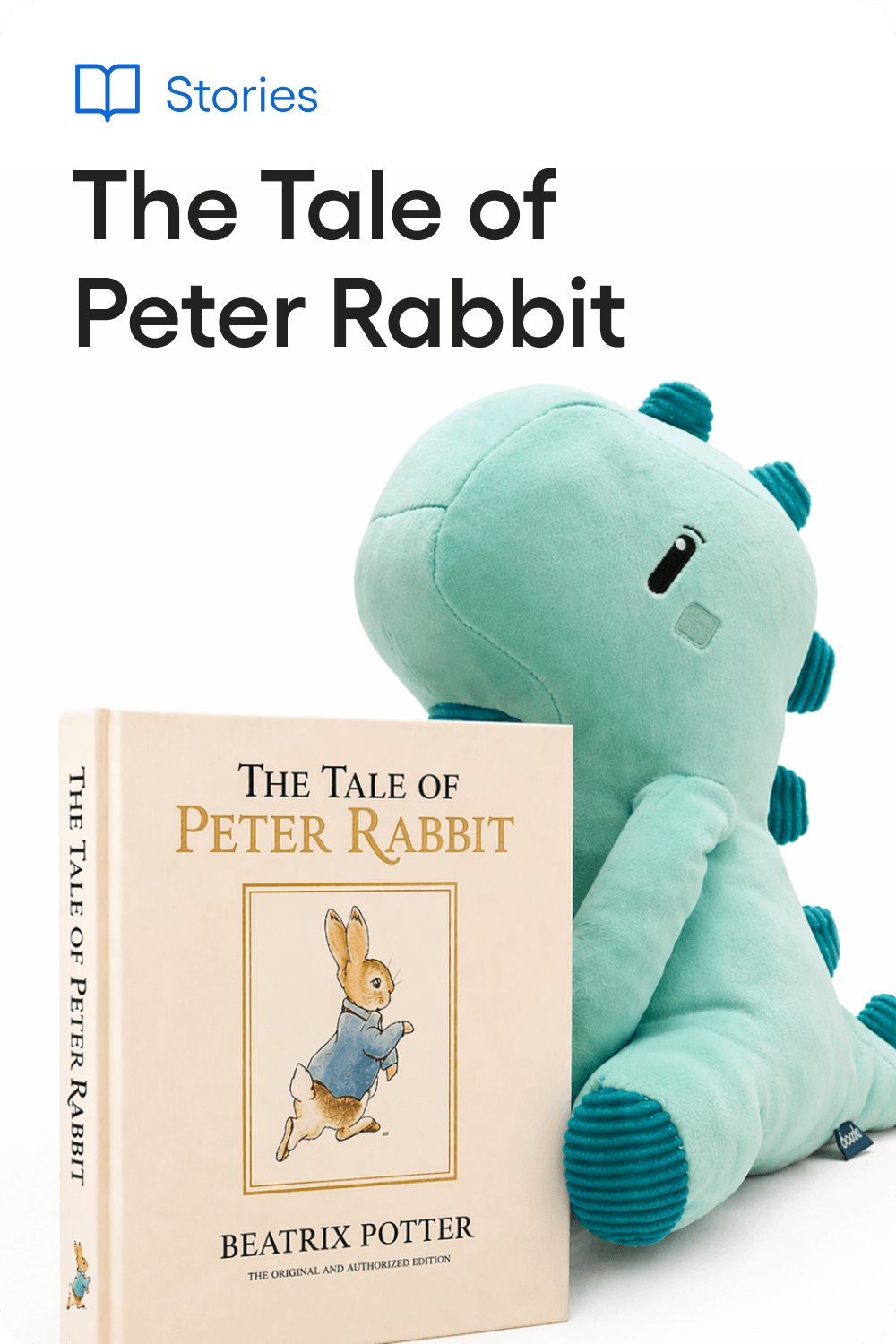
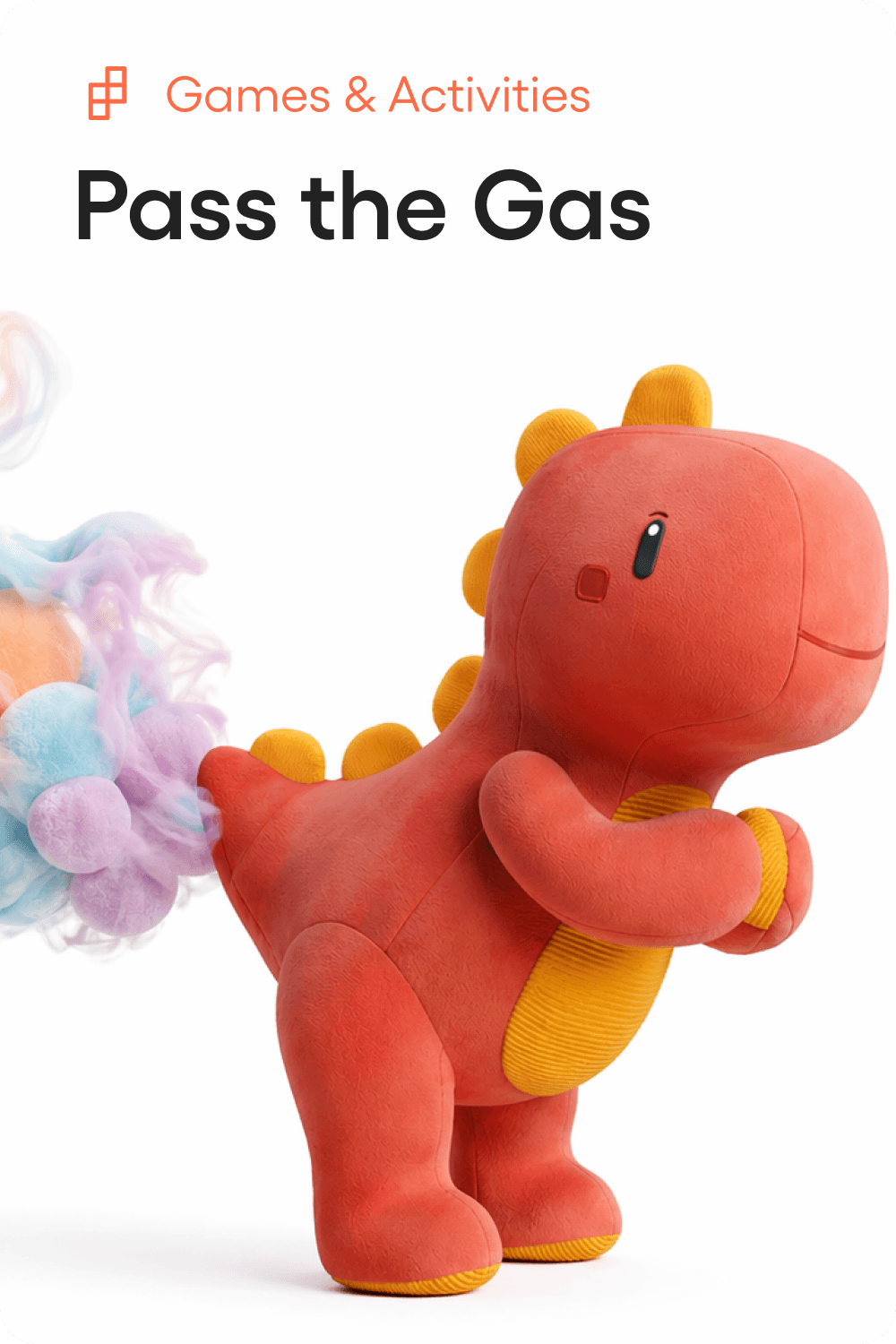
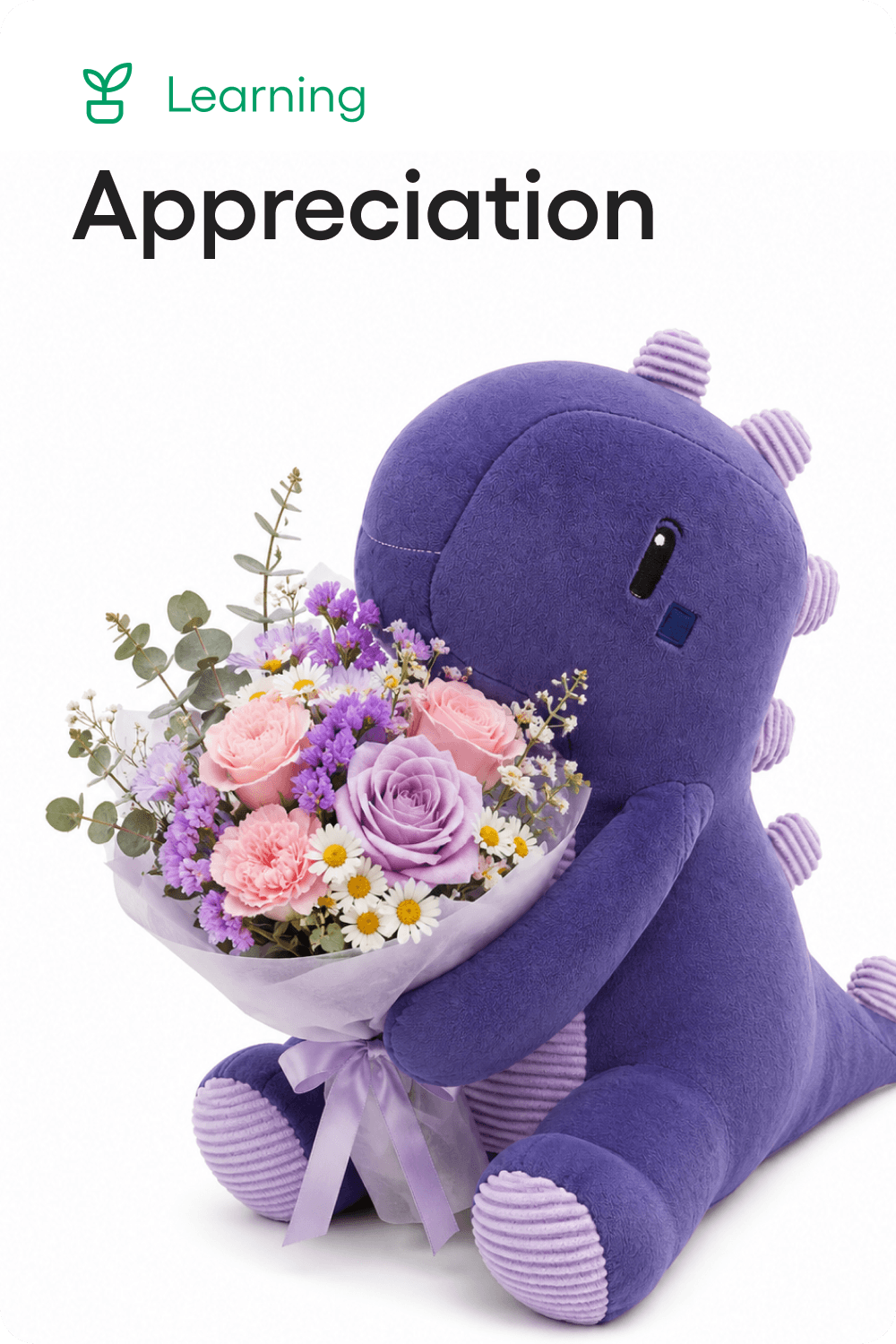
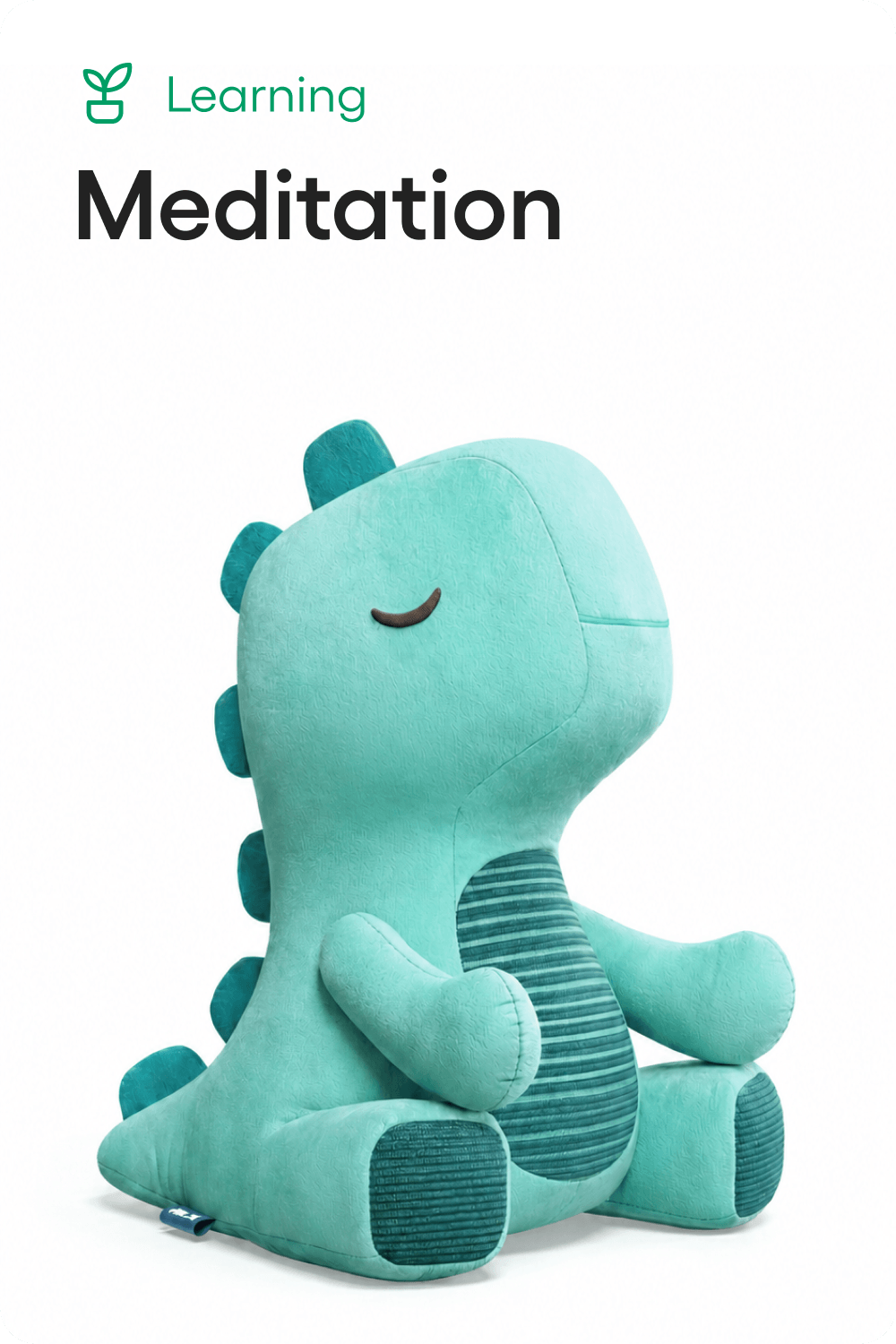
bondu bondu/thumb.png · 4:5
bondu
UI / UX · Embodied AI
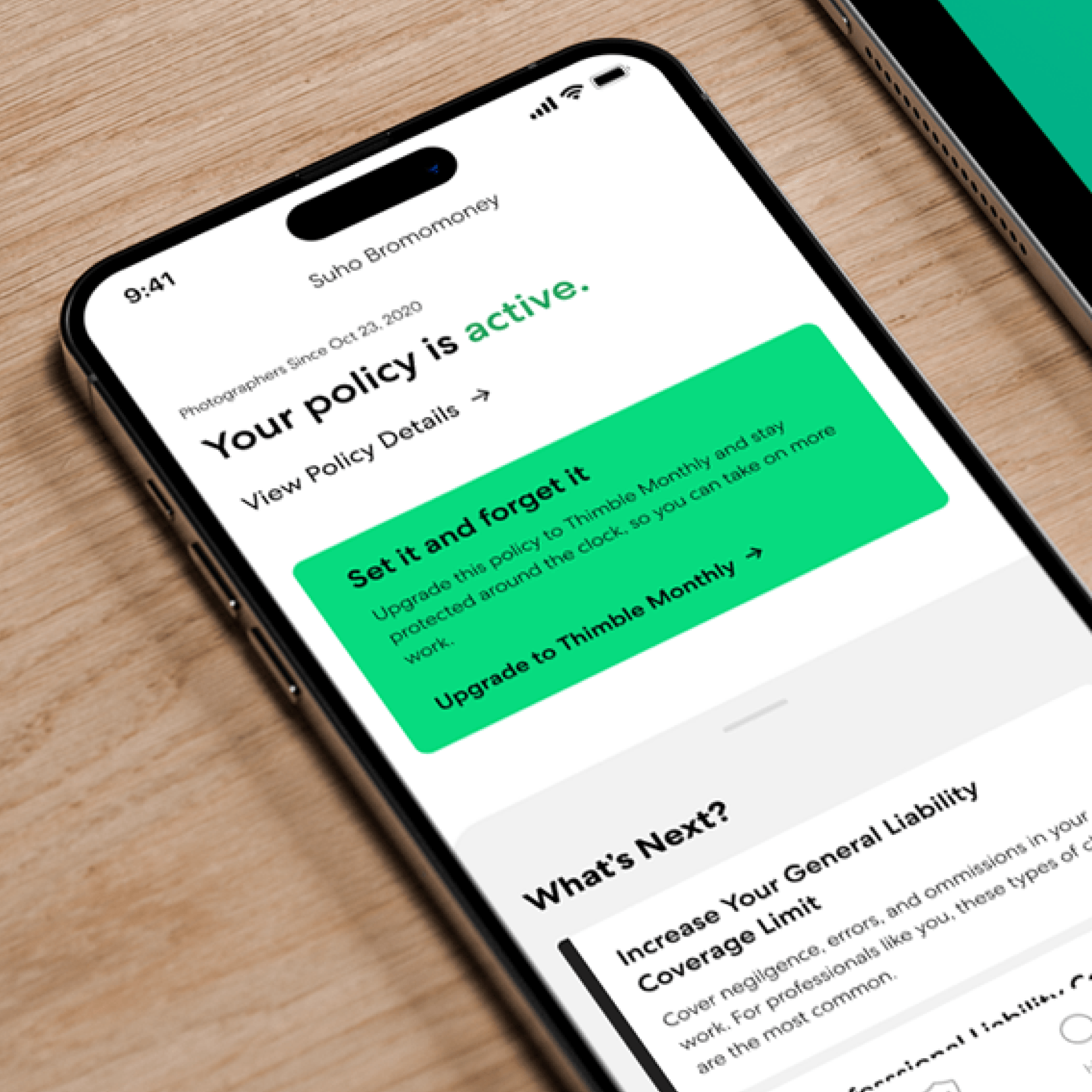
Thimble 0→1 thimble-1/thumb.png · 1:1
Building Thimblefrom 0→1
UI / UX · Insure-tech
Thimble for Brokers thimble-2/thumb.png · 4:5
Thimble for BrokersD2B2C platform
UI / UX · Broker channel
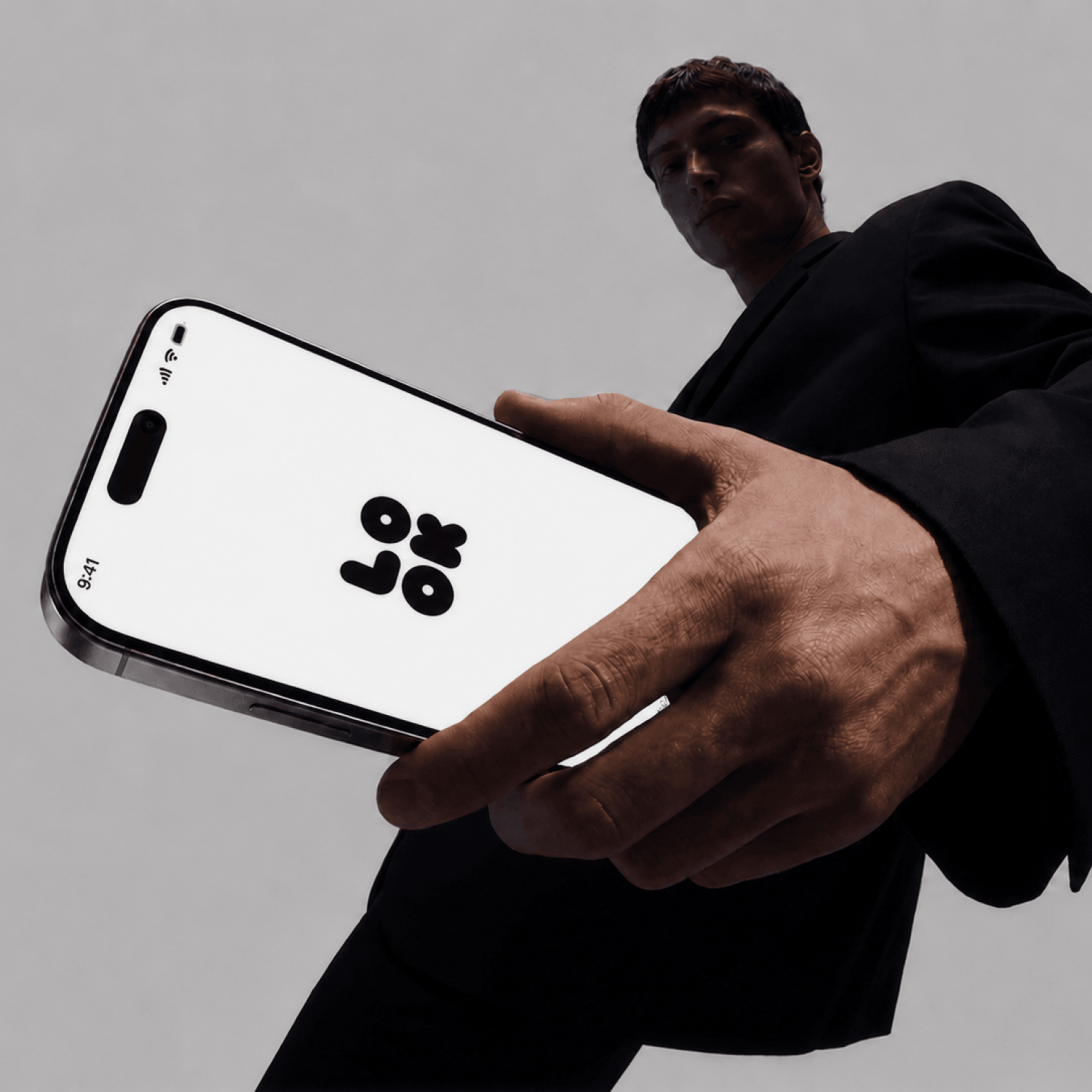
Lookscope lookscope/thumb.png · 1:1
Lookscope
Mobile app · Self-initiated
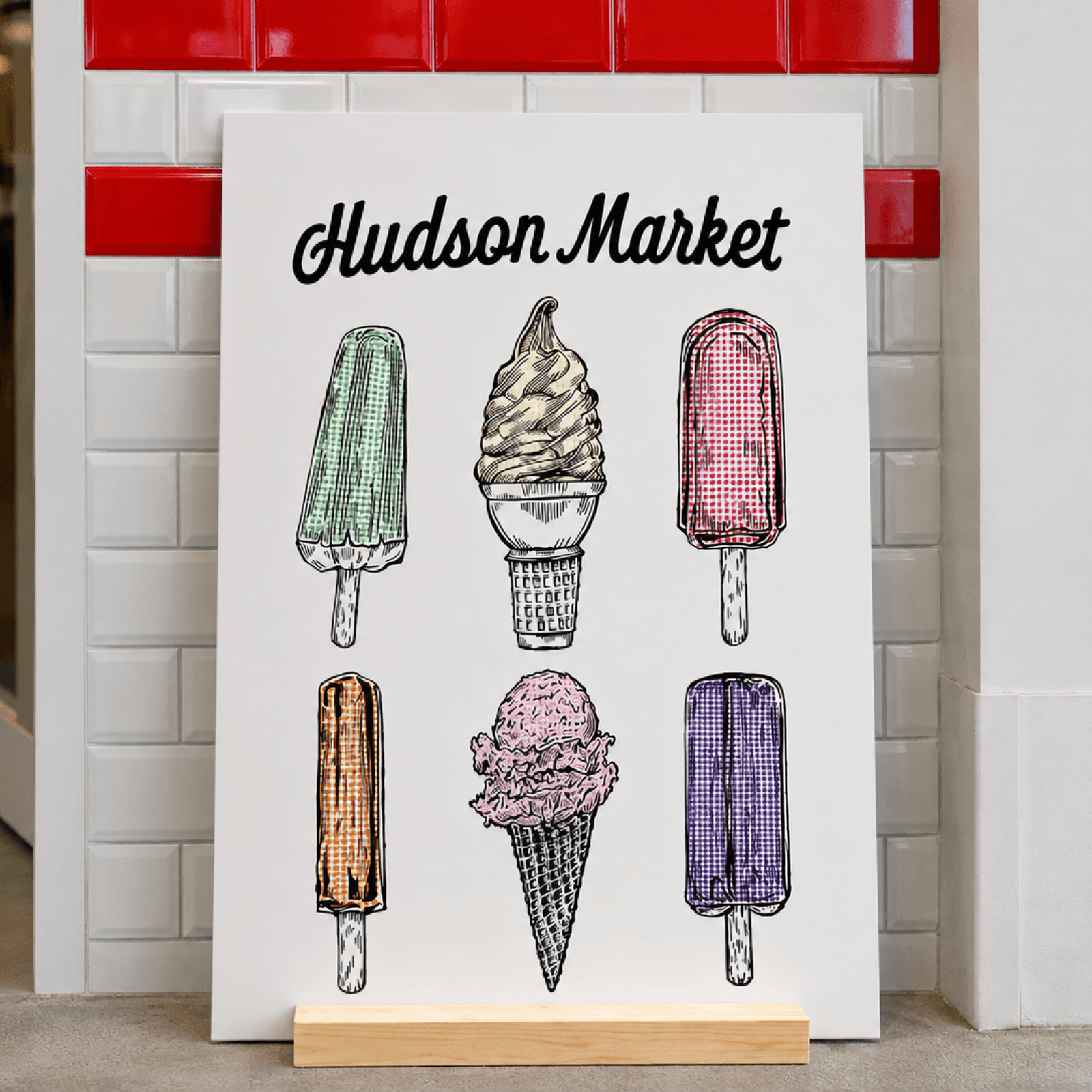
Hudson Market hudson/thumb.png · 1:1
Hudson Market
Branding · NYC
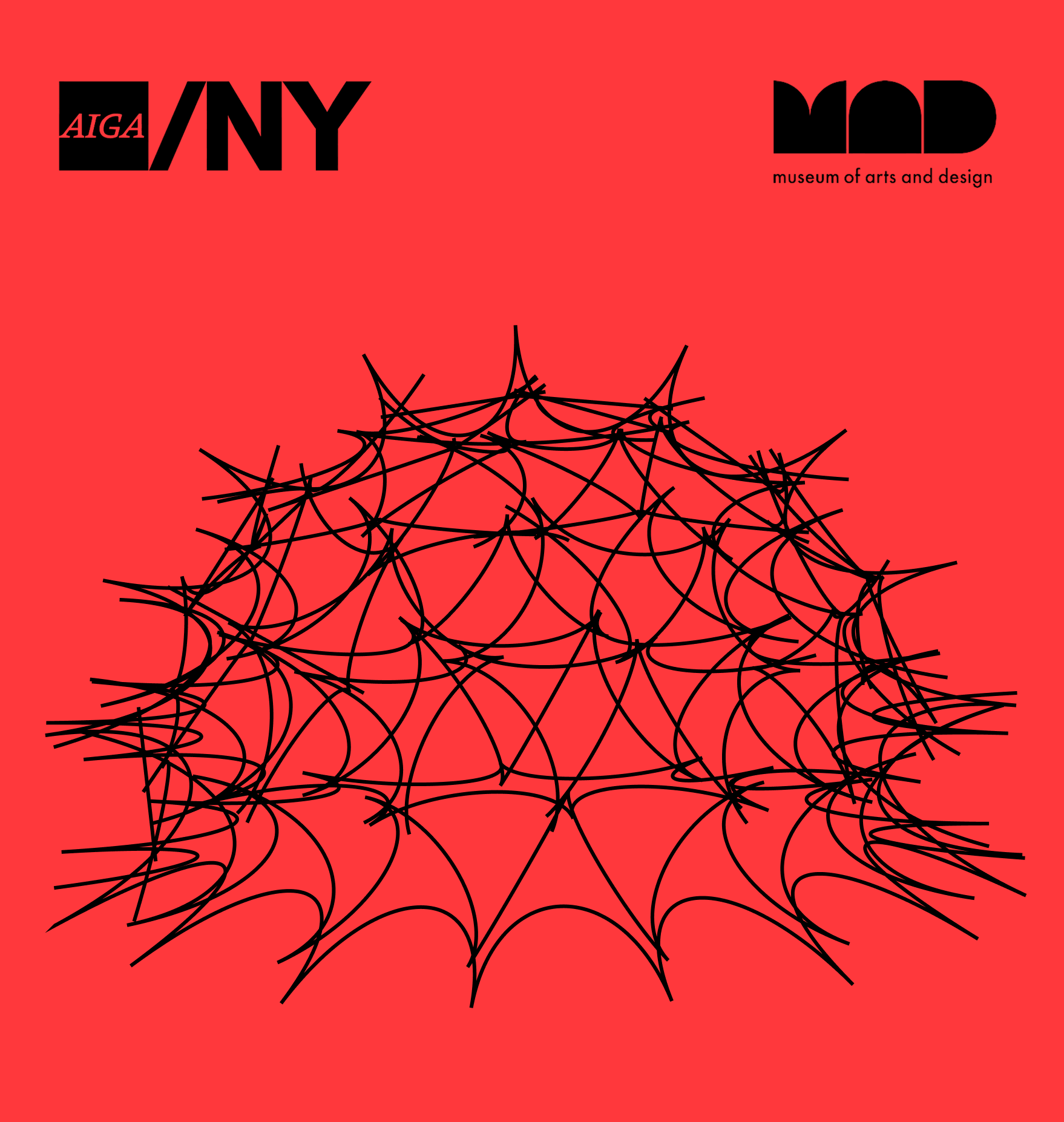
AIGA NY × MAD aiga/thumb.png · 1:1
AIGA NY × MAD
Graphic · Event
Drunken Rice Bomb drunken/thumb.png · 4:5
Drunken Rice Bomb
Branding · Beverage
Transfoner transfoner/thumb.png · 1:1
Transfoner
Mobile app · Pentagram
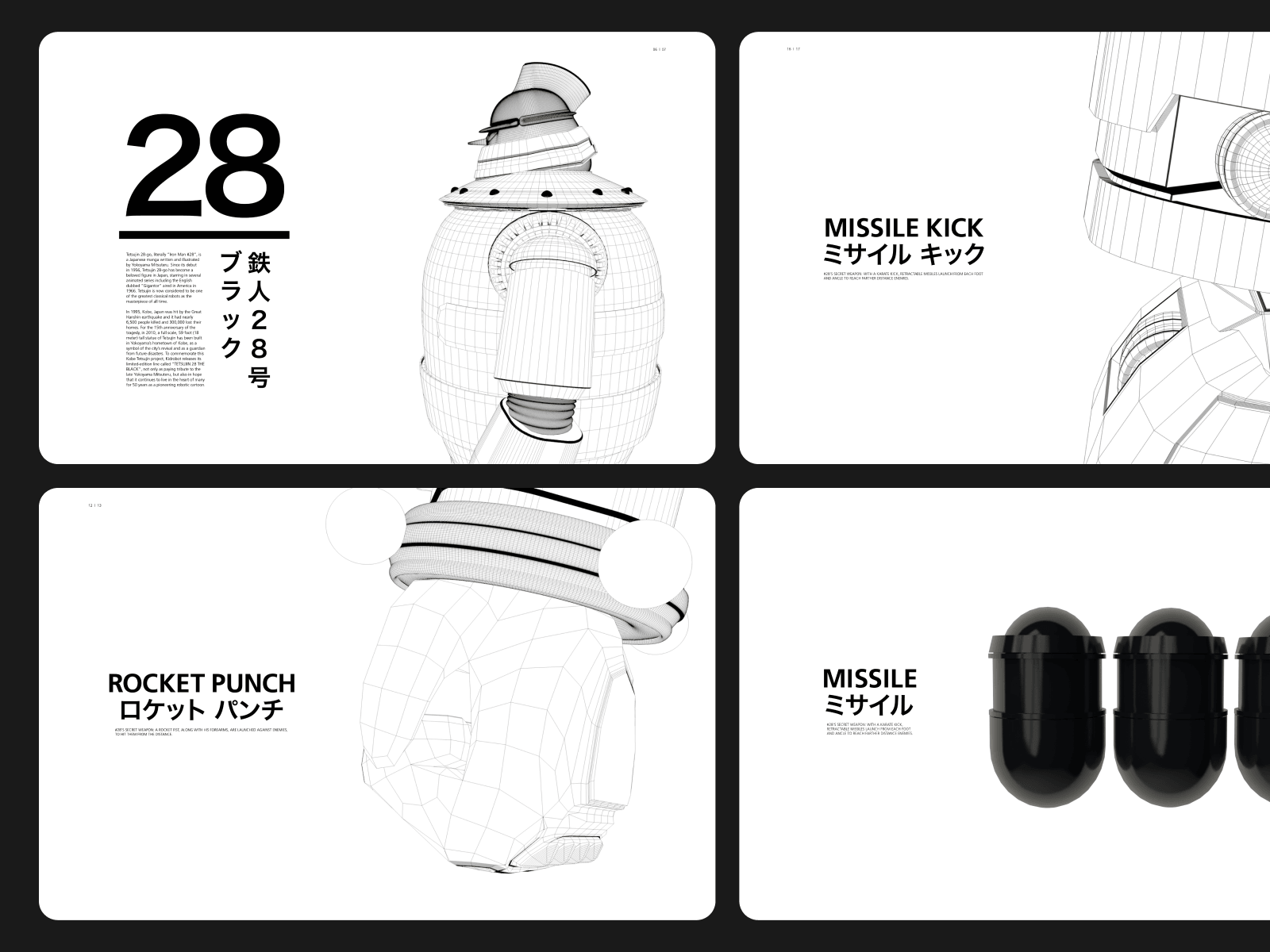
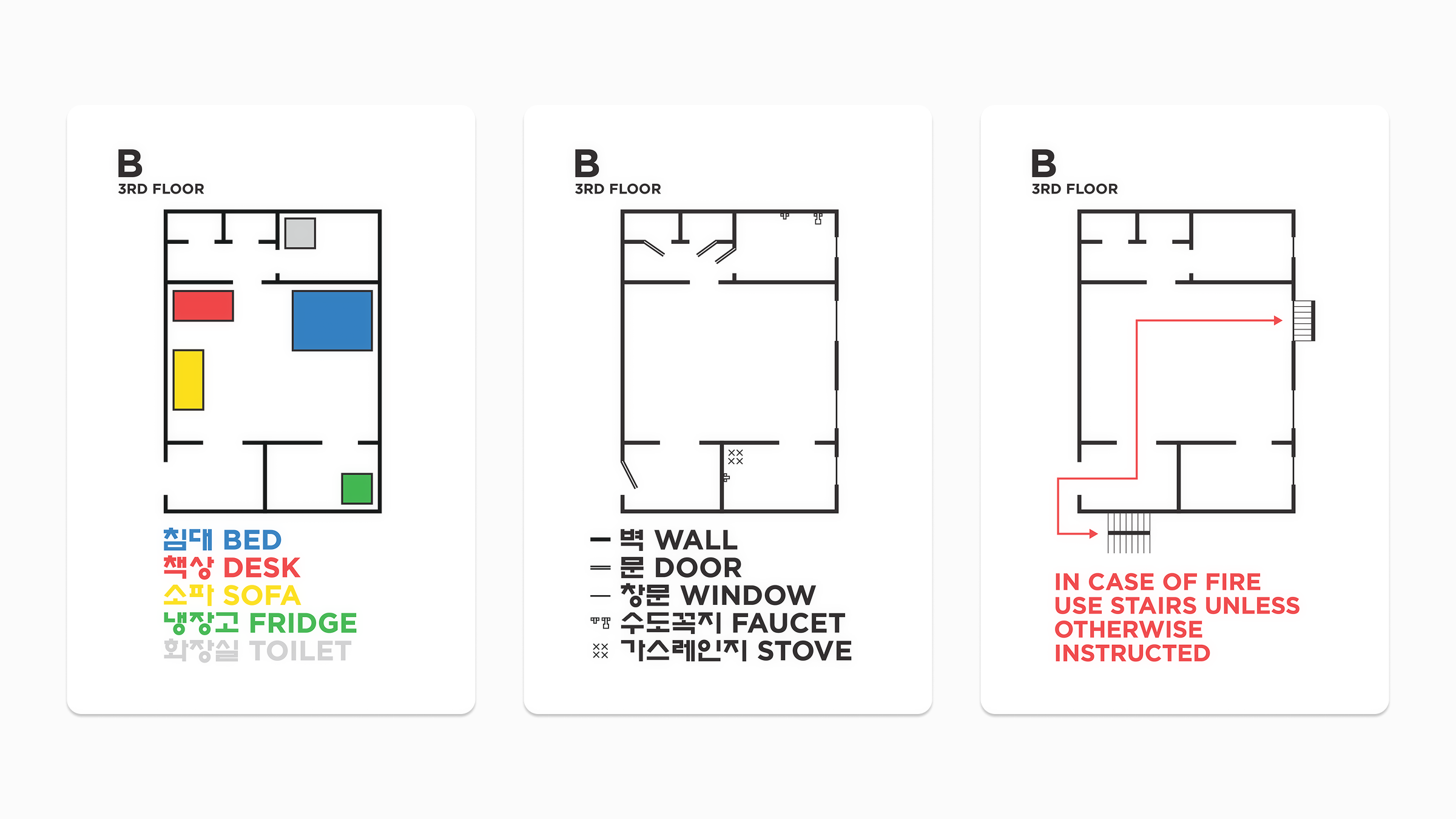
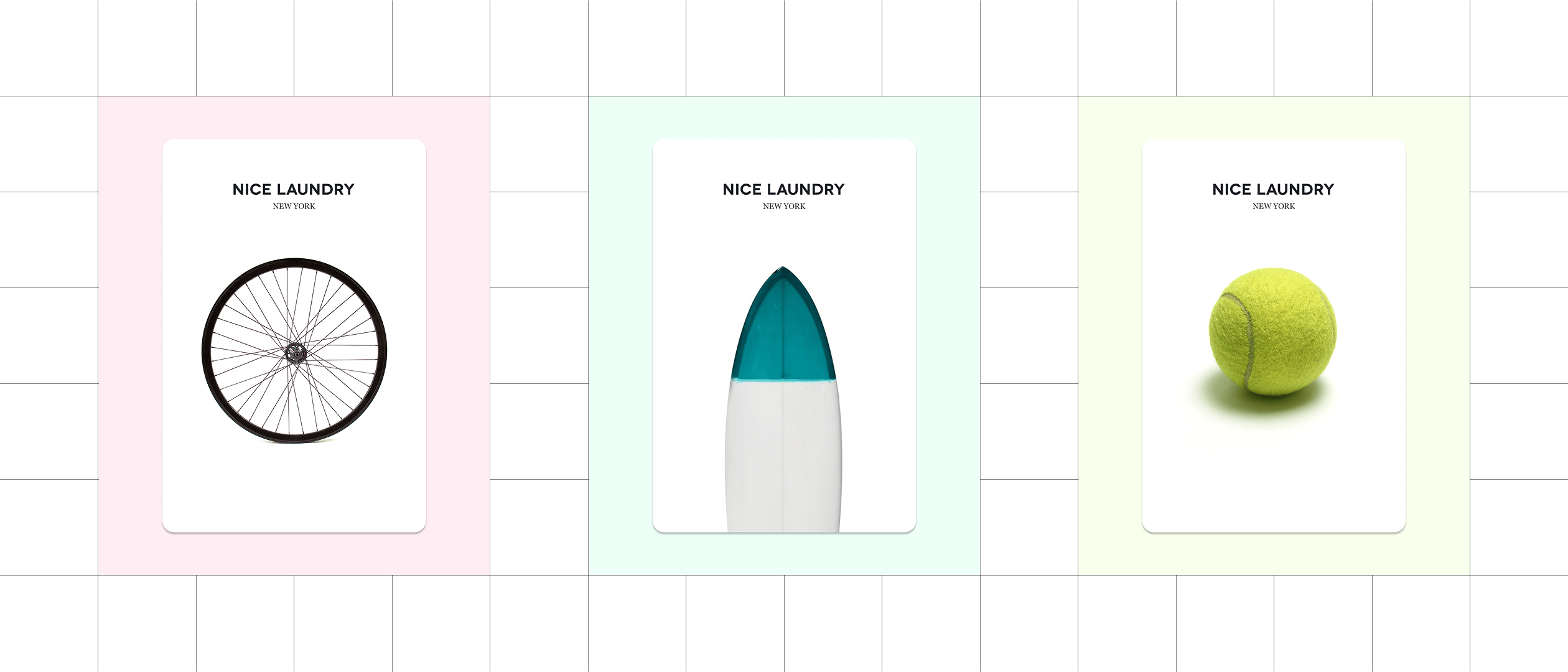
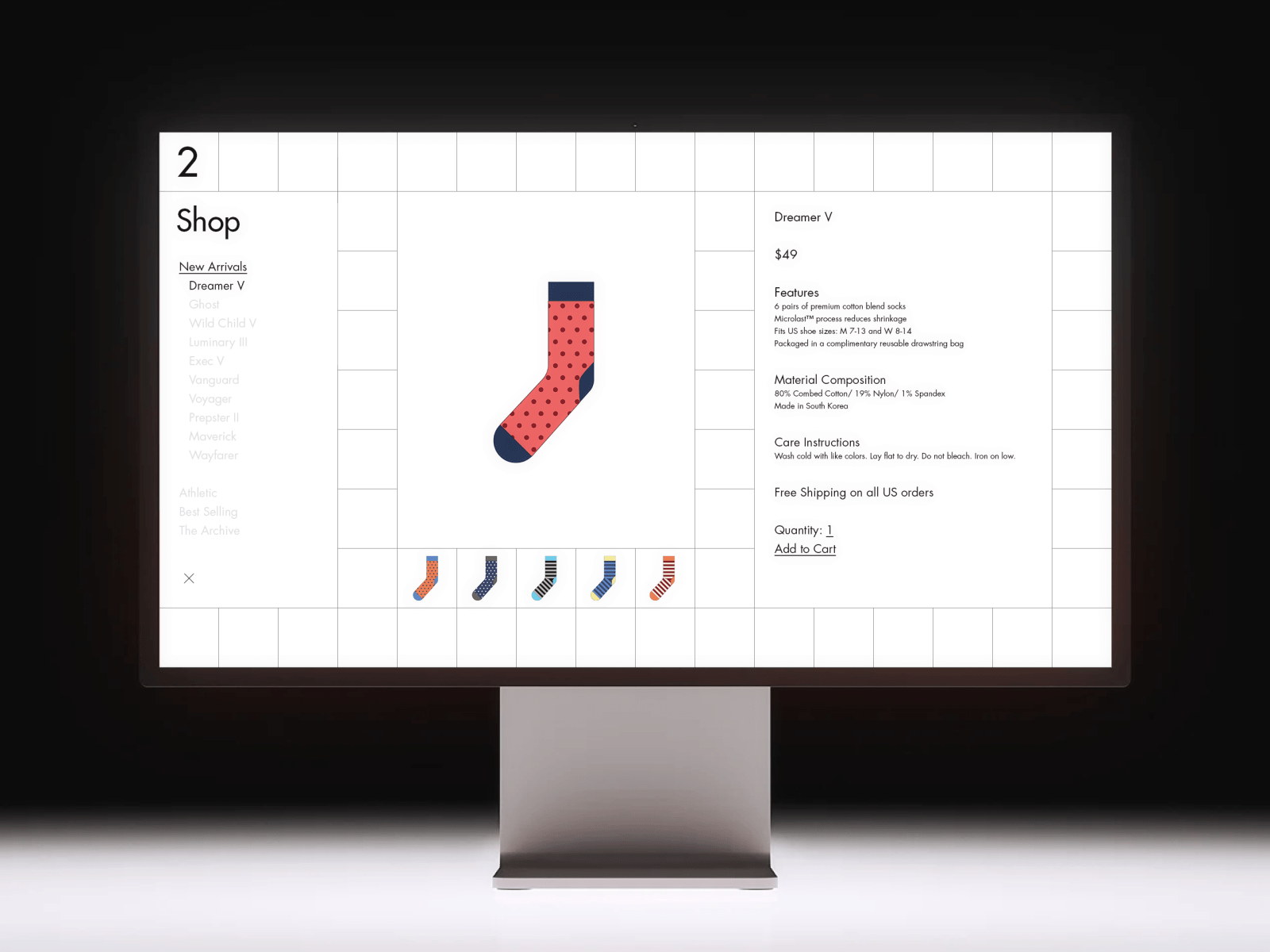
Miscellaneous misc/thumb.png · 4:5
Miscellaneous
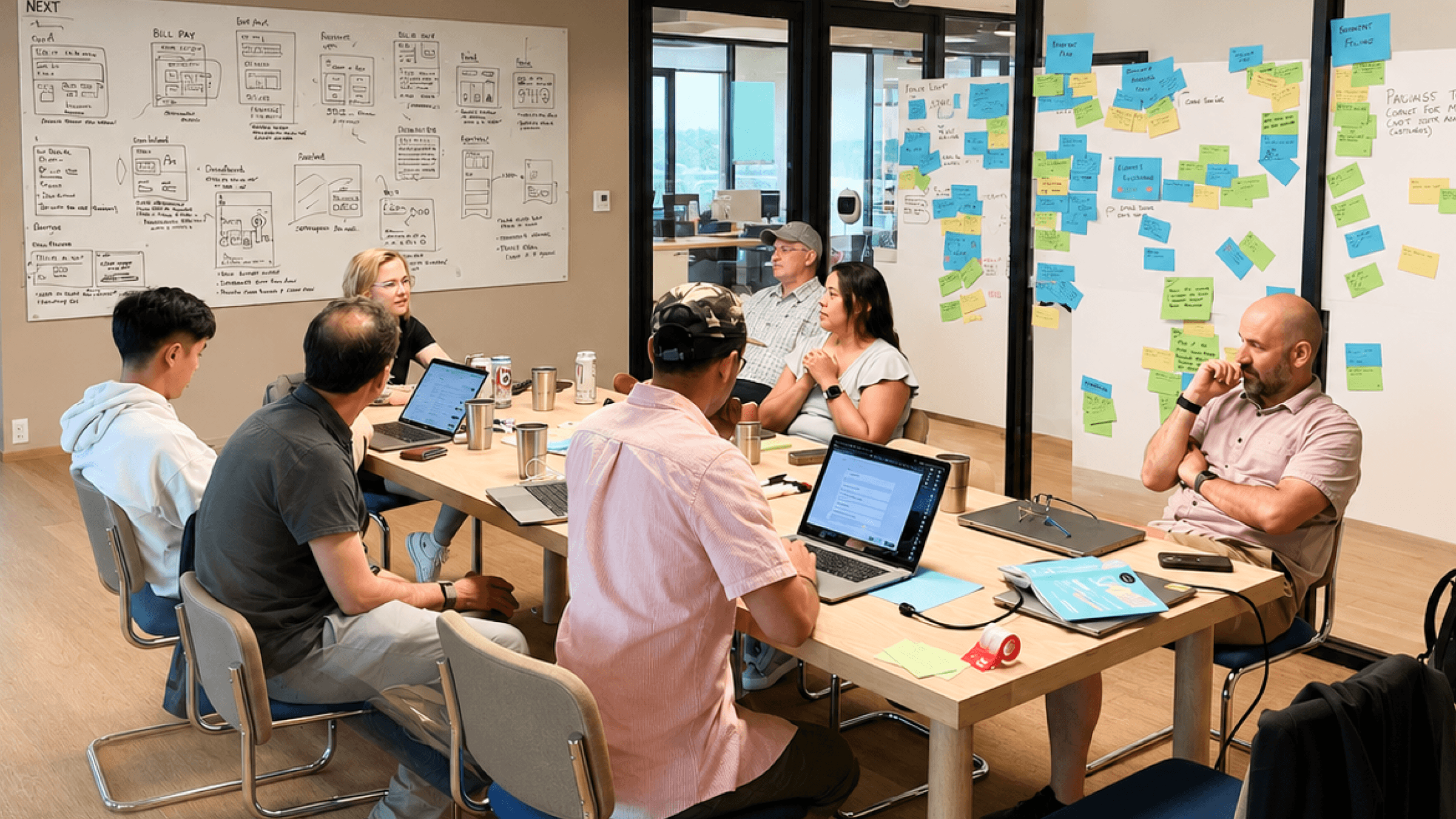
Brand work · Various
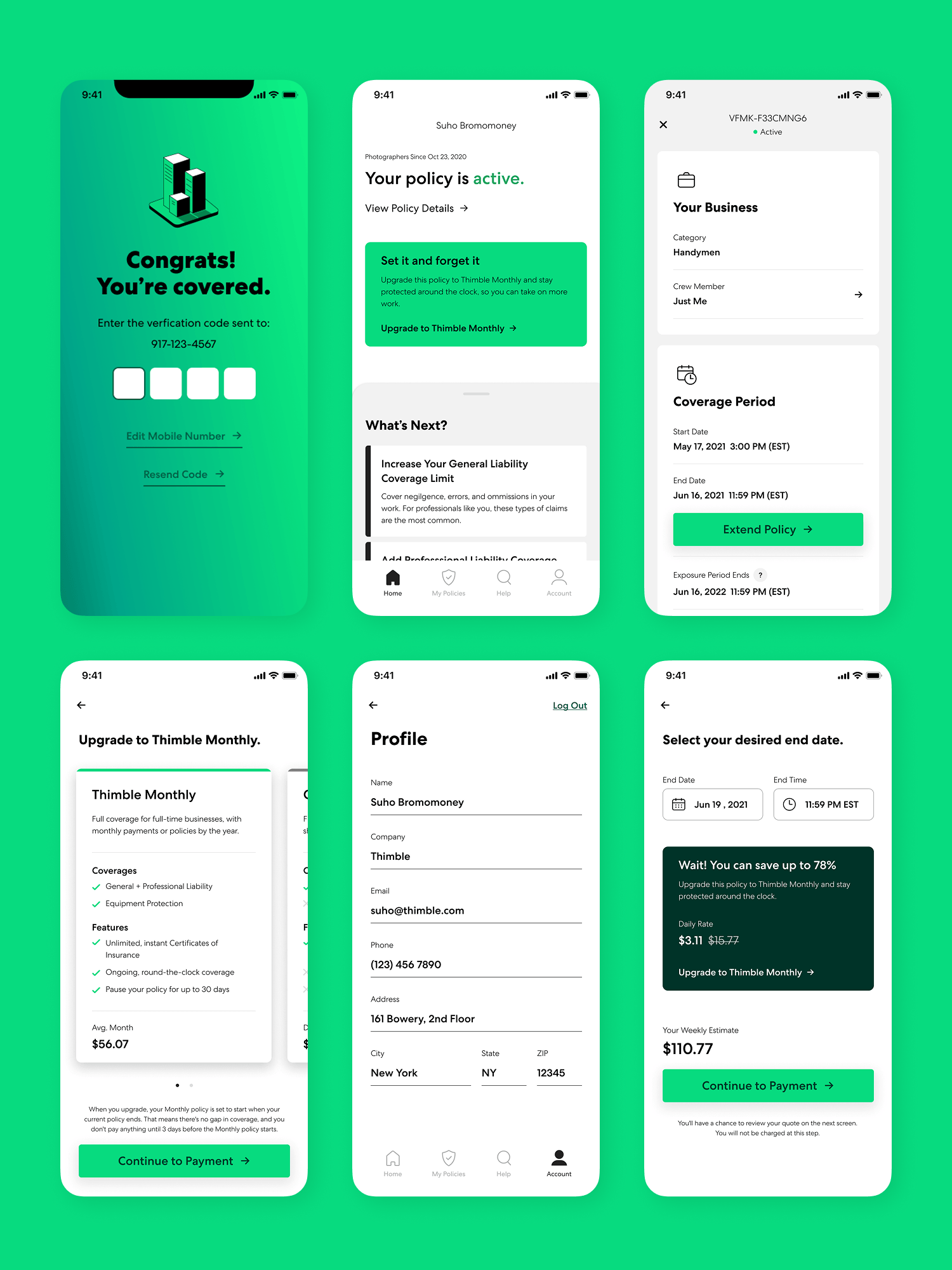
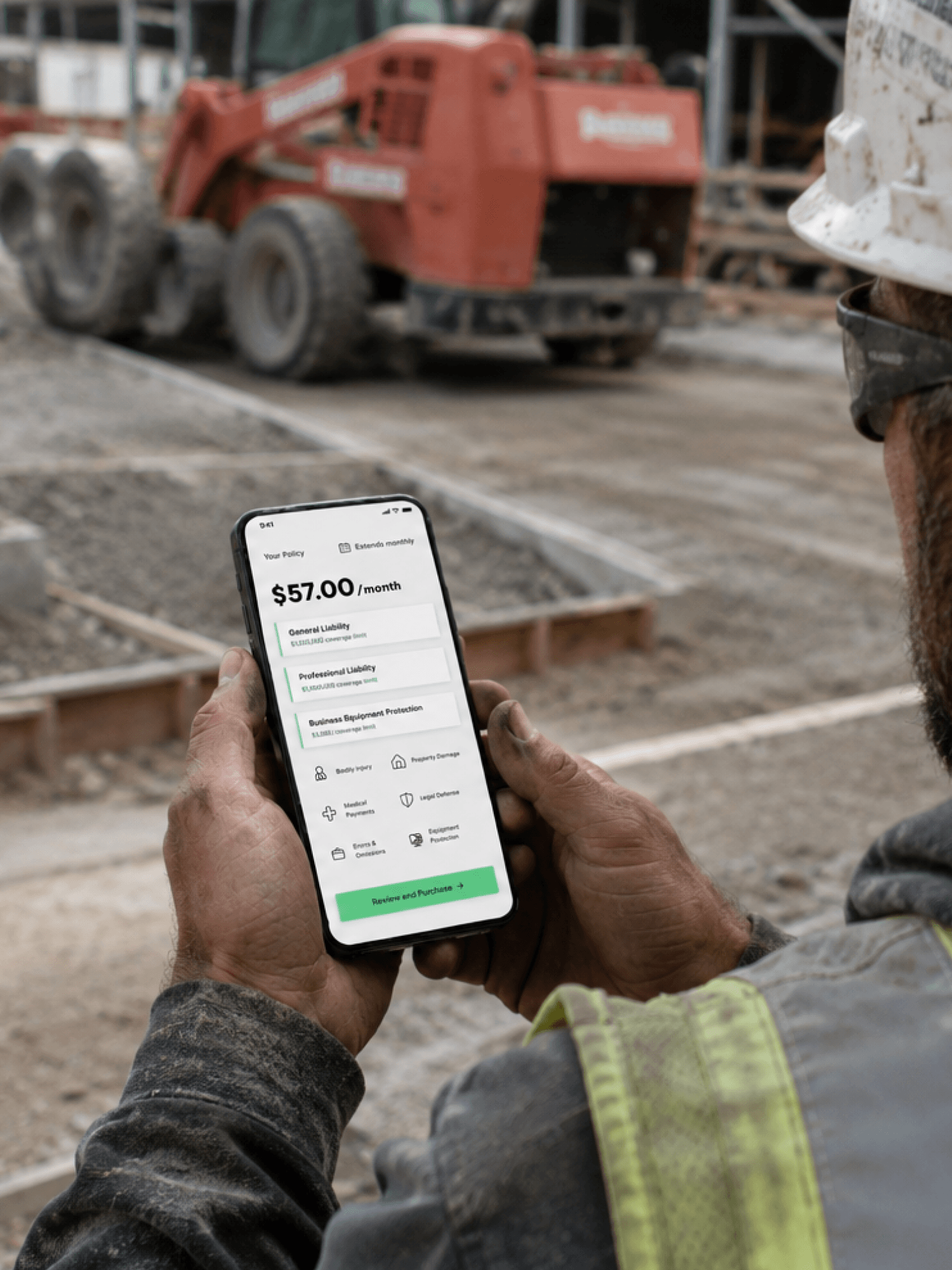
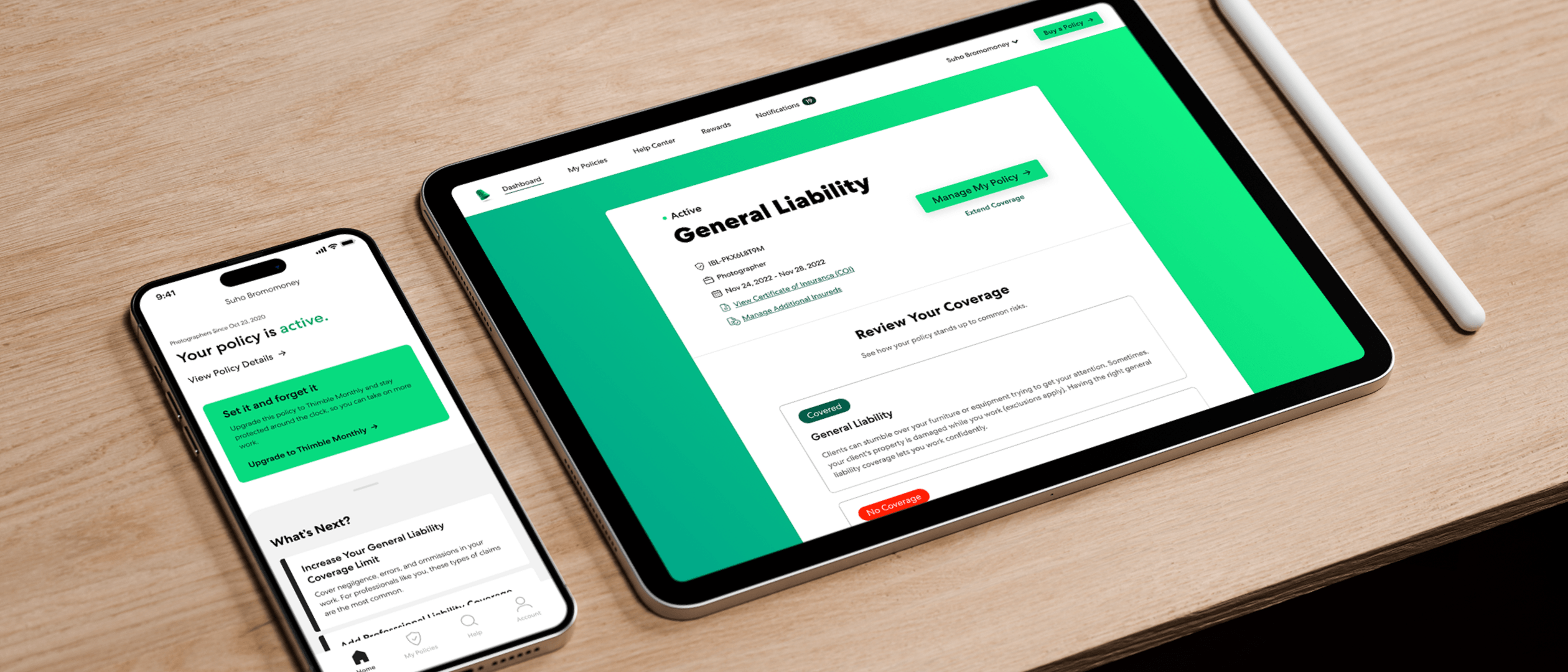
iPhone and iPad showing Thimble app on wood deskthimble-1/01.png · 21:9

Simple insurance, made to fit your work.

Year
2018 — 2020
Company
Thimble (formerly Verifly)
Role
Founding Product Designer · Lead
Scope
iOS · Android · Web · Design System

As the founding product designer at Thimble, I shaped the entire customer-facing experience from a blank canvas. Insurance is famous for its fine print and friction. We turned it into something small business owners could understand, buy, and manage from their phone in 60 seconds.

A new way to
buy insurance.

Traditional insurance only came one way — a year-long policy, bought through a broker, locked in for twelve months. But independent workers were hiring out by the gig, by the day, sometimes by the hour. Thimble built a platform where they could buy short-term, flexible coverage on demand. Insurance that matched how work actually happened.

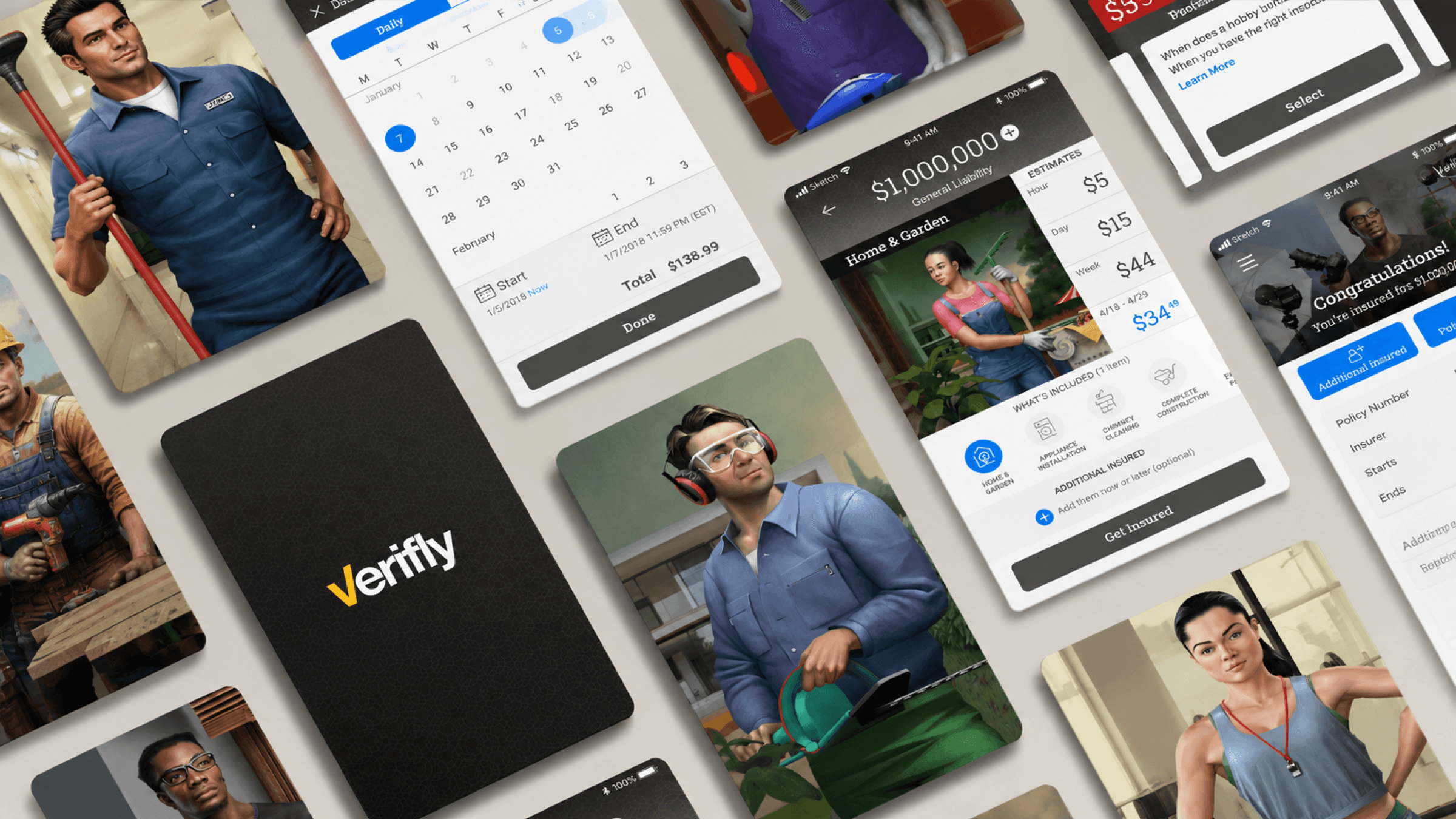
Verifly's initial launch screensthimble-1/02.png · 16:9
2018 — Initial Launch · Thimble (formerly Verifly)
"I just need to show this venue I'm covered in a few hours."
— Small business owner, user interview · 2018
2018
Q1
Joined Thimble
Q3
Initial launch · GL
2019
Q2
PL & Cyber launch
Q3
Event & IM launch
Q4
$22M Series A
2020
Q2
Subscription launch
Q3
Nationwide launch

A foundation built
once, used everywhere.

As founding designer on a team of seven, I owned the full design framework — the transactional mobile app, the marketing site, the visual identity, even the deck that closed our Series A. Working directly with the CEO and early stakeholders, I helped translate a new SaaS model for episodic liability coverage into something users could actually grasp. Every surface had to feel like the same product. I built the early system around three principles — plain language over jargon, momentum over completeness, and one decision per screen — and applied them consistently across mobile, web, and email.

— The product promise

Tap. Insure. Go.

A new platform built for independent workers. Short-term, flexible coverage. Quotes and approvals in 60 seconds. No phone calls. No paperwork.

Product image — 03thimble-1/03.png · 3:4
Product image — 04thimble-1/04.png · 3:4

Stream and subscribe
your policy.

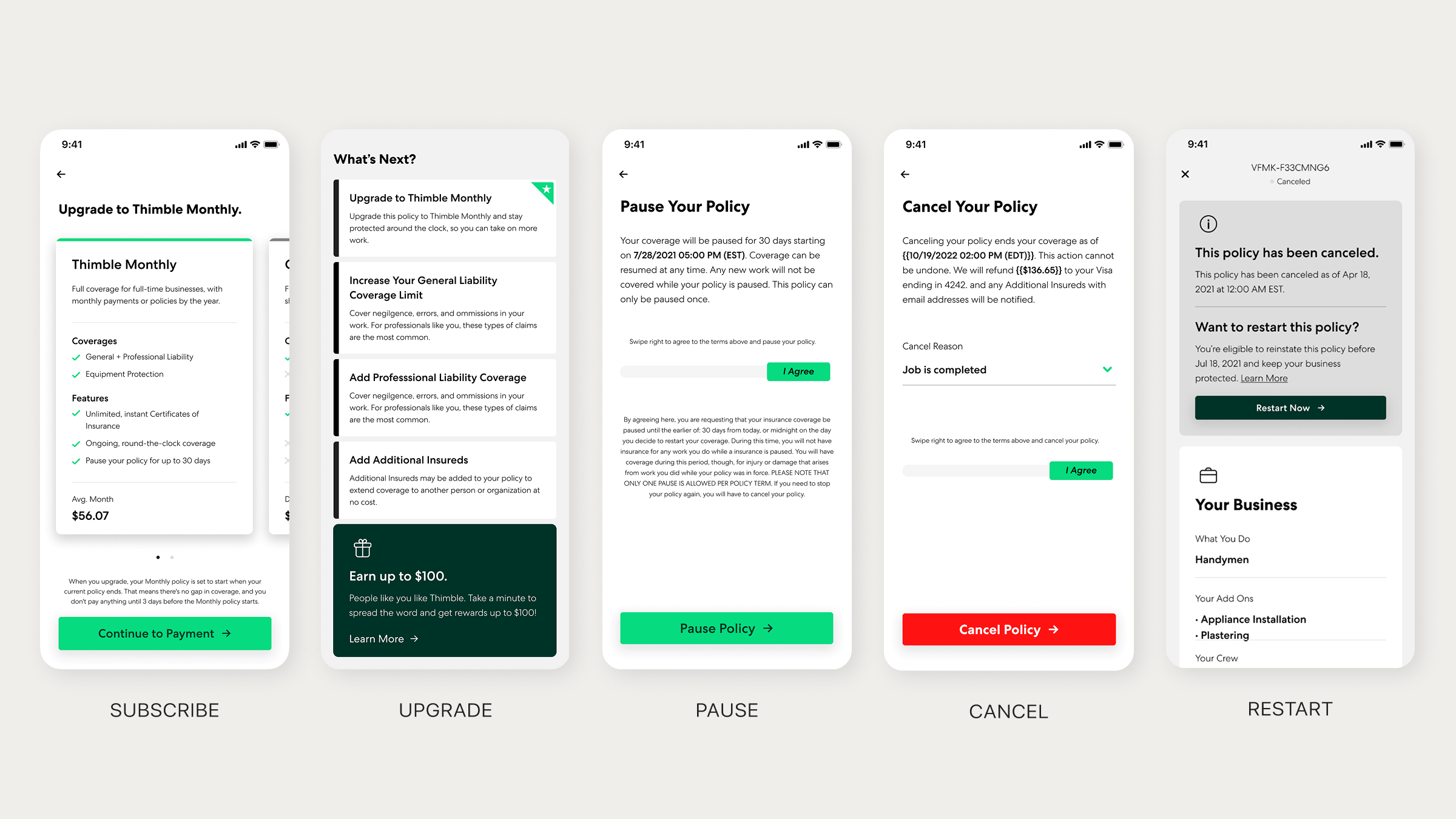
To become a one-stop shop, we kept expanding — more jobs covered, more product lines, and a new subscription plan. Users could pay monthly, modify their coverage, pause when work slows down, and cancel anytime. Insurance you could use the same way you use a streaming service.

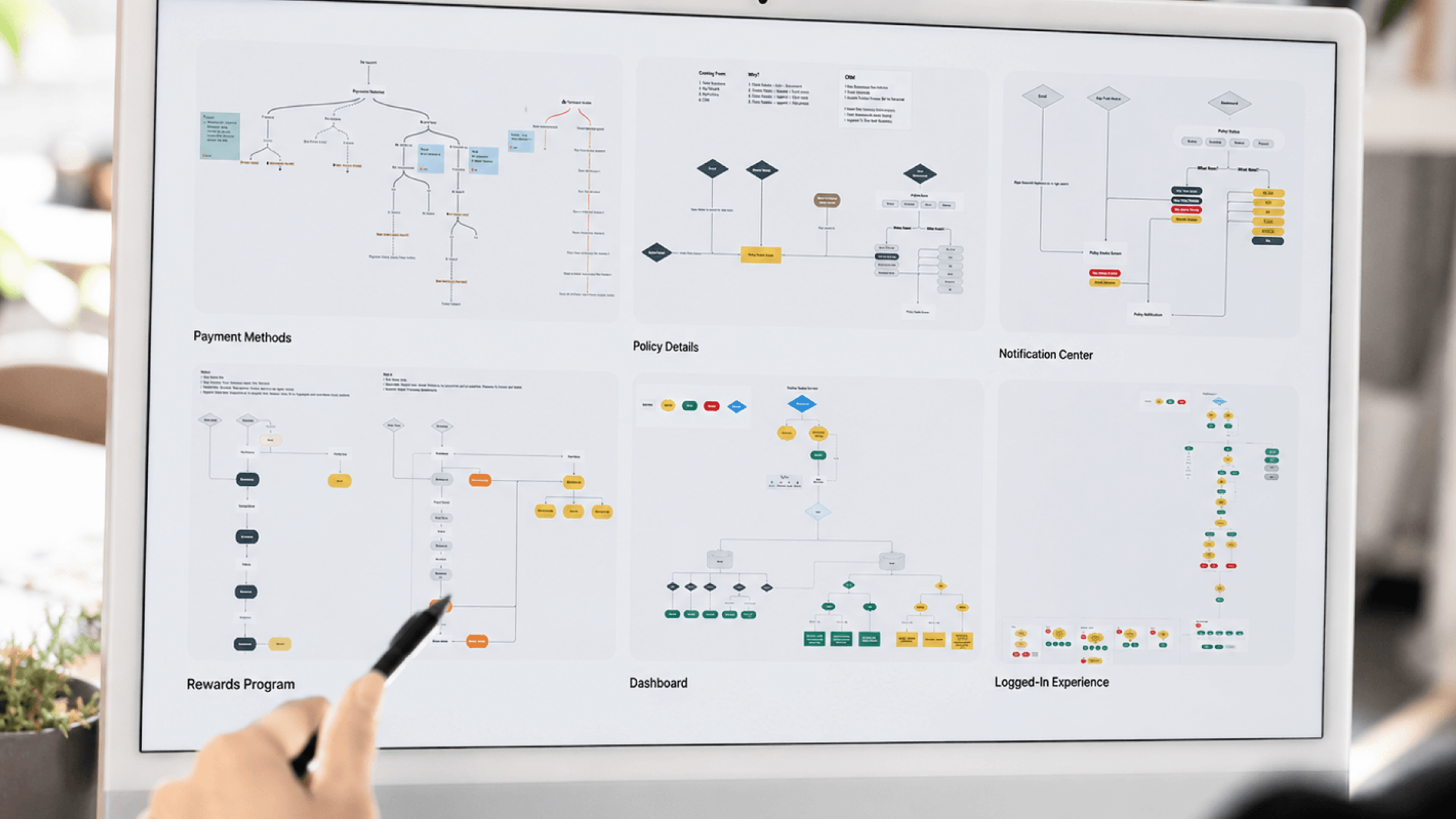
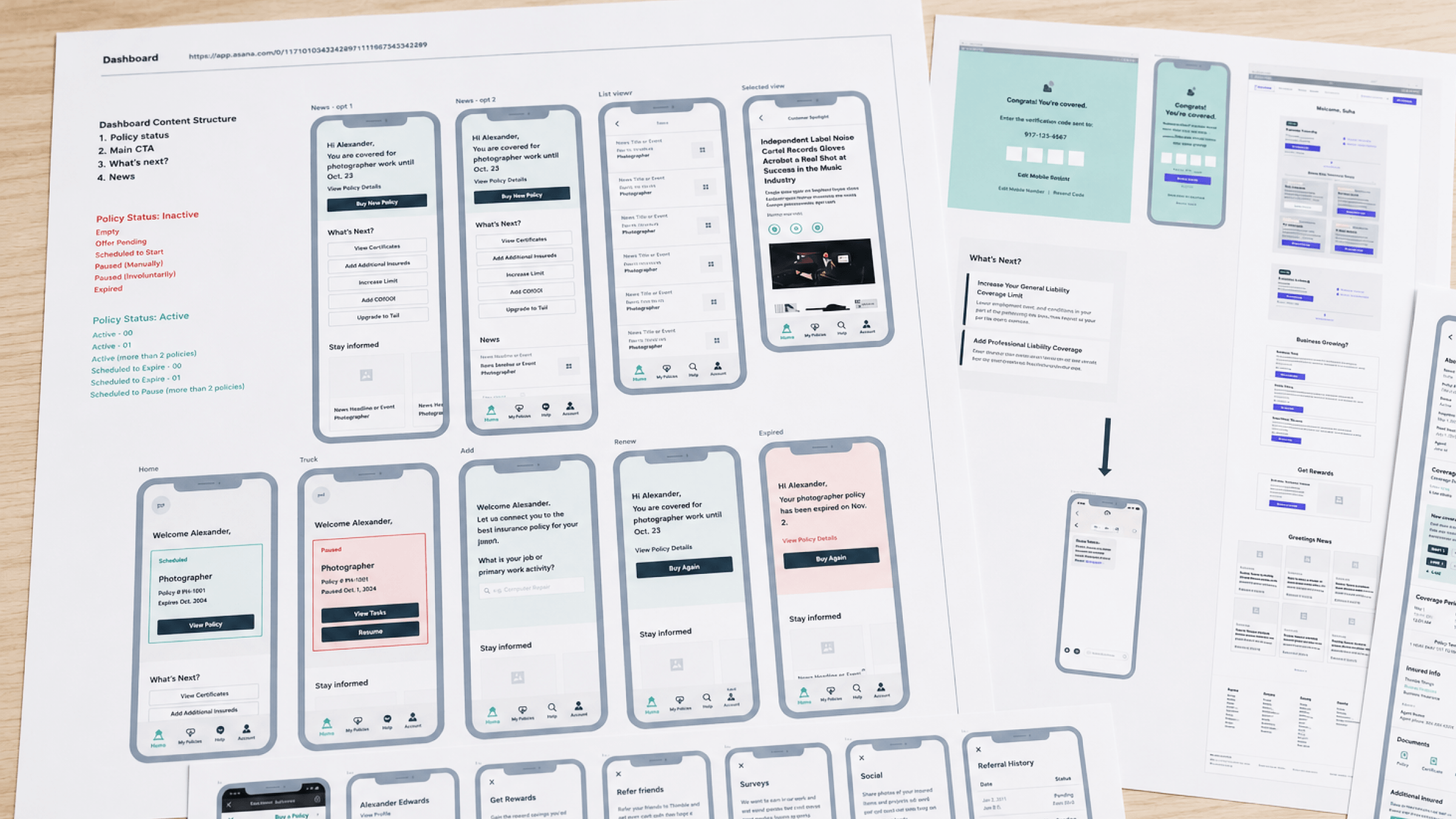
Process artifact 1thimble-1/05.png · 16:9
Process artifact 2thimble-1/06.png · 16:9
Process artifact 3thimble-1/07.png · 16:9
Process artifact 4thimble-1/08.png · 16:9

A design system, rebuilt
for a remote team.

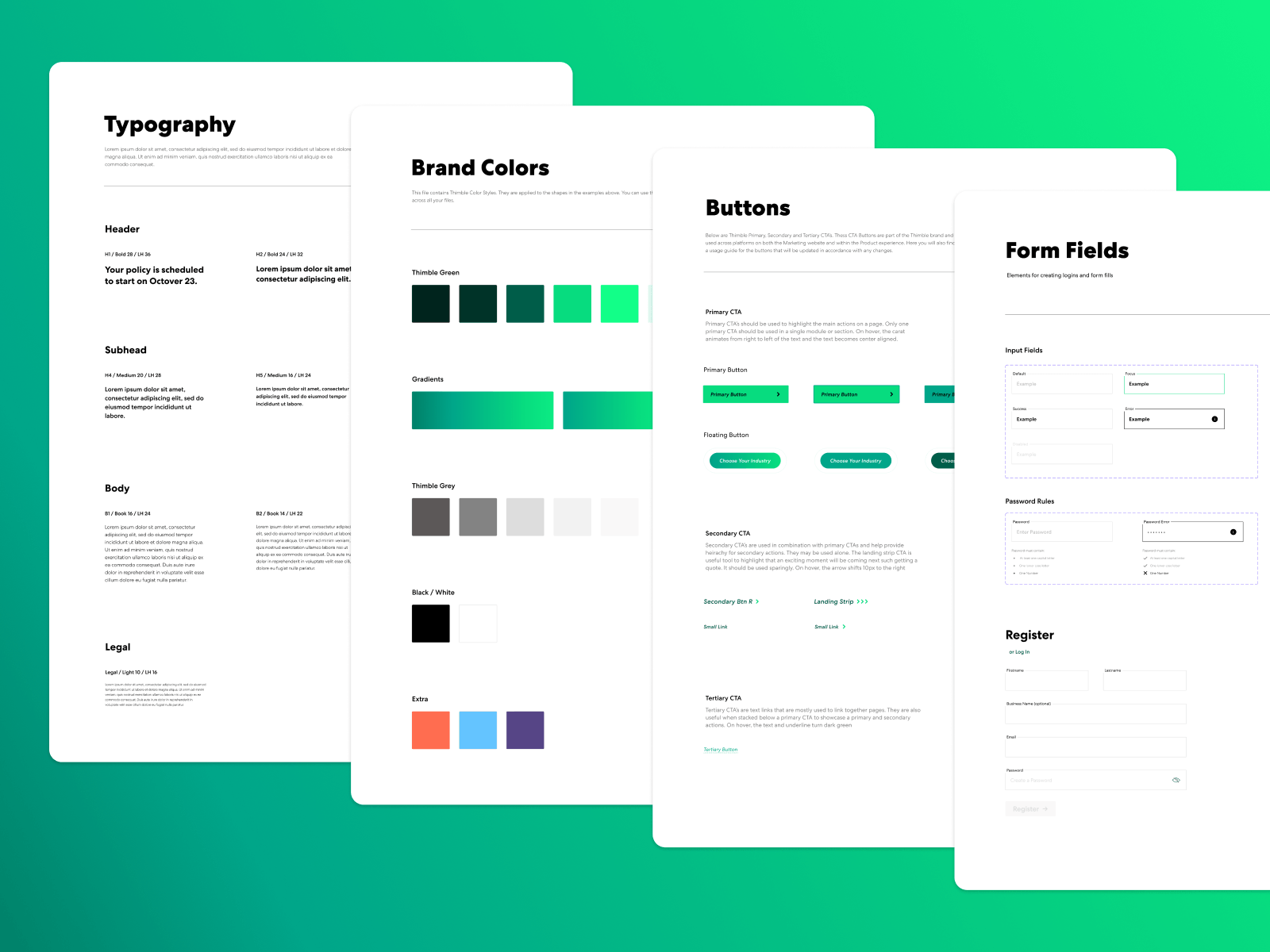
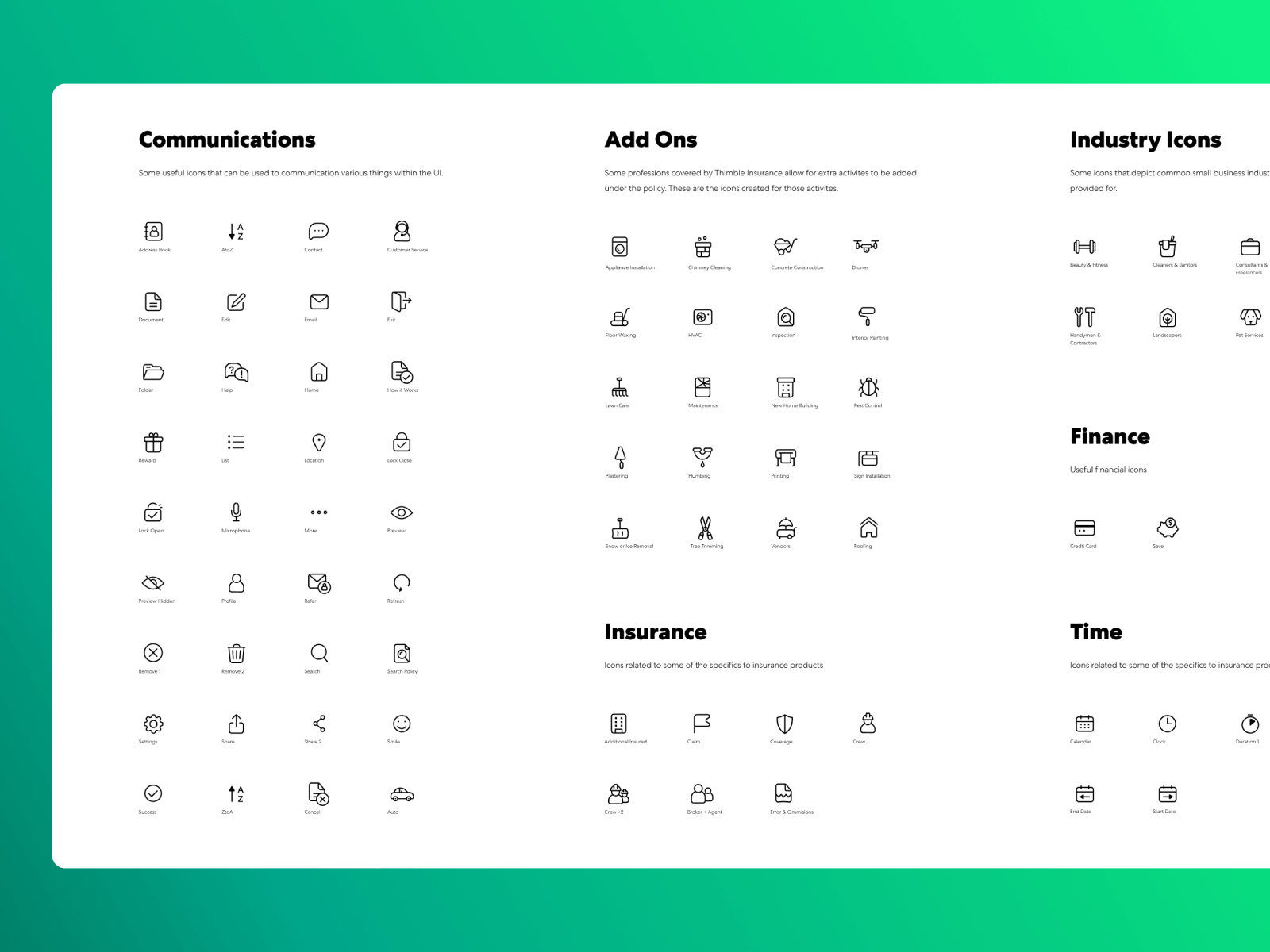
When the team went fully remote during the pandemic, I led the migration from Sketch to Figma and rebuilt the design system from atomic principles. Tokens, components, and patterns were all versioned and shared — letting a small team ship product faster, with more consistency, across more surfaces than its headcount should have allowed.

Design system pages — typography, colors, buttons, form fieldsthimble-1/09.png · 4:3
Icon library categorized — communications, add-ons, insurance, industrythimble-1/10.png · 4:3
Changelog and Text Styles guide — system in active maintenancethimble-1/11.png · 21:9

From a blank canvas
to a category disruptor.

100K+
Policies sold in Year 1
$22M
Series A · IAC-led, 2019
NPS 78
vs. industry average of 35
70K
Monthly active users · churn −28% · renewals 6→25%
+800%
LTV growth · $52 → $470 (2020—22)
2021
Fast Company · Best UX Design finalist
An insurance broker working with a clientthimble-2/01.png · 21:9

Designing for the people who sell insurance to everyone else.

Year
2021 — 2023
Company
Thimble
Role
Lead Designer · End-to-end
Scope
Broker portal · Onboarding · Enterprise

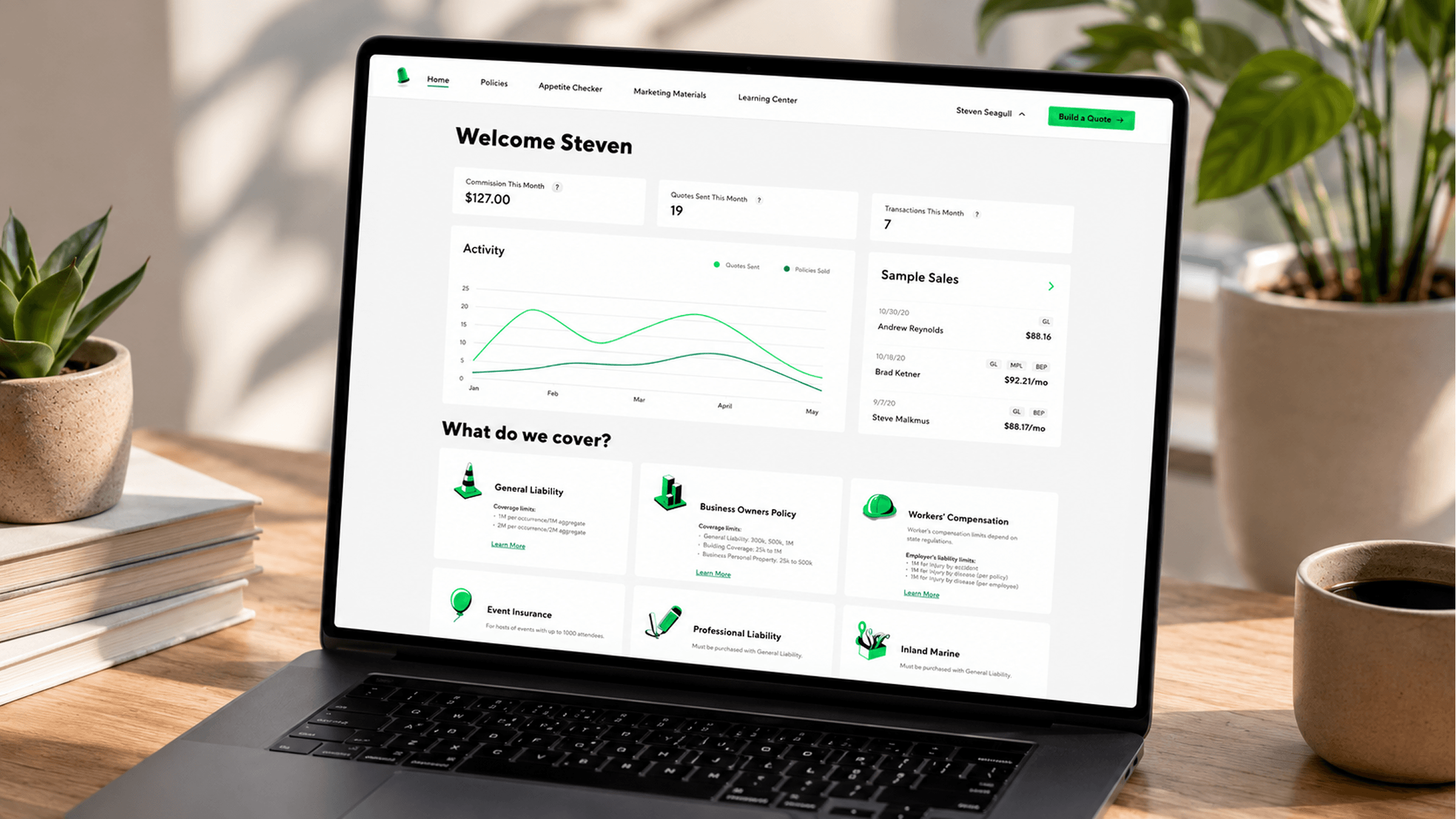
During the pandemic, Thimble's flexible, on-demand coverage gained traction in an unexpected place. Insurance brokers. I led the end-to-end design of a new broker platform, opening a D2B2C channel that grew Gross Written Premium by 900% in two years and became a core driver behind Thimble's acquisition by Arch Insurance in April 2023.

A new channel,
a new kind of user.

Brokers started using Thimble on their own, placing coverage faster than traditional carriers could. Together with PMs, customer support, insurance, and BD, I ran broker interviews and audited their workflows: dozens of clients in motion, multi-carrier spreadsheets, fifteen-minute calls that needed a quote on screen by minute three. The opportunity was clear. A D2B2C channel could expand revenue without diluting the consumer product. But brokers needed a product built for how they actually work.

Thimble broker portal — Welcome dashboard with activity, commission, and coverage overviewthimble-2/02.png · 16:9
"Brokers don't want to be charmed.
They want to be fast."
— Insight from broker discovery interviews

Built for volume,
not for a single sale.

A consumer buys insurance once or twice a year. A broker writes dozens of policies a week — different pace, different mental model, different design. Through research, I learned that broker workflows are full of friction the consumer product never had to handle: verifying broker licenses, collecting state-specific documents, linking commission bank accounts, and keeping track of dozens of clients at once. To translate that gap into product, I ran a four-phase process across research, strategy, design, and implementation. Each phase was grounded in real broker workflows and validated with PMs, customer support, insurance, and BD.

Phase 01
Conduct Research
Competitive analysis · CS feedback · Broker interviews
Phase 02
Plan & Strategize
Card sorting · Workshops · Commitments
Phase 03
Design
Flow mapping · Wireframing · Prototyping
Phase 04
Implement & Monitor
FullStory · Looker · Amplitude
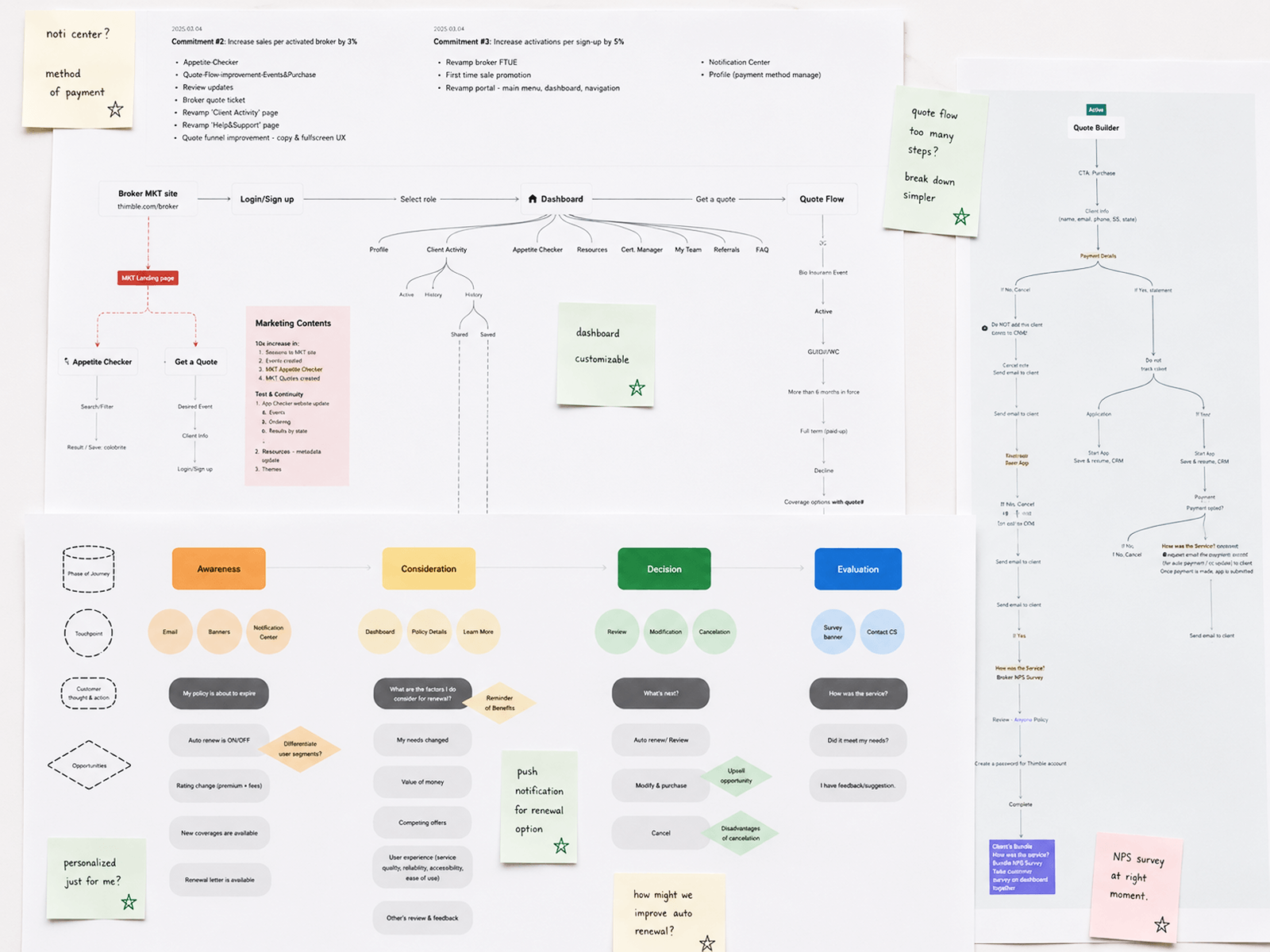
Strategy artifact — broker journey mapping, customer phase analysis, opportunitiesthimble-2/03.png · 4:3
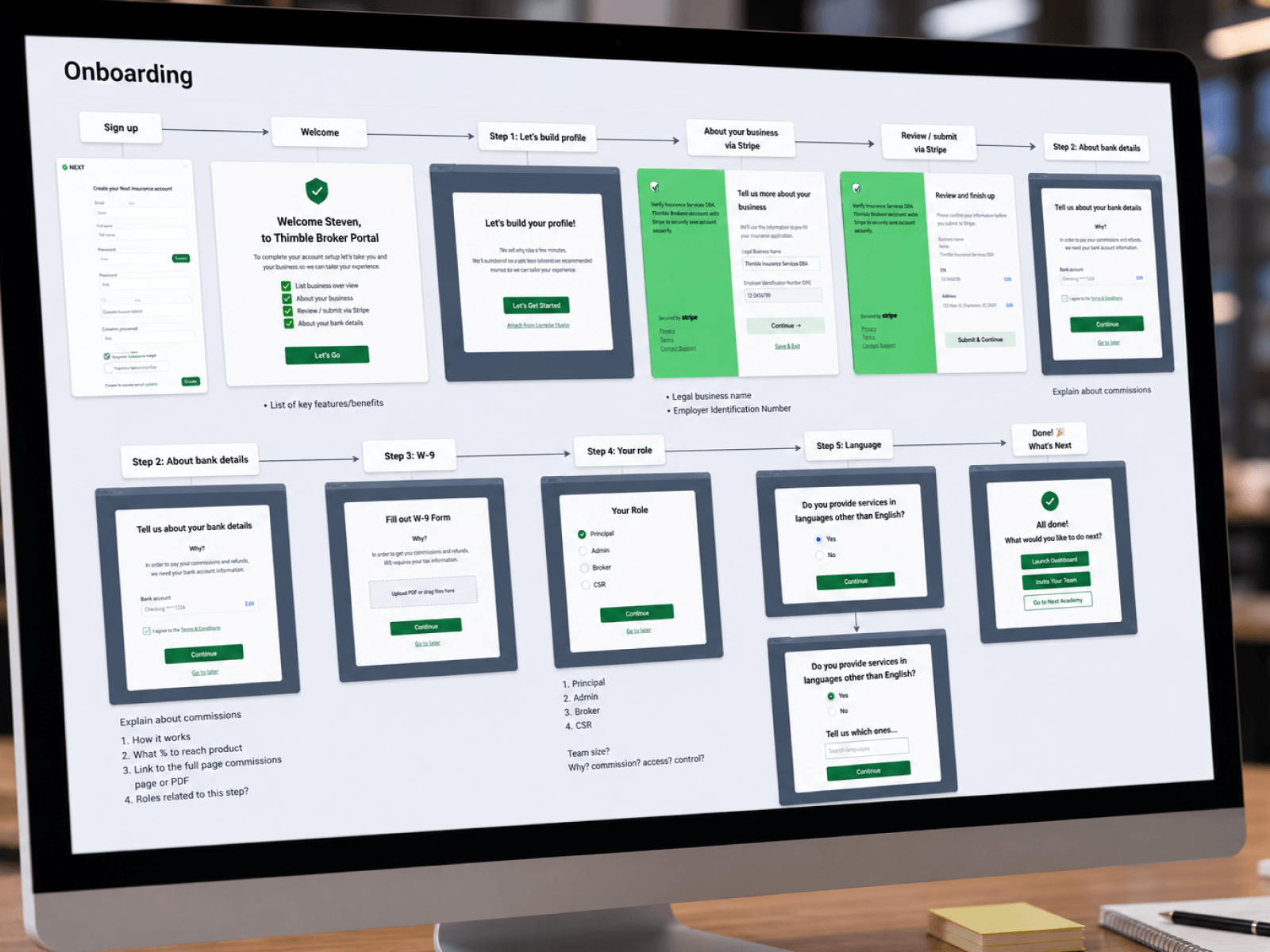
Design artifact — broker onboarding flow from sign-up through Stripe verification, W-9, role, and languagethimble-2/04.png · 4:3

See what's possible,
then sell it.

The hardest part of selling insurance isn't writing the policy. It's figuring out what to write. The Appetite Checker takes a few inputs about the client's business and surfaces every coverage Thimble can write, including GL, PL, Cyber, IM, and WC, along with the flexible durations Thimble is known for. From there, brokers move straight into quote and bind. No dead ends, no second guessing, no leaving the page.

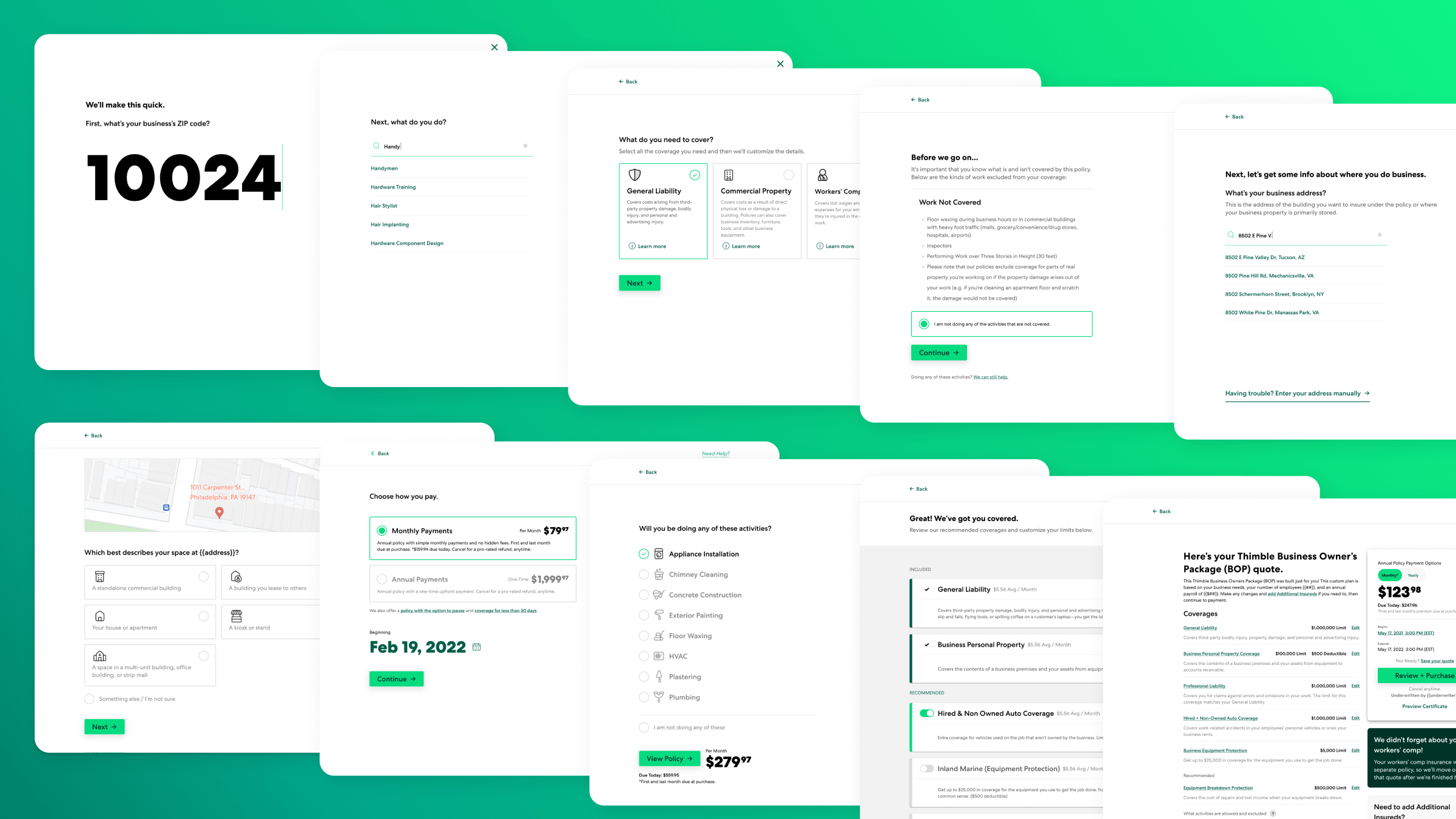
Quote and bind flow — from ZIP code to coverage selection to bound policythimble-2/07.png · 16:9

Quote, bind, manage
in one place.

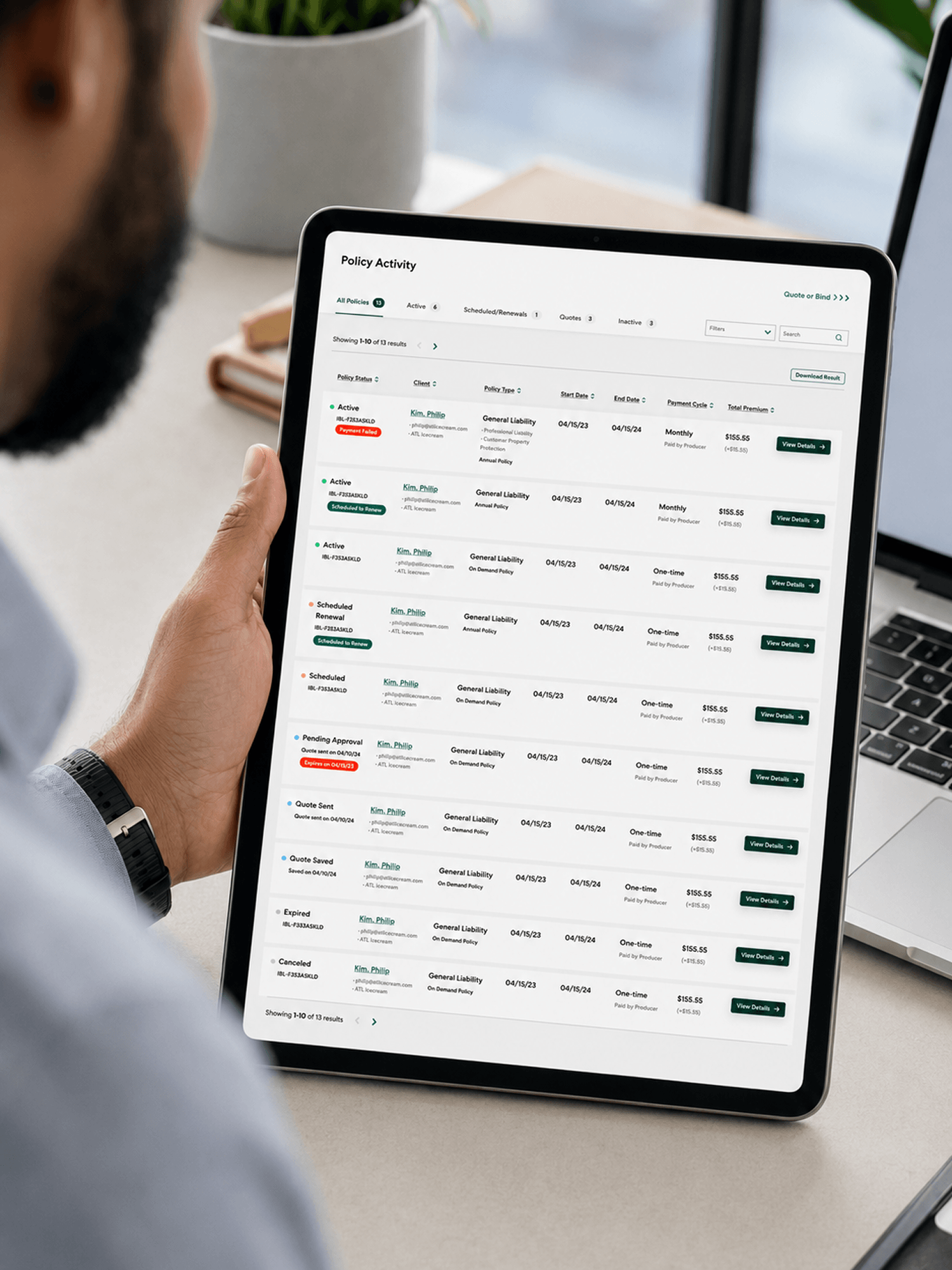
Beyond a single sale, brokers run an ongoing book of business. The portal brings every client and policy into one workspace where brokers track activity, manage renewals, handle endorsements, and scale from a solo agent to an agency of 200 with role-based permissions and agency-level reporting.

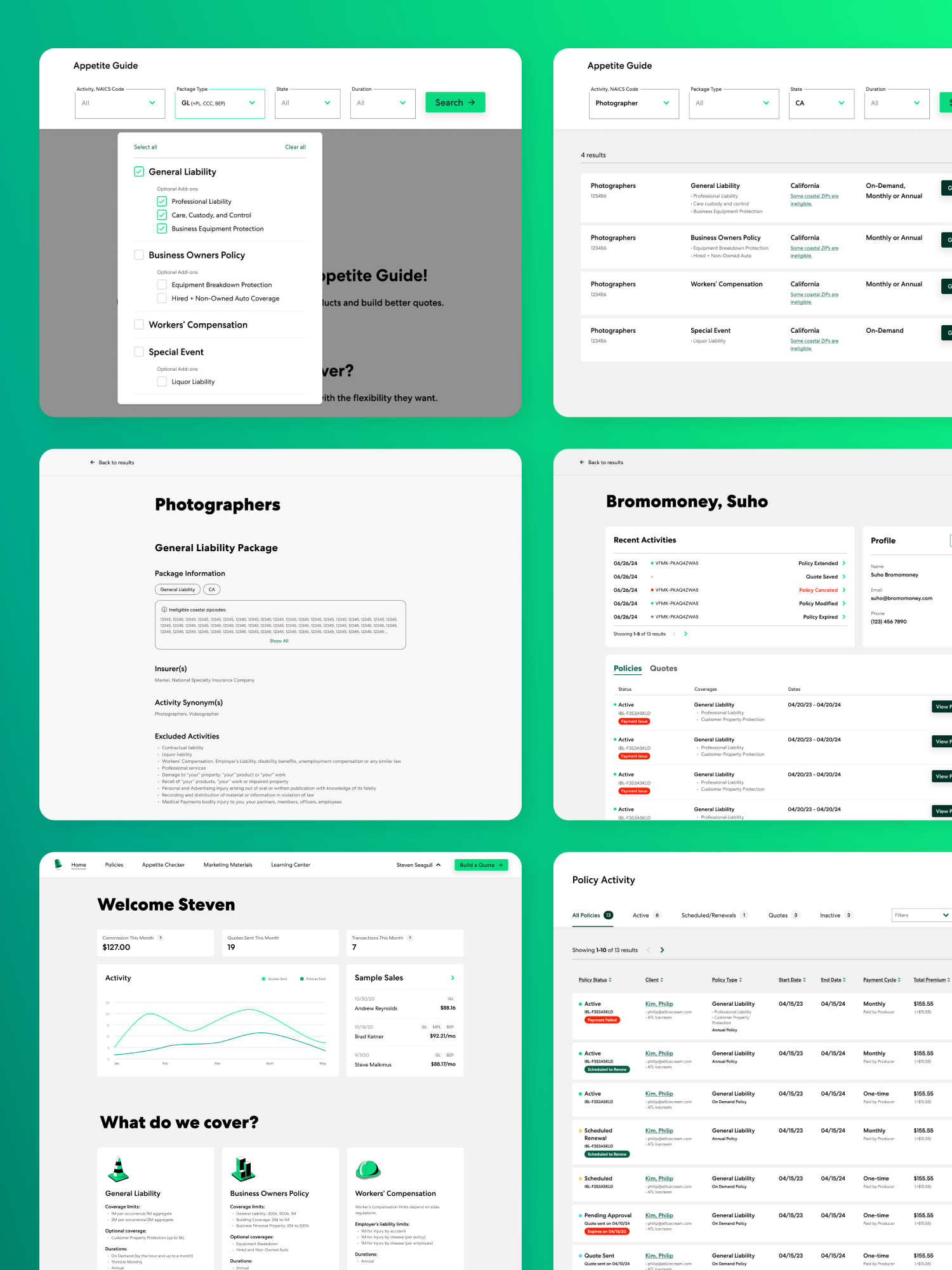
Appetite Checker results — every coverage Thimble can write for a given businessthimble-2/05.png · 3:4
Policy Activity — manage active, scheduled, pending, and expired policies in one viewthimble-2/06.png · 3:4

A side channel
that became the channel.

18K
New broker signups
+91%
YoY active brokers · 1,320 monthly
+125%
AOV · $144 → $324 (2021—22)
+900%
GWP in 2 years · $1.4M → $14M
40%
Of total GWP from brokers · Q3 2023
Apr 2023
Acquired by Arch · broker channel central to the deal
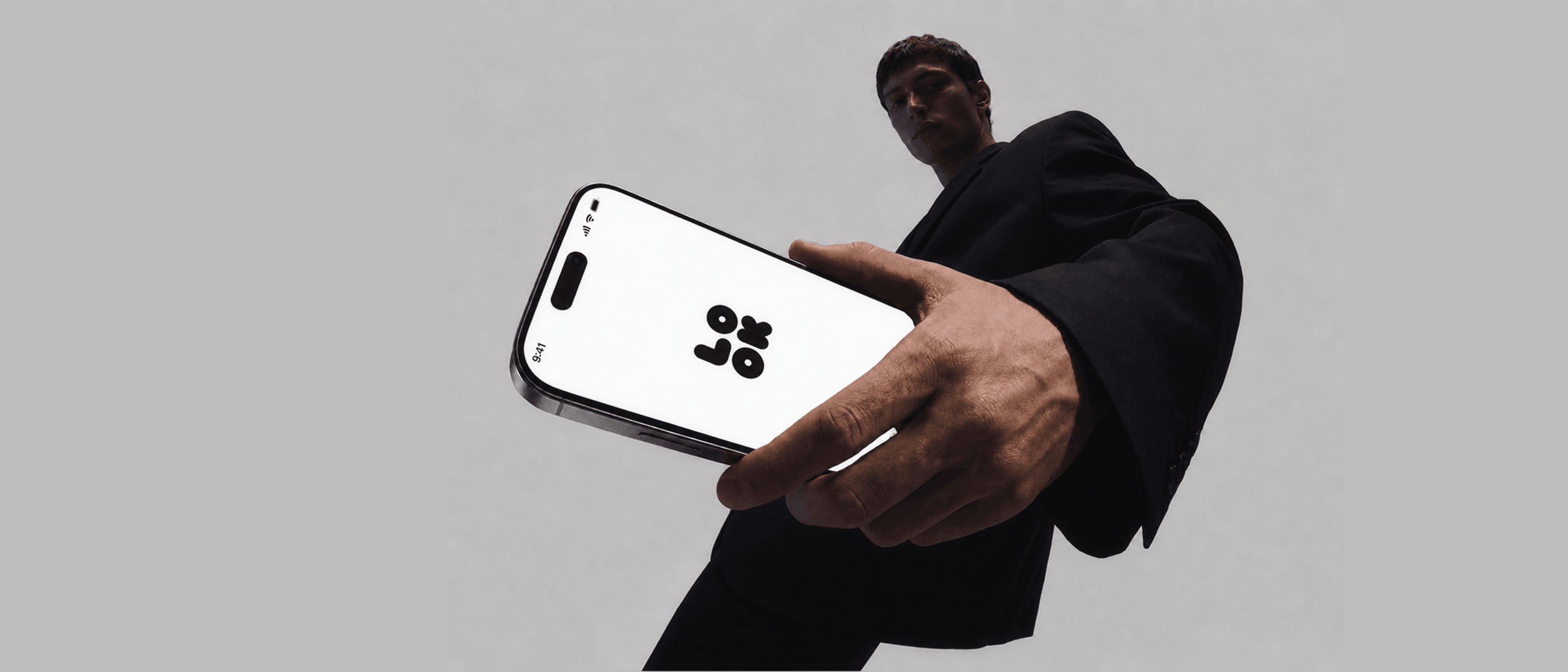
Person holding iPhone with Lookscope logo, editorial portraitlookscope/01.png · 21:9

Two friends, one year, three hundred thousand wardrobes.

Type
Self-initiated · iOS app
Role
Product Identity · Product Design
Team
Launched with Jay (iOS Engineering)

Lookscope is a wardrobe organizer and outfit planner. It now lives in over 300,000 closets. Jay built the iOS app, and I designed everything else — the brand, the screens, every interaction. We started with a question that sounded almost too simple: why is getting dressed so hard when you already own everything you need?

A closet full of clothes
and nothing to wear.

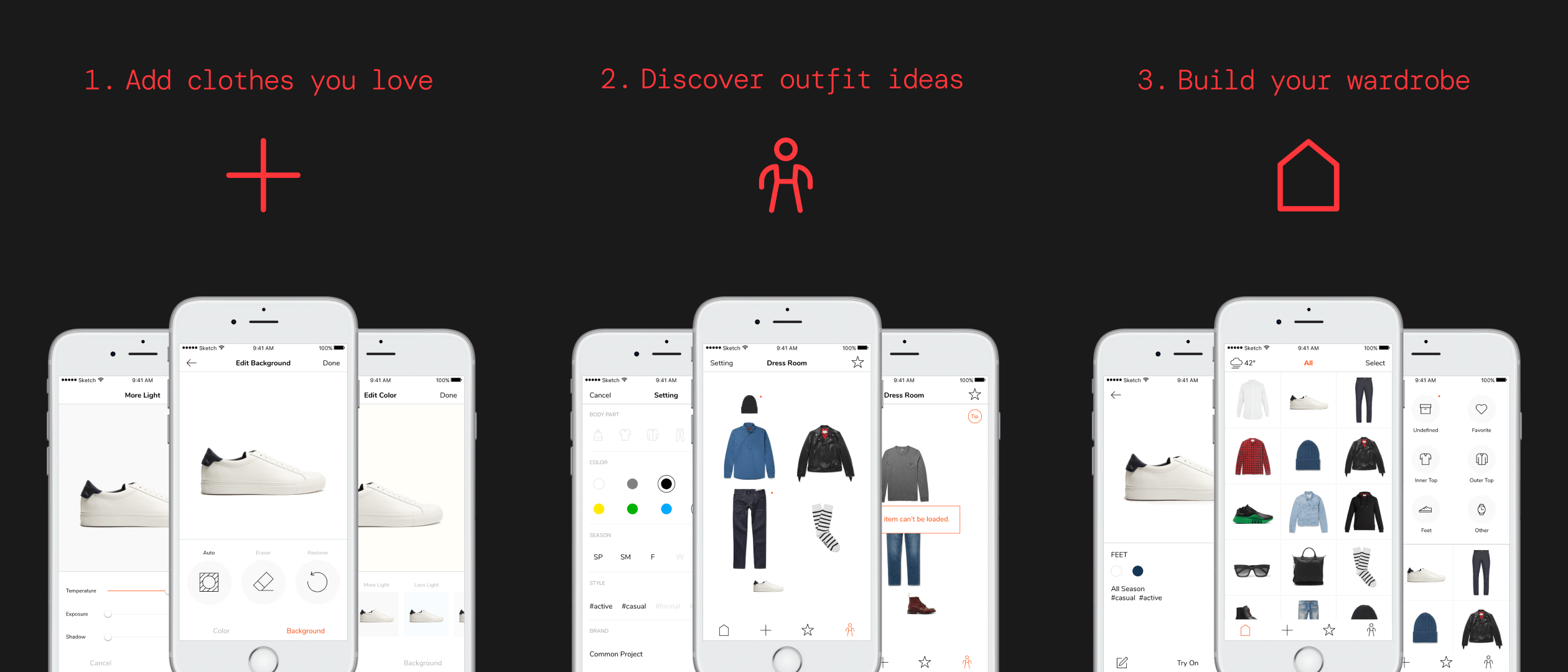
Jay and I weren't trying to build a company. We were trying to solve our own problem. Most people own dozens of clothes they barely think about. Every morning, they pick from the same five things on top. Wardrobe apps existed, but they all looked like spreadsheets with photos. We wanted something that felt like a tool you'd actually open. No funding, no investors, no roadmap longer than a weekend. The whole product came down to three moves: add the clothes you love, plan outfits, build your wardrobe.

Lookscope three-step onboarding — Add clothes, Discover outfits, Build wardrobelookscope/02.png · 21:9
"Let's just make the thing
we'd actually use ourselves."
— Where the whole project started

Every detail, decided
by the same two people.

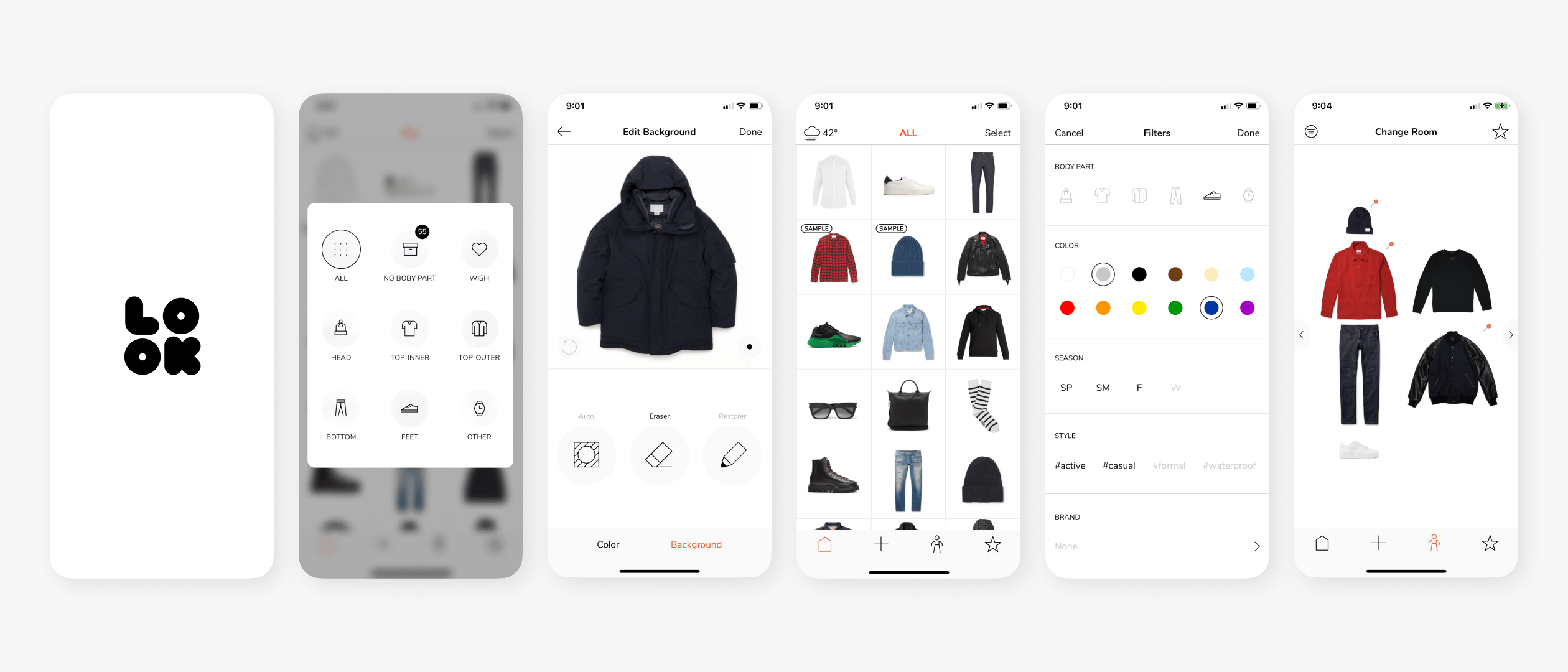
I led the full design end-to-end. Logo, color, typography, icons, every screen, every micro-interaction. The app handled a lot: importing clothing photos with background removal, sorting by category and color, filtering by weather and occasion, building outfits visually, saving favorites. With no team to split the work, every decision came back to the same desk. That kept the app clean. If a feature couldn't justify itself, it didn't ship.

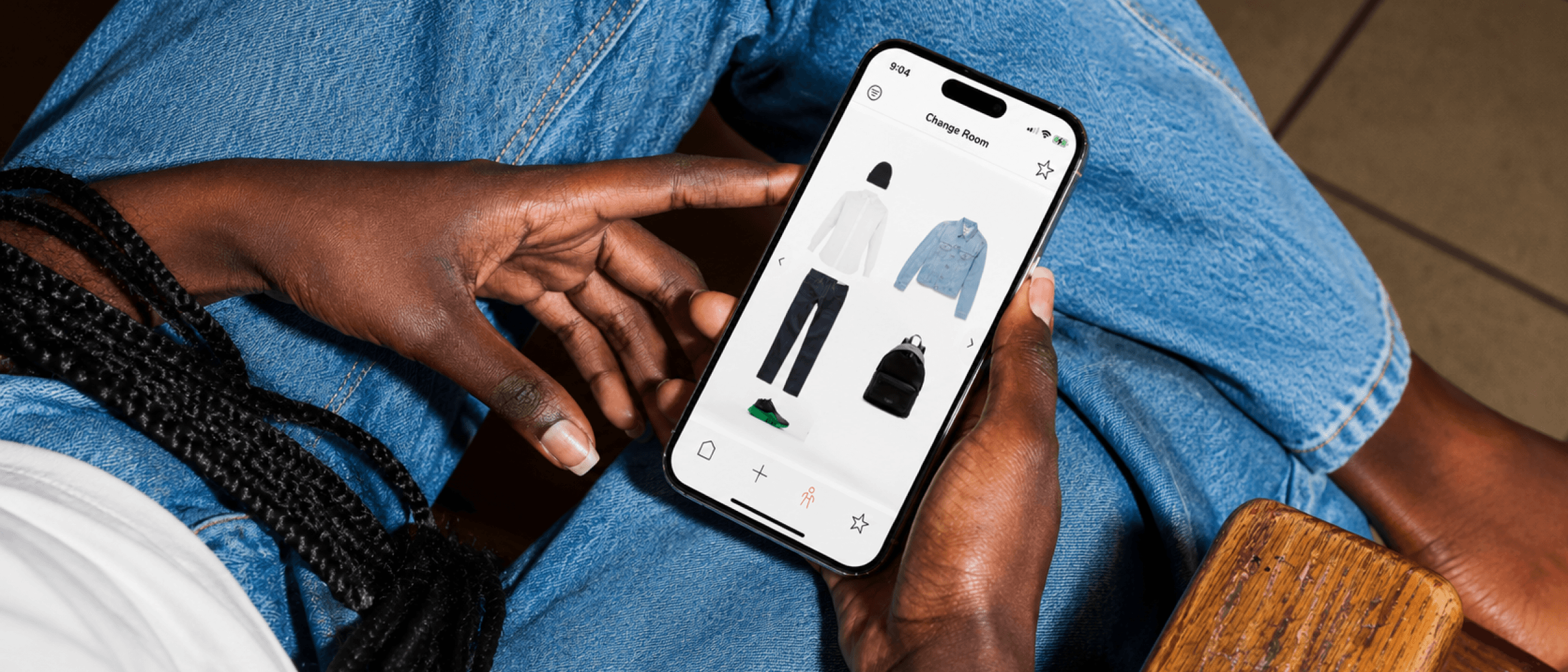
Lookscope app screens — category picker, photo editor, wardrobe grid, filters, change roomlookscope/03.png · 21:9

Where design meets engineering,
something has to give.

A year of working with one engineer taught me lessons no team could have. We disagreed often — sometimes for weeks — about whether a feature was worth building. The fix wasn't picking a winner. It was sitting down, talking through trade-offs, and finding a third option together. The harder lesson was time. Without a client or deadline, the project stretched longer than it should have. Even a passion project needs milestones. "We'll get to it" is the most expensive sentence two collaborators can say.

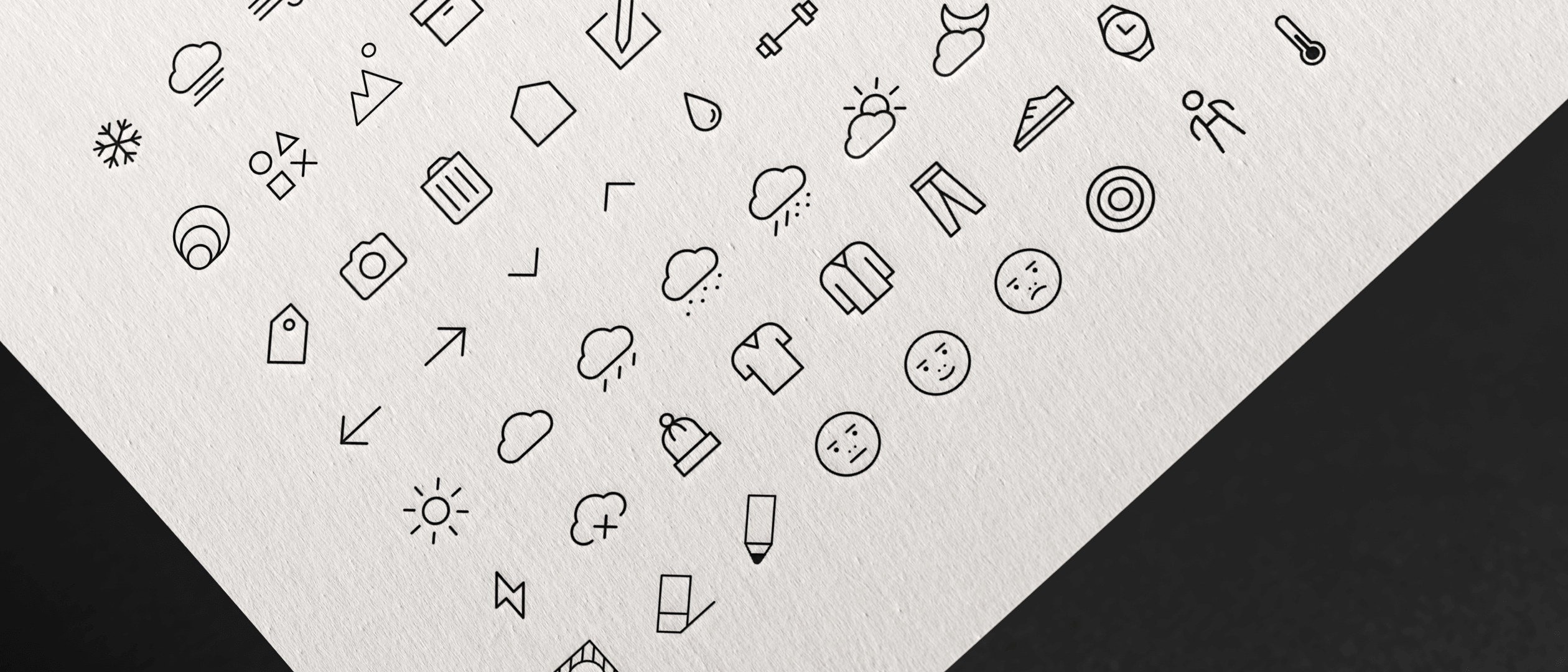
Lookscope icon system printed on paper — weather, garments, expressionslookscope/04.png · 21:9

The app we built for ourselves
found everyone else.

Lookscope launched on the App Store and, to our surprise, kept growing. Apple featured it as an Editor's Recommendation of the Week. Users started subscribing — one month, six months, a year at a time. Years later, the app is still live, still updated, still earning. Two people, one year, a quiet product that found its audience. It taught me what I later brought to Thimble: how to own the whole experience, how to speak for users when no one else is in the room, how to keep going without anyone telling you to.

Person using Lookscope app on iPhone in denim outfitlookscope/05.png · 21:9

A side project
that kept growing.

300K+
App Store downloads · by 2025
4.3 ★
Global App Store rating
Editor's Pick
Apple's Recommendation of the Week
1 year
Concept to App Store launch
2 people
Design + iOS engineering
Still live
Monetized · 1mo / 6mo / 1yr plans
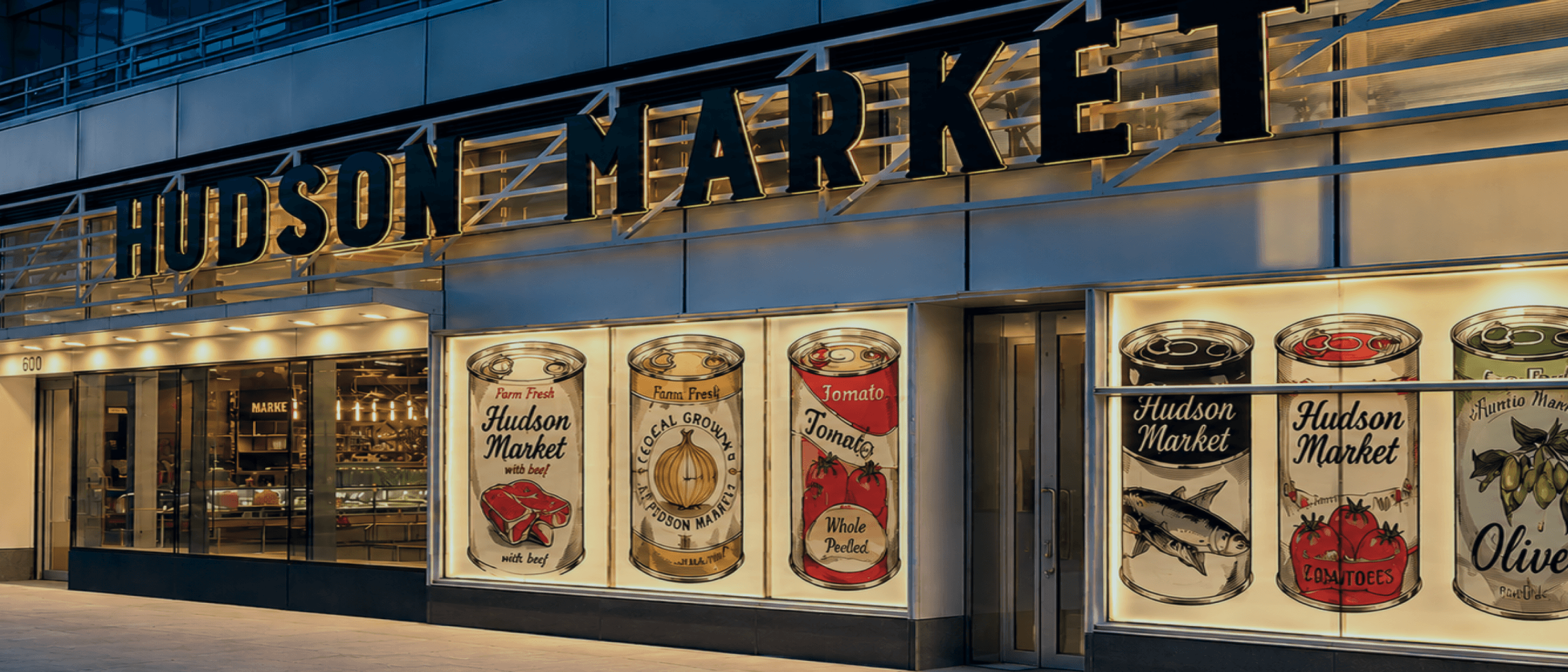
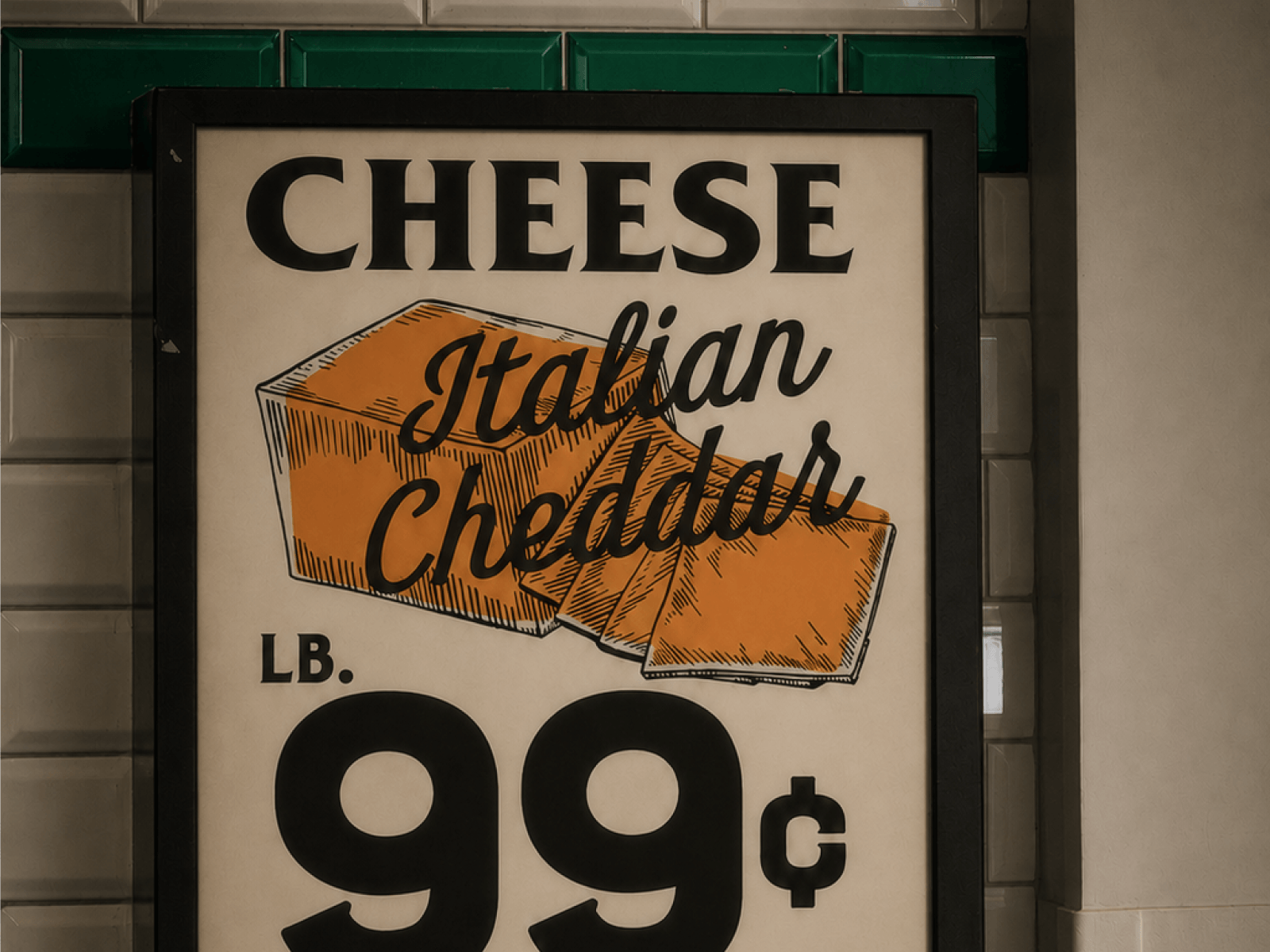
Hudson Market storefront / exterior signage hero shothudson/01.png · 21:9

Reimagining retro for Hudson Market.

Client
Hudson Market · W 57th St, NYC
Role
Art & Design Direction · End-to-end
Scope
Identity · Signage · Print · Web

Hudson Market is a neighborhood organic grocer on West 57th Street in Midtown Manhattan, just steps from the Hudson River. The brief was a brand that could feel rooted in the corner-grocer history of postwar New York — without ever feeling like a costume. I led the art and design direction across every surface of the identity.

Nostalgic. Retro.
American.

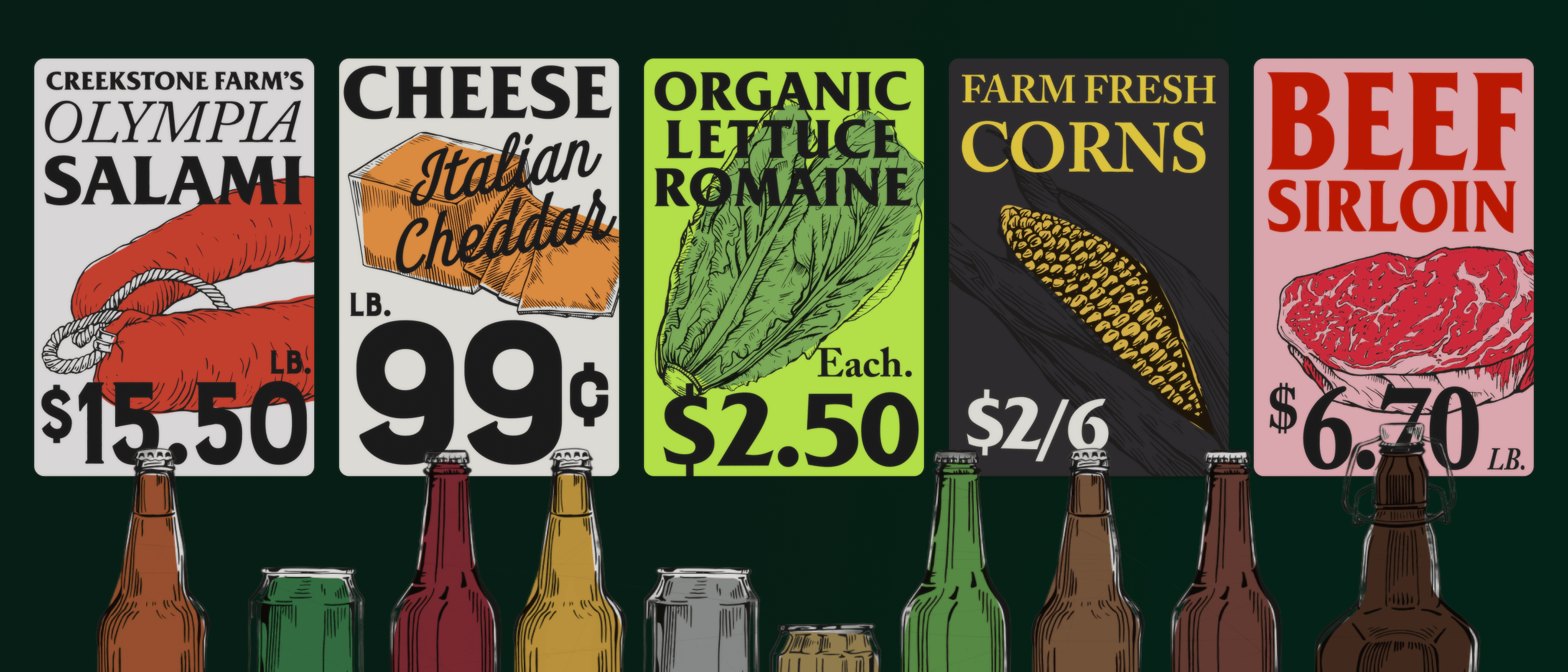
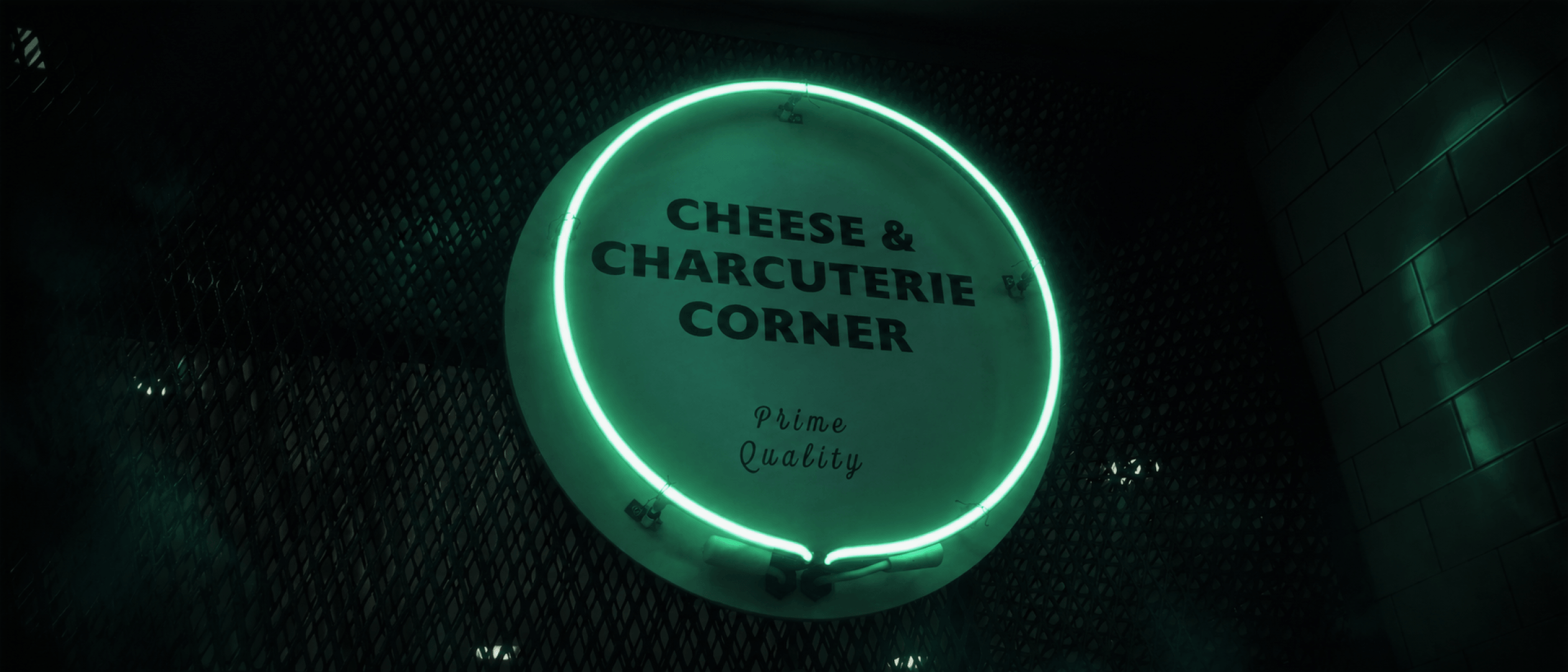
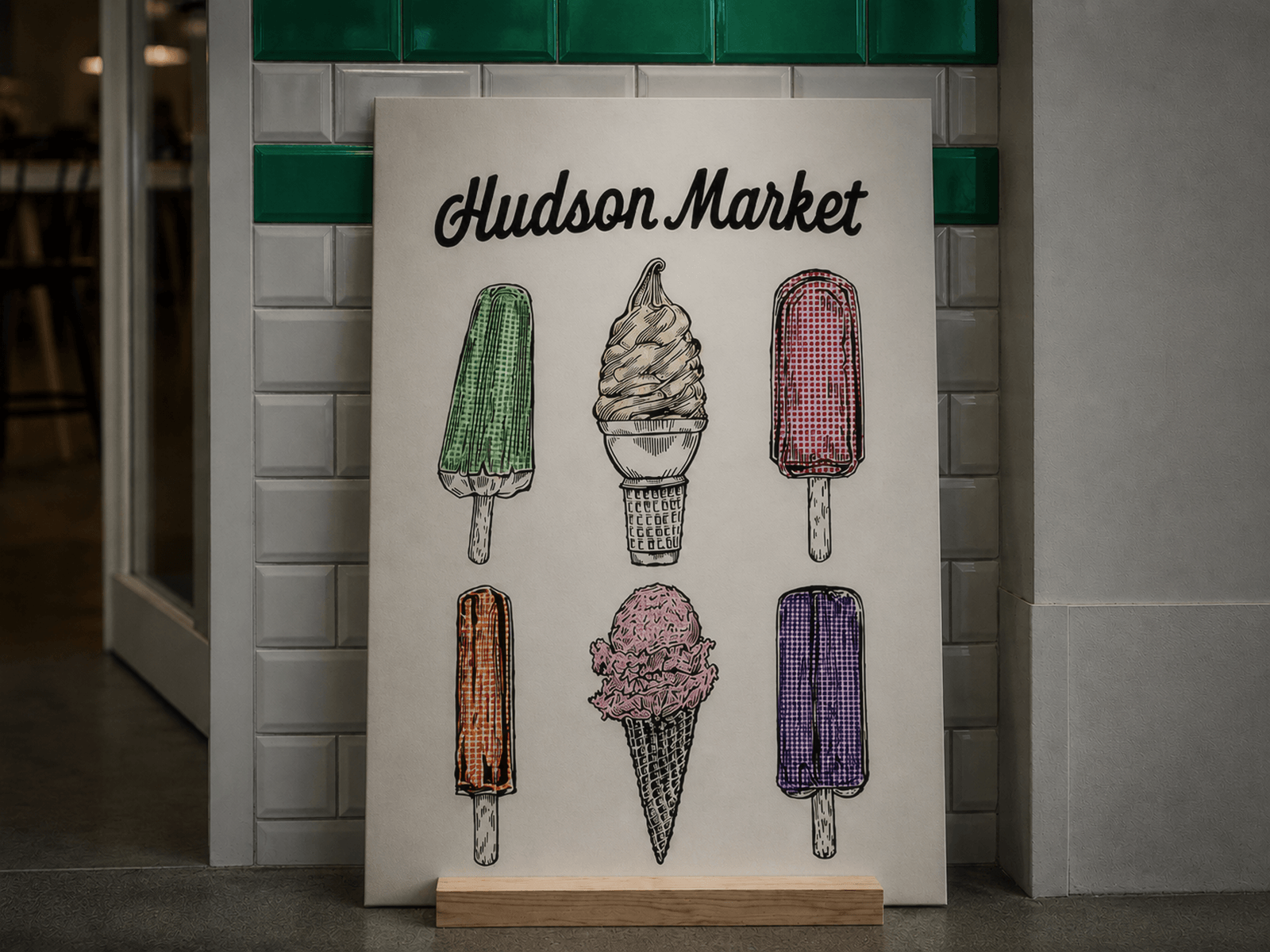
The 1950s and 60s supermarket era is a rich visual language — bold letterforms across serifs, sans, and scripts; hand-painted signage; saturated produce posters. I built the identity around a small set of retro signals: a confident mix of weights and styles, a strong color pairing, and decorative supporting marks, held together by quiet modern typography and generous whitespace.

Logo / wordmark — final identity mark, multiple lockupshudson/02.png · 4:3
Color palette, typography system, secondary markshudson/03.png · 4:3
Mood / reference board — 1950s-60s American grocery aestheticshudson/04.png · 21:9

The store, out
of time.

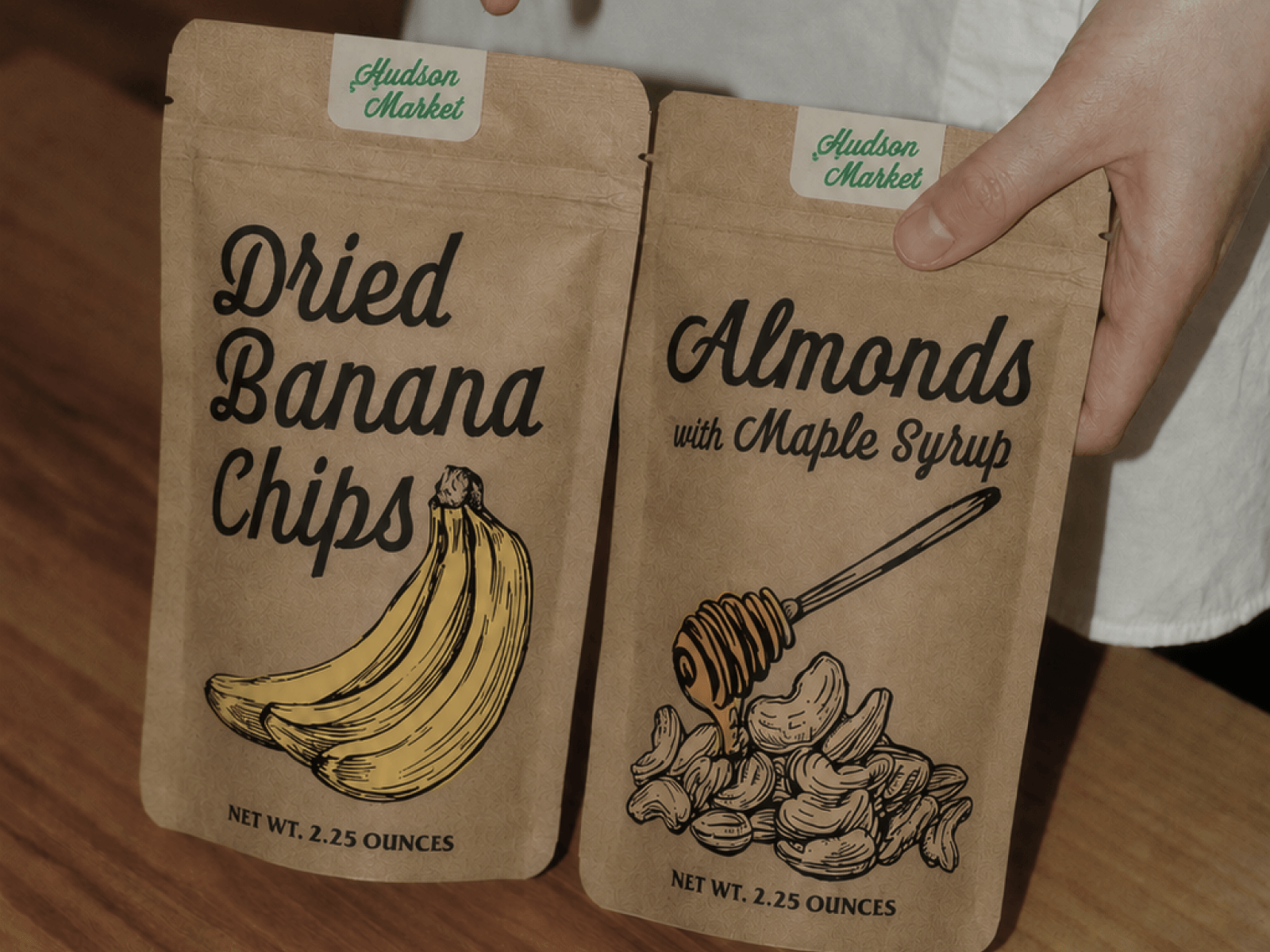
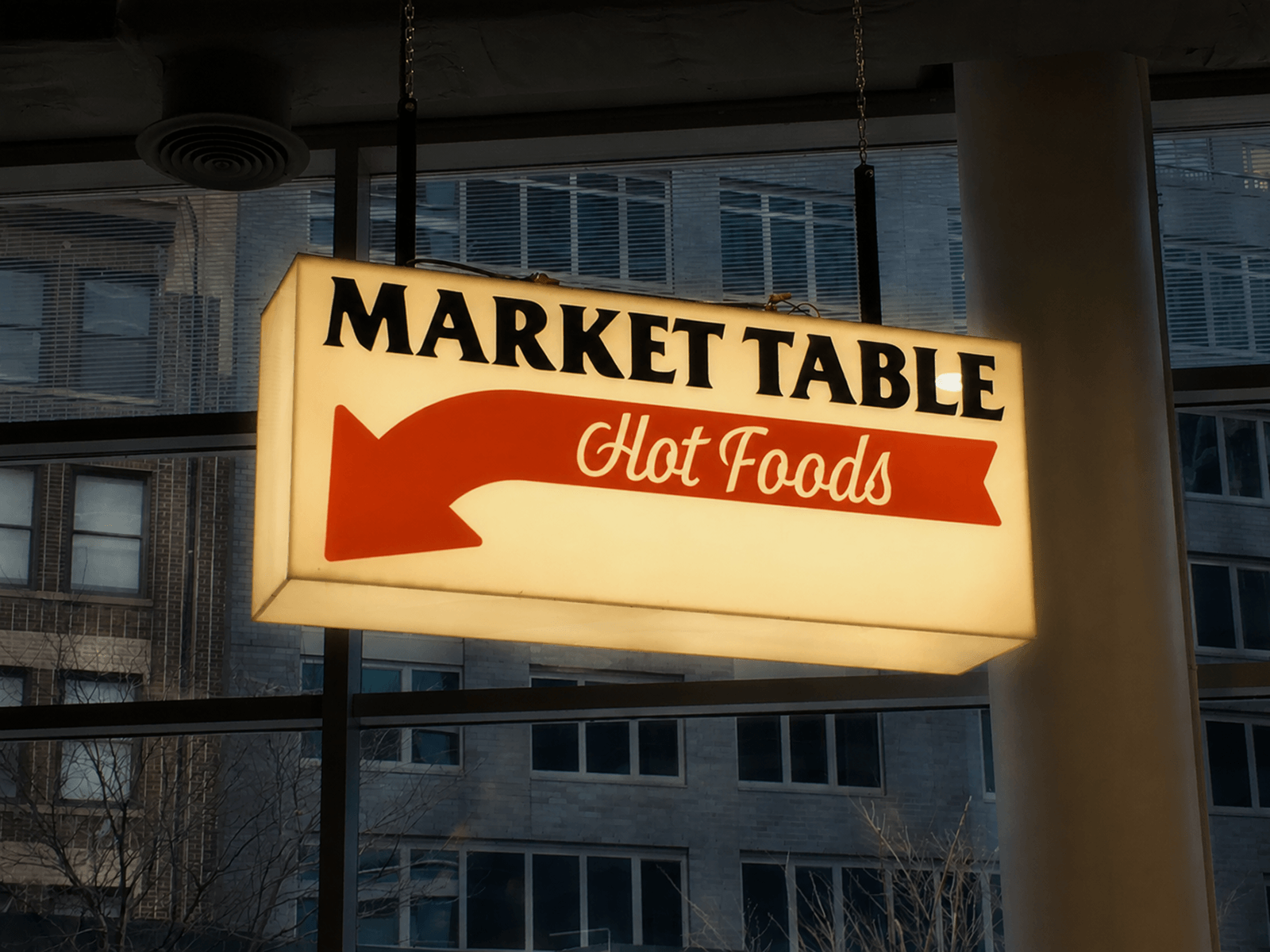
A grocery brand isn't a logo — it's every surface around it. The sign, the napkin, the price tag, the receipt. I designed it all as one system, with one direction holding it together: a 1960s American grocer, found in the present. Familiar enough to walk into. Strange enough to stay with you.

Exterior signage — main storefront awning / blade signhudson/05.png · 21:9
Window displays — produce announcements, seasonal graphicshudson/06.png · 4:3
Interior signage — aisle markers, department headers, wall graphicshudson/07.png · 4:3
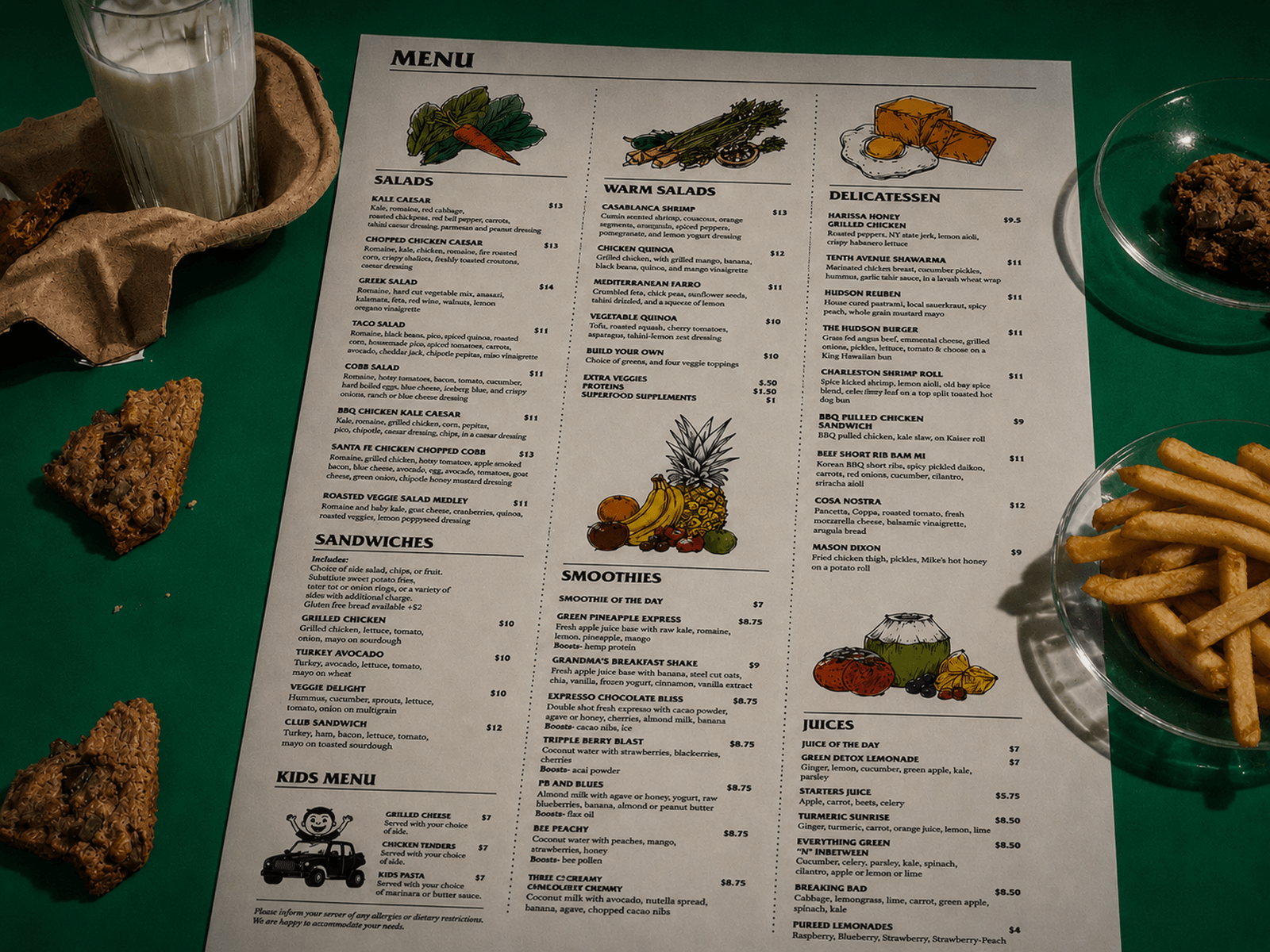
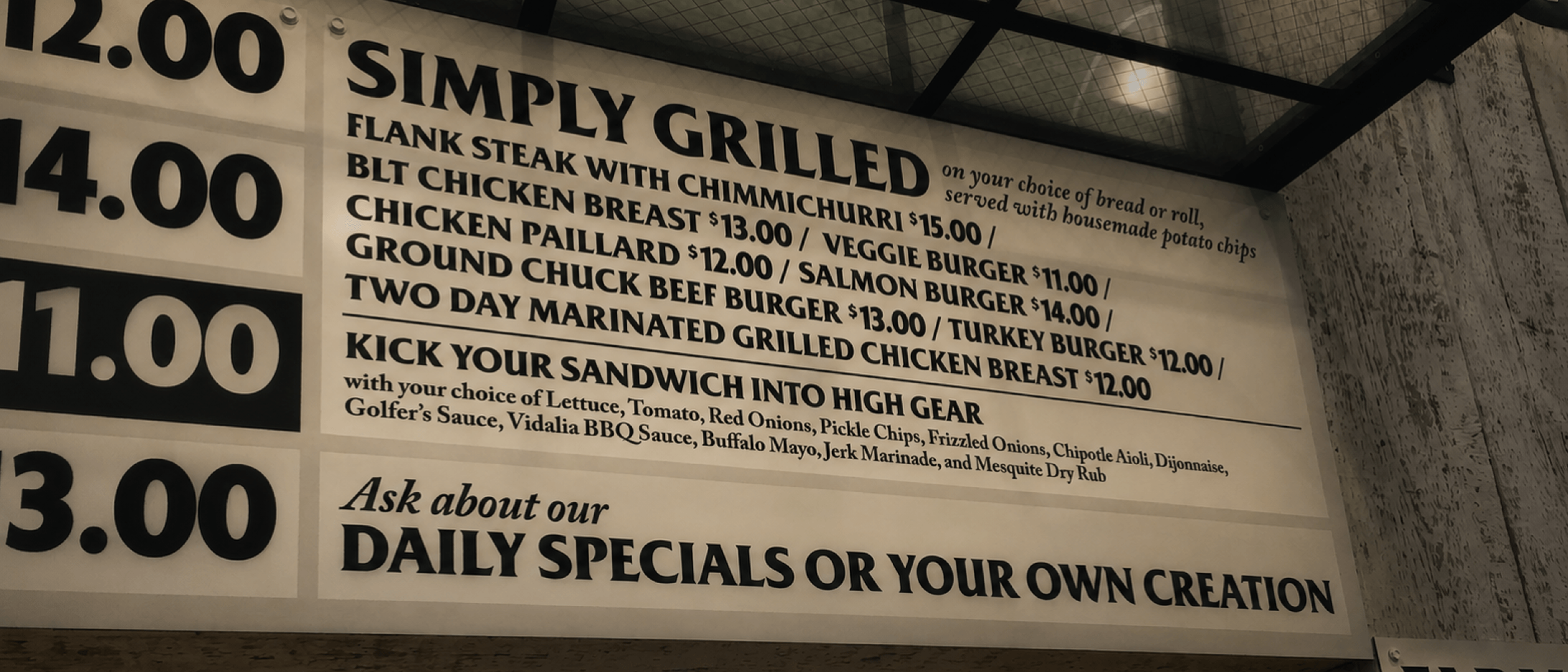
Menu / deli boards — typography in use at counter scalehudson/08.png · 4:3
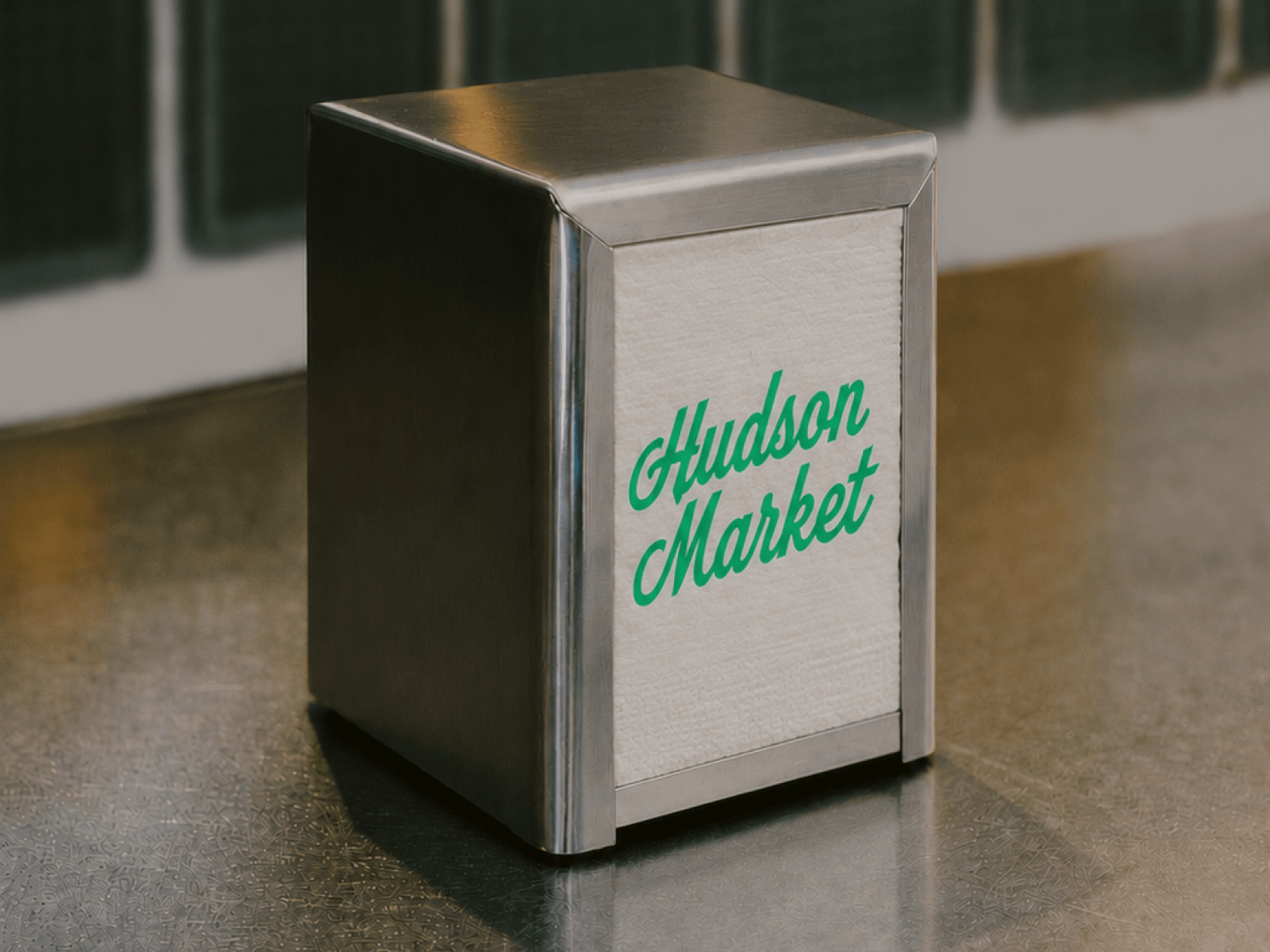
Collateral — business cards, packaging stickers, bags, receipts, loyalty cardshudson/09.png · 4:3
Website — homepage / hero screenhudson/10.png · 21:9

A quiet job,
done.

Good retail design disappears. The store stops feeling designed and starts feeling found. That was the bar I set: not loud, just inevitable on the block. A corner of Midtown that finally felt like it had always been there.

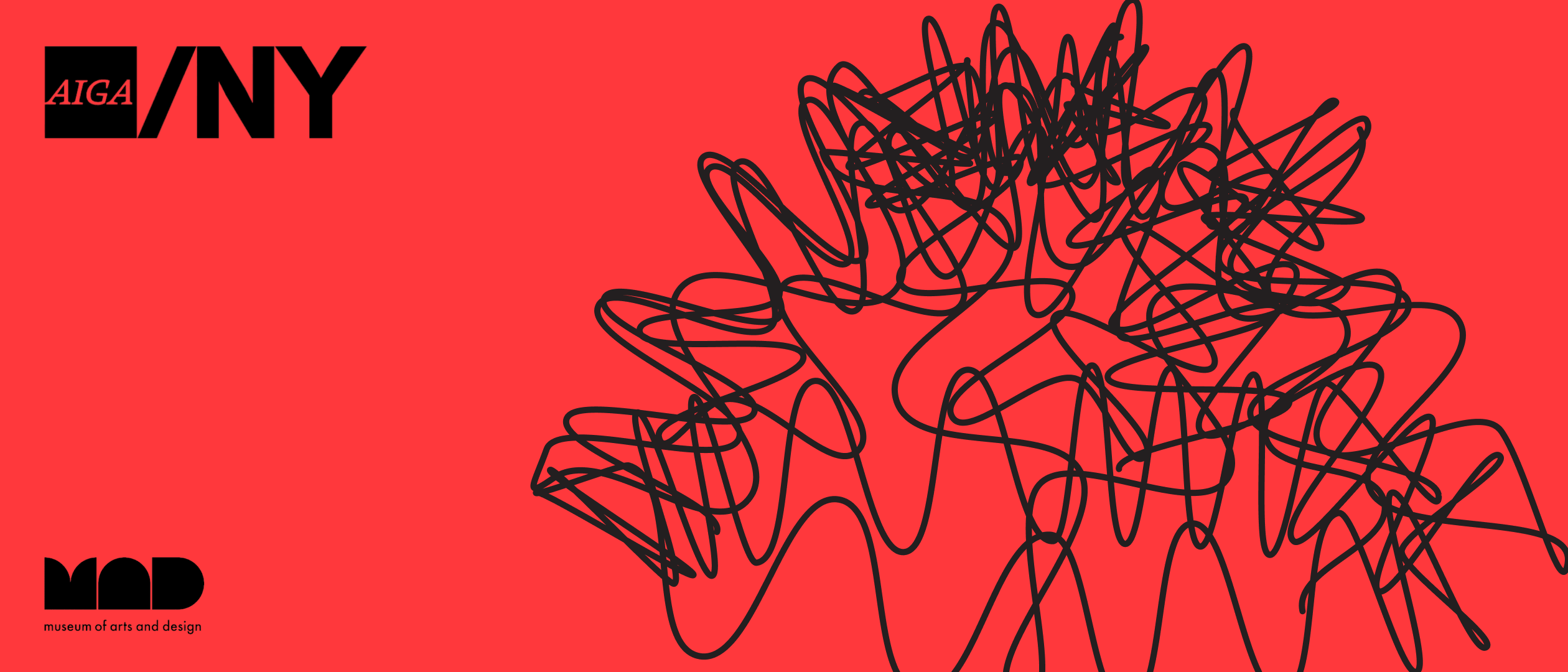
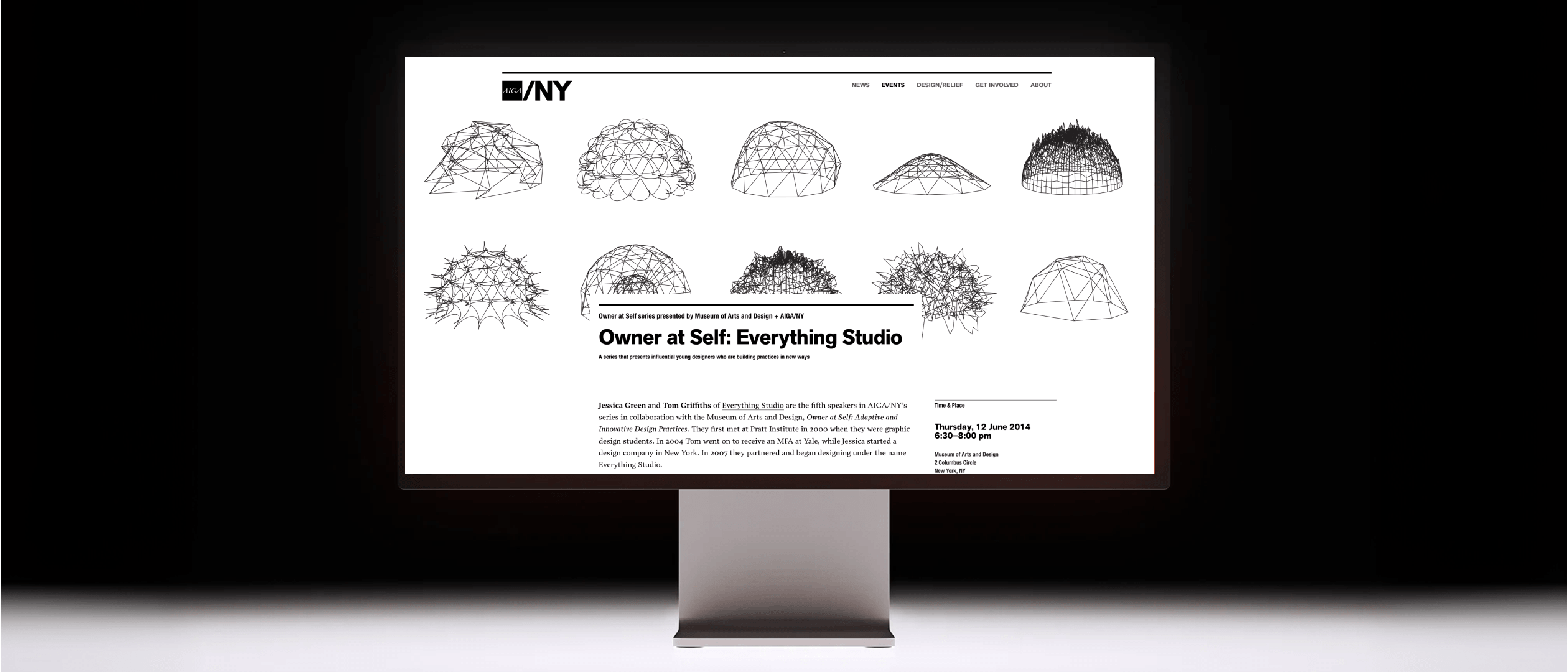
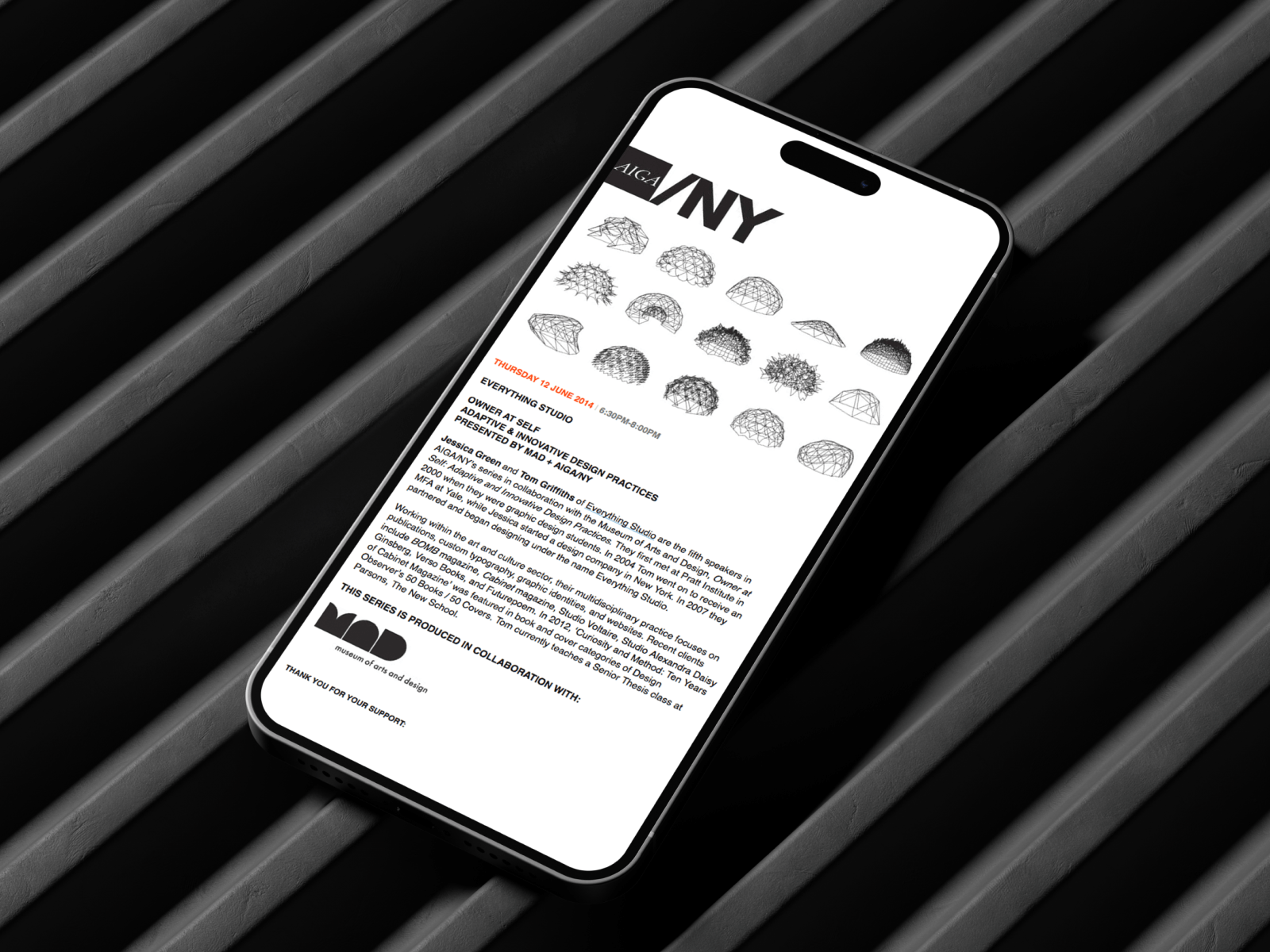
AIGA NY × MAD invitation — final dome compositionaiga/01.png · 21:9

When a logo becomes the lecture.

Studio
Everything Studio · Lower East Side, NYC
Client
AIGA NY × Museum of Arts and Design
Role
Invitation Design
Event
"Owner at Self: Adaptive and Innovative Design Practices"

Everything Studio was invited as the guest speaker for an AIGA NY event hosted at the Museum of Arts and Design — a lecture about adaptive, multidisciplinary design practice. Joining the studio early in my career, working alongside its founder, I was asked to design the event's digital invitation. The brief was small. The audience was anyone who pays attention to graphic design in New York.

One dome,
then many domes.

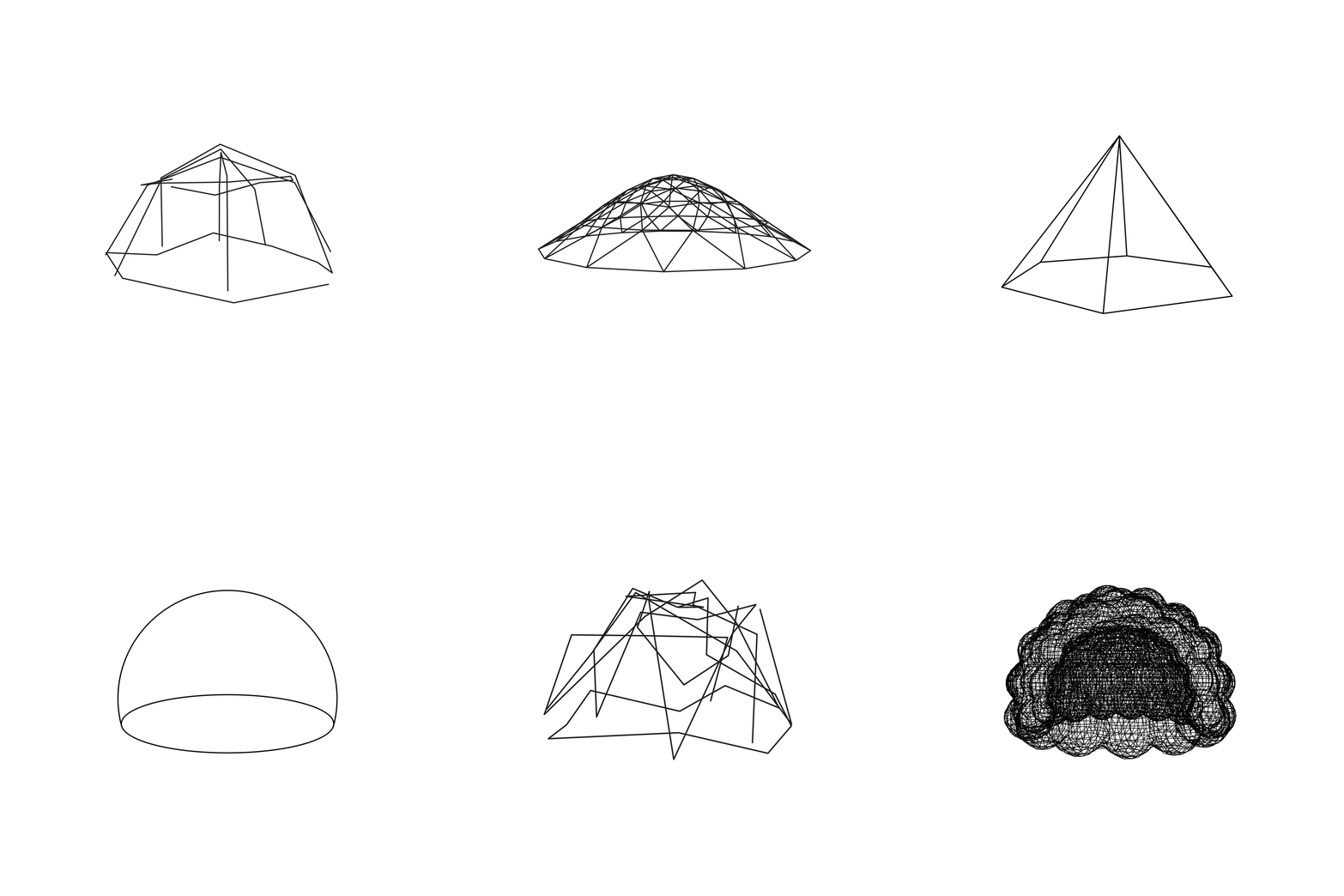
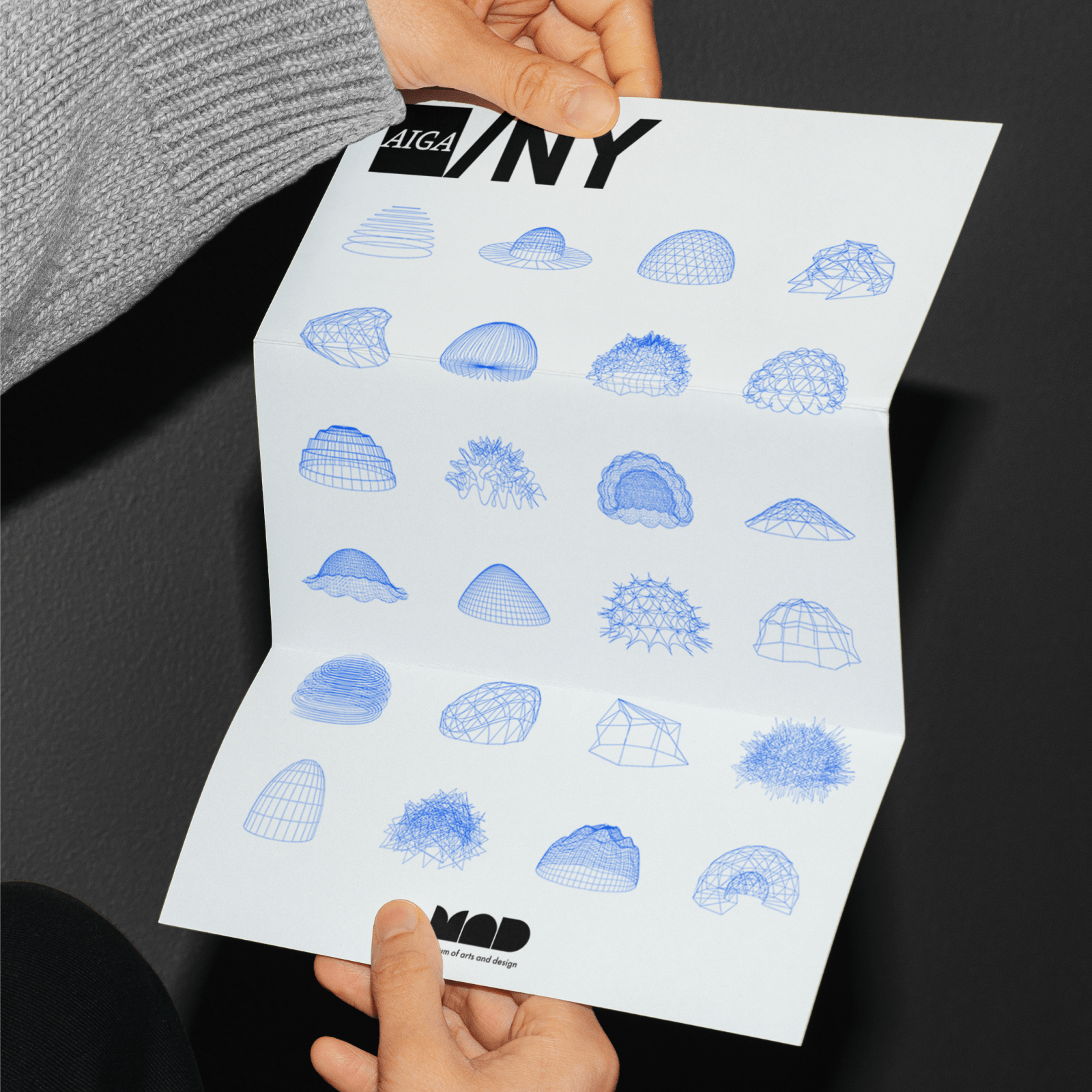
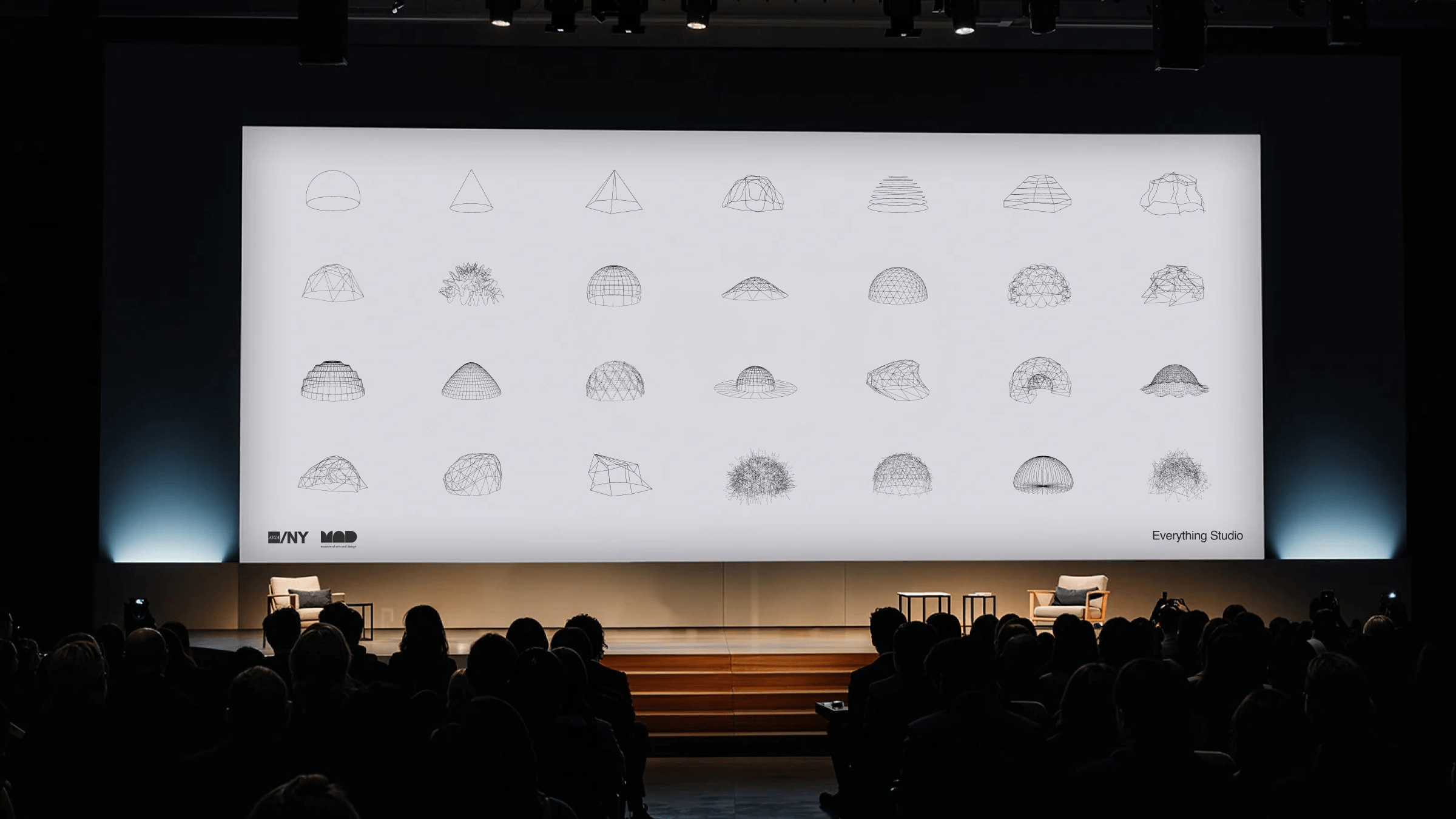
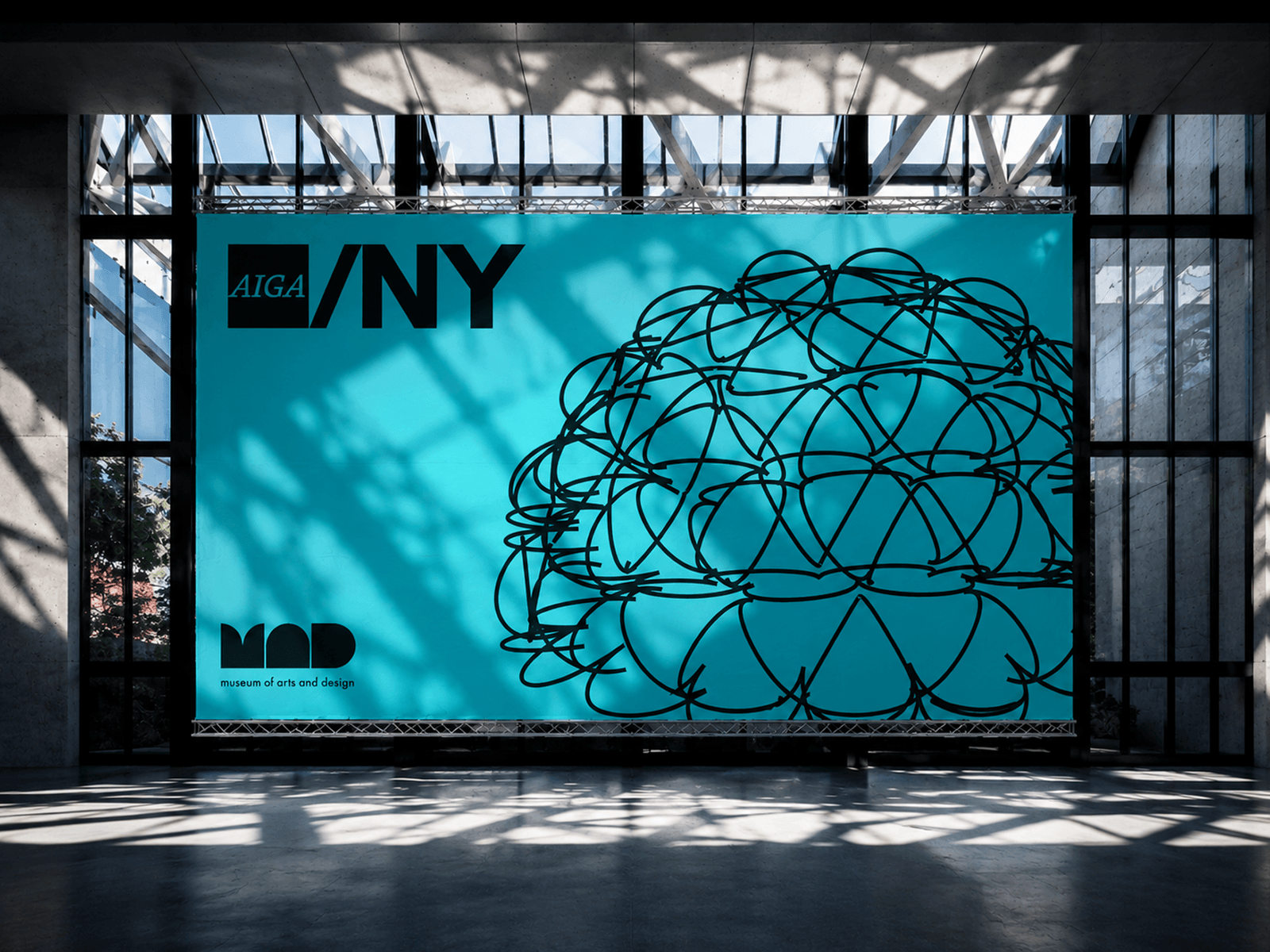
Everything Studio's identity is built around the geodesic dome — Buckminster Fuller's icon of structure achieved through diversity of parts. The studio's whole practice runs the same way: many disciplines, one shape. The invitation needed to say something about how Everything Studio thinks before anyone had clicked into the event details, so I started where the studio starts — its own logo — and let it multiply. A single dome became a field of them, each one a slightly different angle, weight, and rhythm. The visual is the lecture in miniature: one studio, many ways of working, held together by a recognizable form.

Final invitation hero — dome composition in contextaiga/02.png · 21:9
Everything Studio's original geodesic dome logo, Bucky Fuller referenceaiga/03.png · 4:3
Sketches and explorations of dome multiplying into variationsaiga/04.png · 4:3
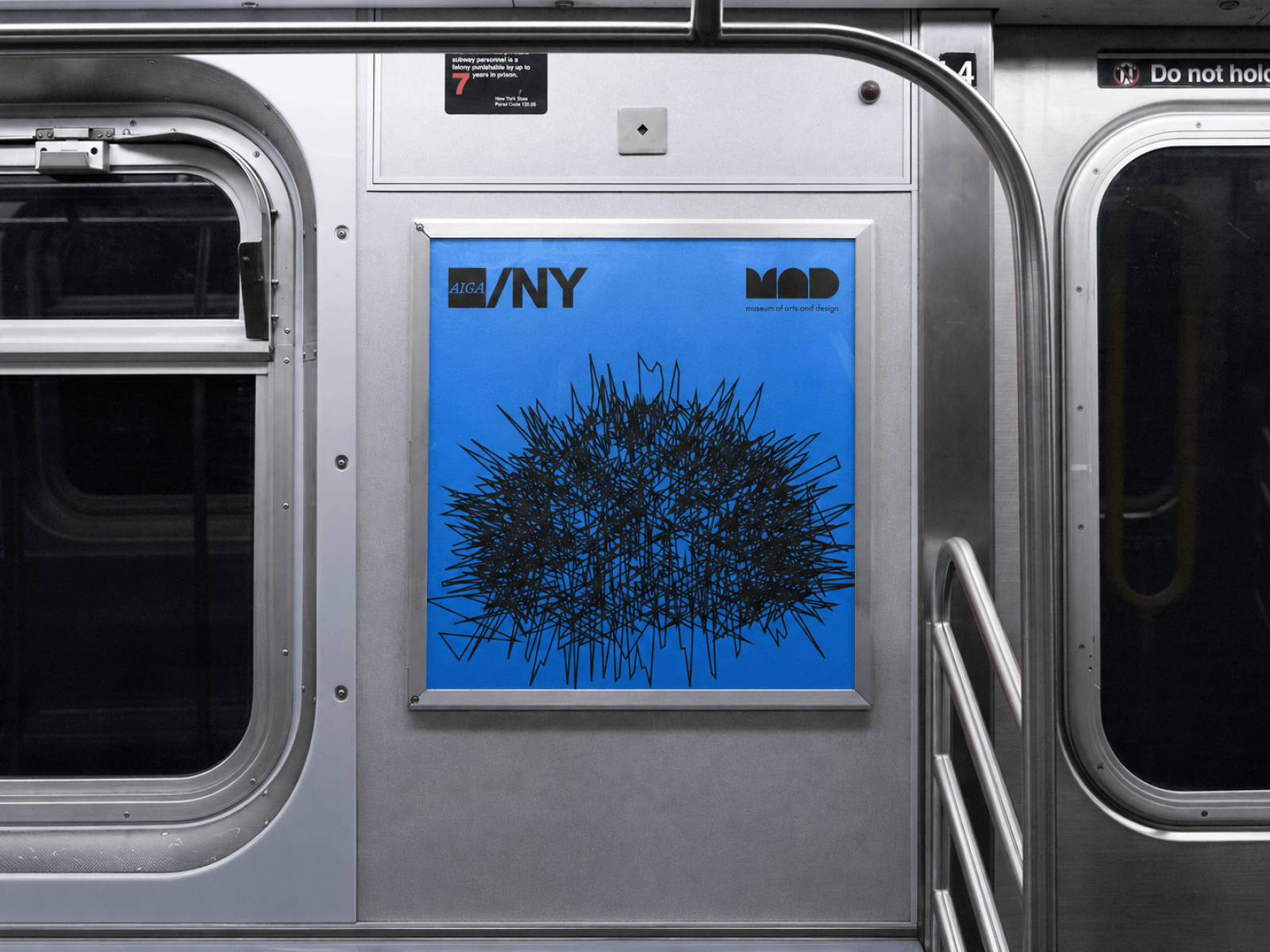
Poster — printed invitation pieceaiga/05.png · 4:3
Poster — printed invitation pieceaiga/06.png · 4:3

A small invitation
for a large room.

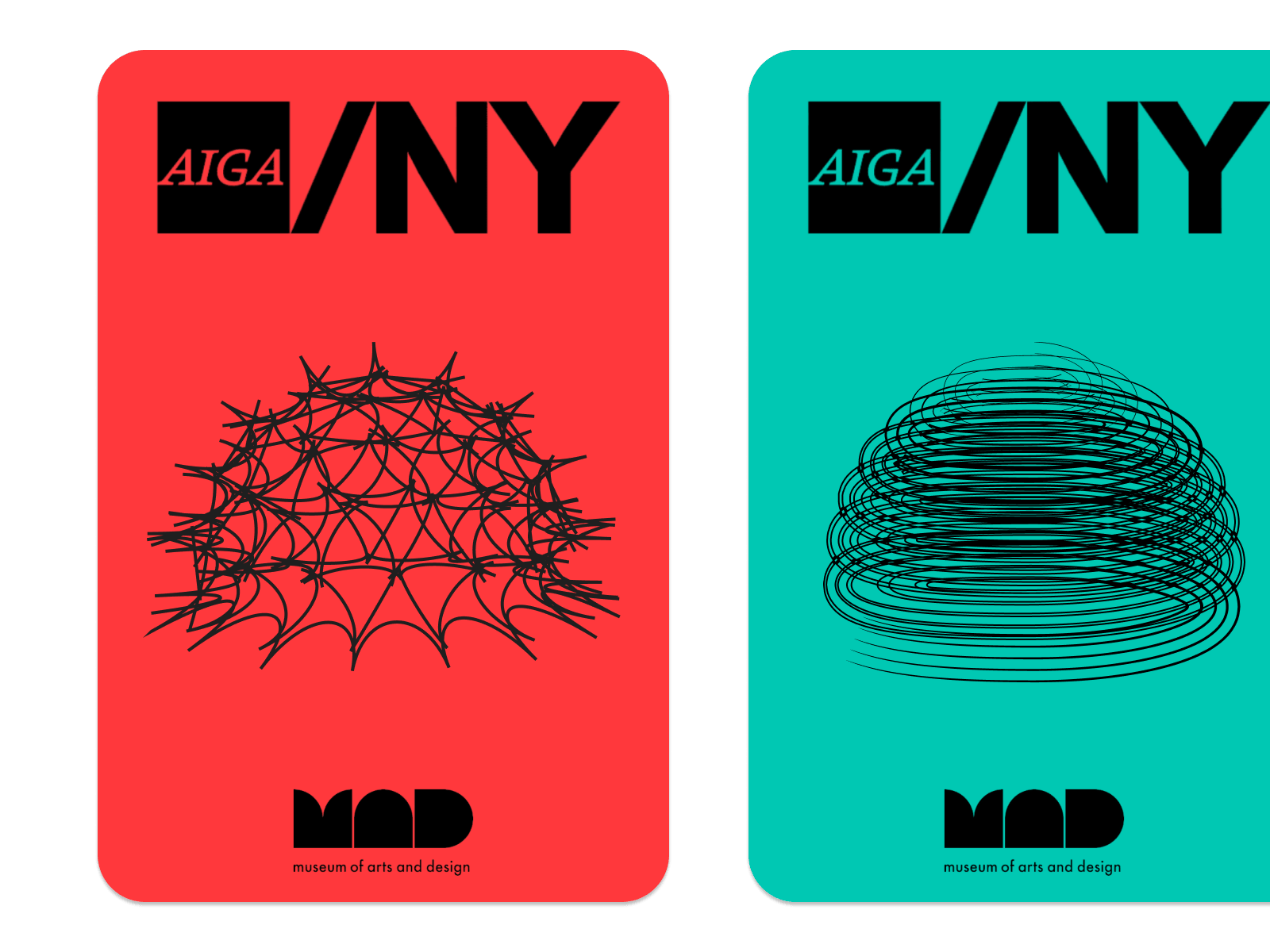
The final invitation lived across digital and print — a primary composition for the announcement, with supporting graphics and posters for the lead-up. The system was tight enough to feel cohesive on a single feed, and varied enough to keep returning visitors curious about what came next.

Primary invitation — animated dome compositionaiga/07.gif · 1:1
Variations — alternate dome arrangements, motion-ready framesaiga/08.png · 1:1
Full system — invitation cover, social cards, supporting graphicsaiga/09.png · 16:9

A small project
on a large stage.

It was a short brief, an early credit, and a room I'm still proud to have designed for. The lesson stuck: when a studio's identity is strong enough, you don't need to invent a new visual language to speak with it — you just need to know how to make it talk.

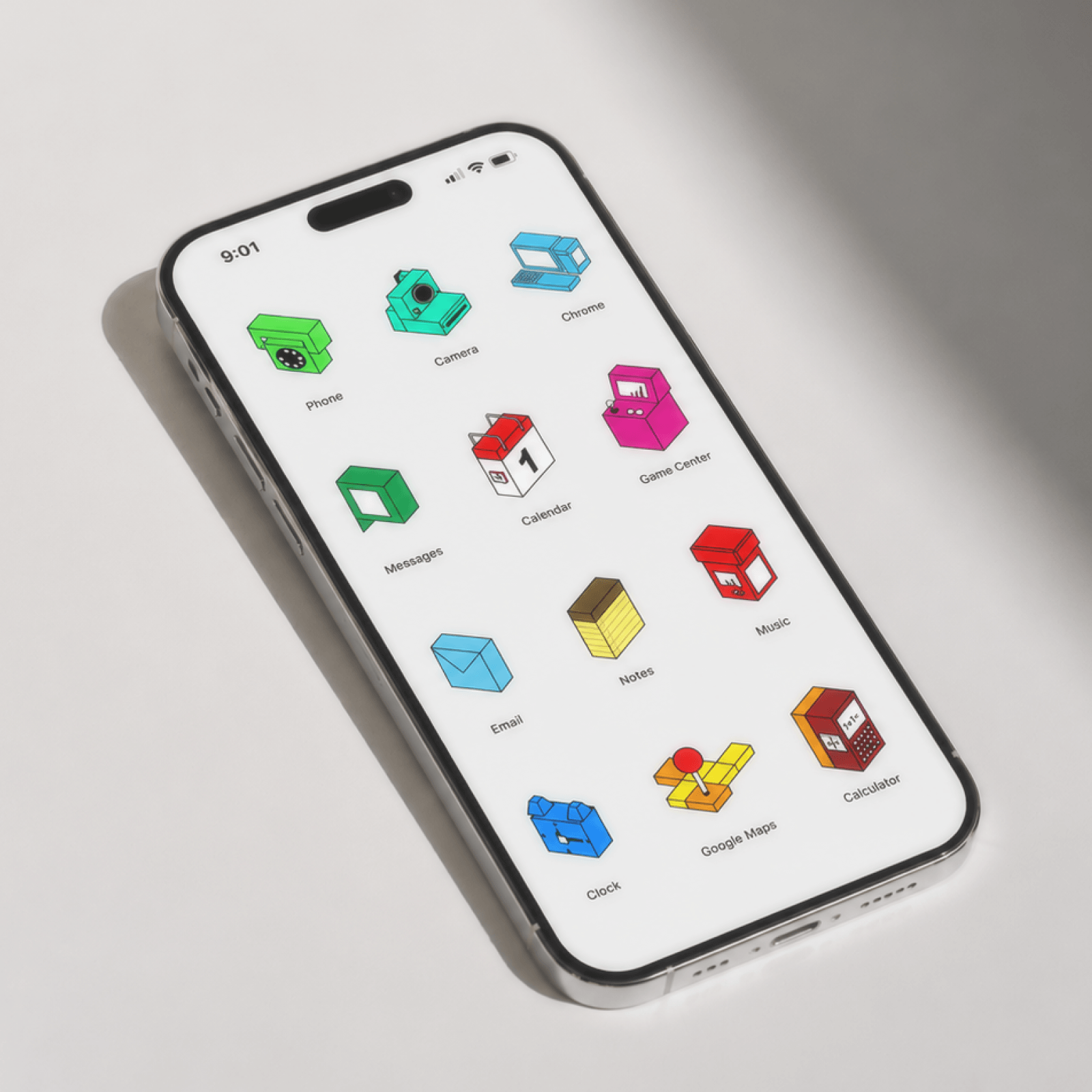
Transfoner home screen hero shot, showing icons mid-transformationtransfoner/01.png · 21:9

App icons with a life of their own.

Studio
njenworks (now Pentagram)
Project
Transfoner · Mobile app
Role
Visual Identity

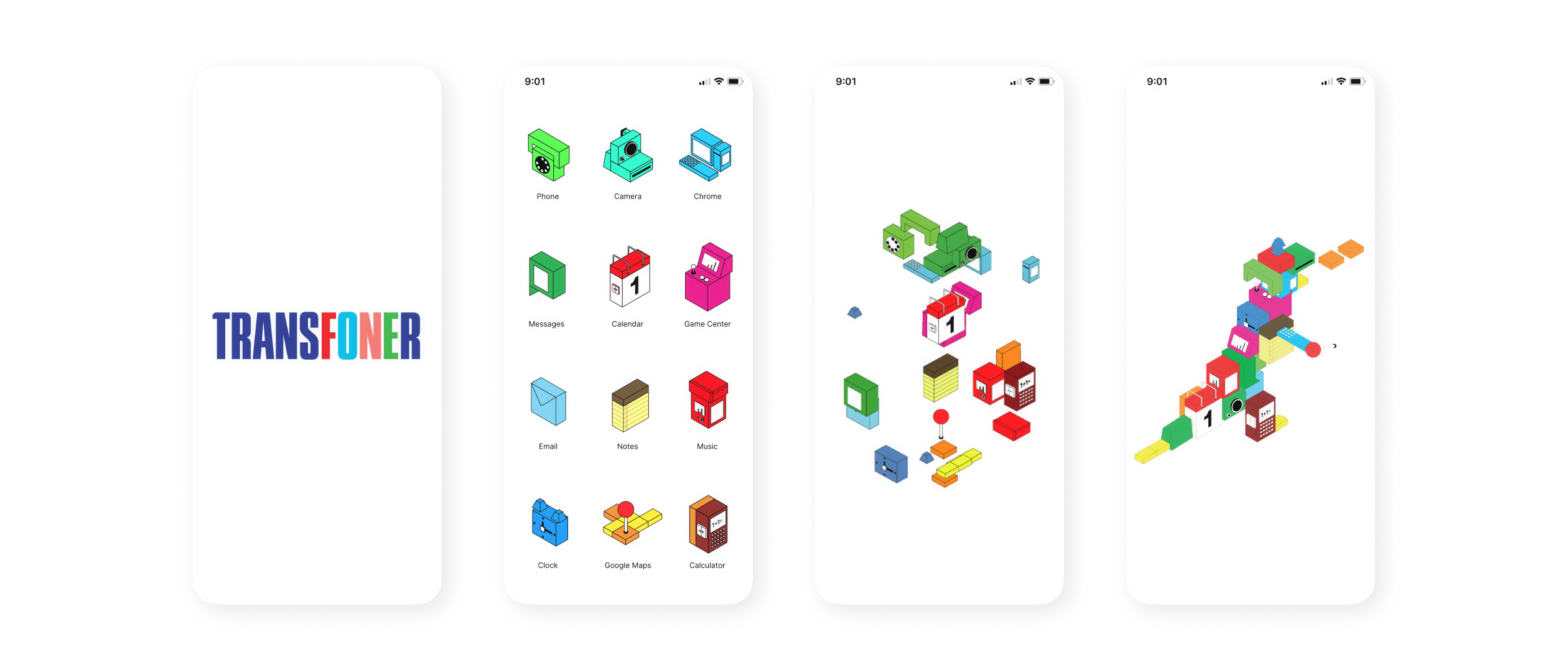
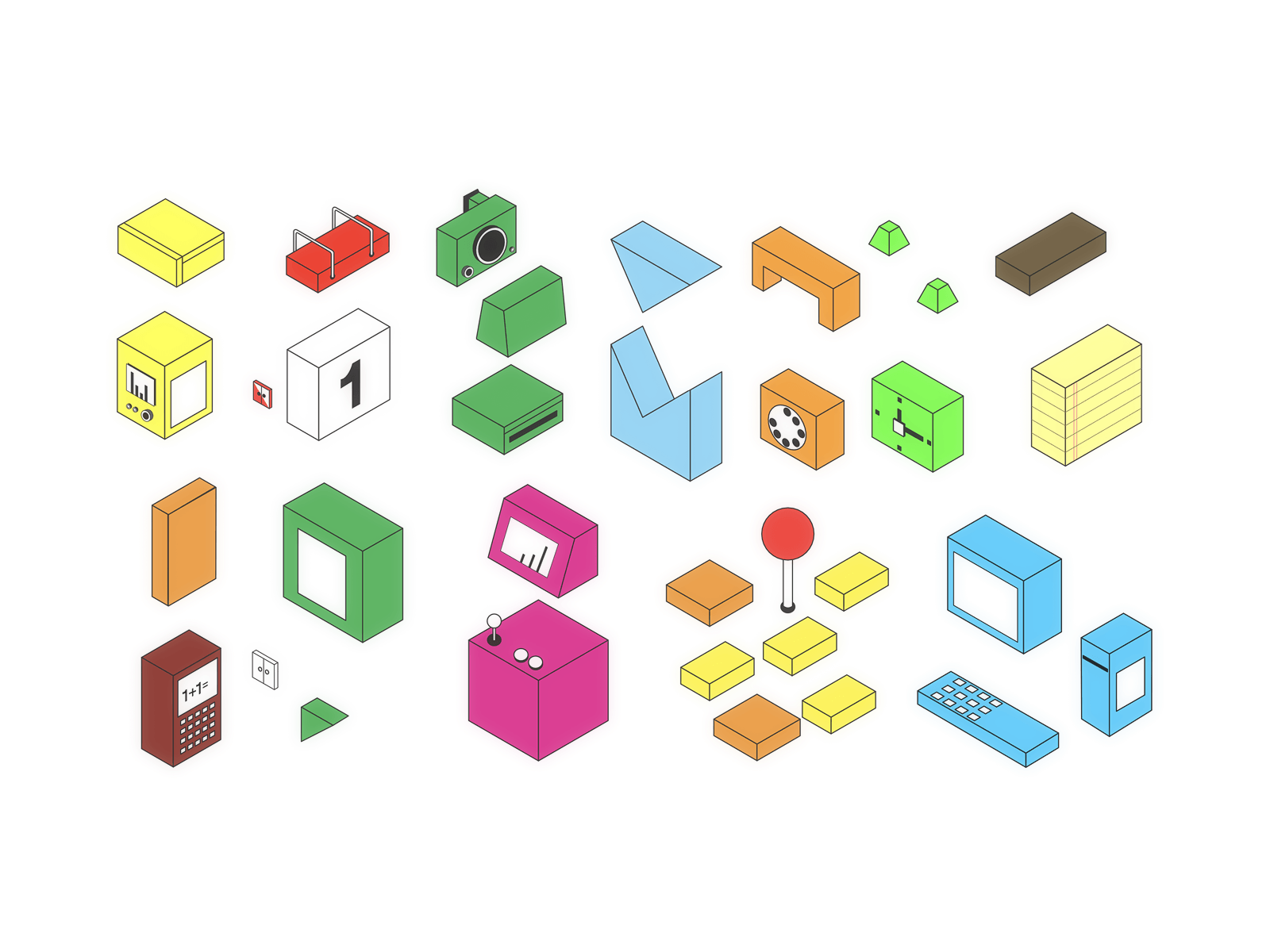
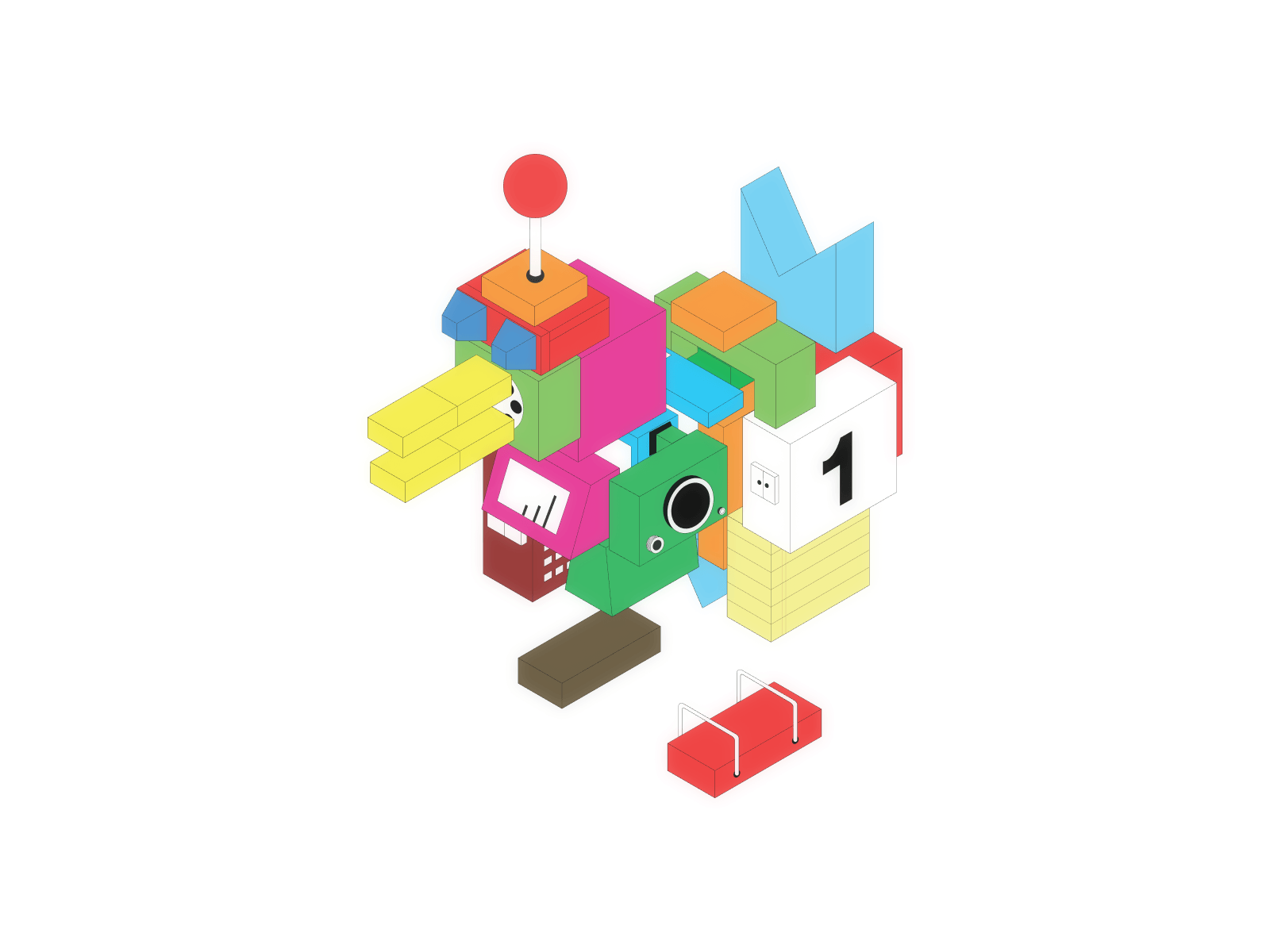
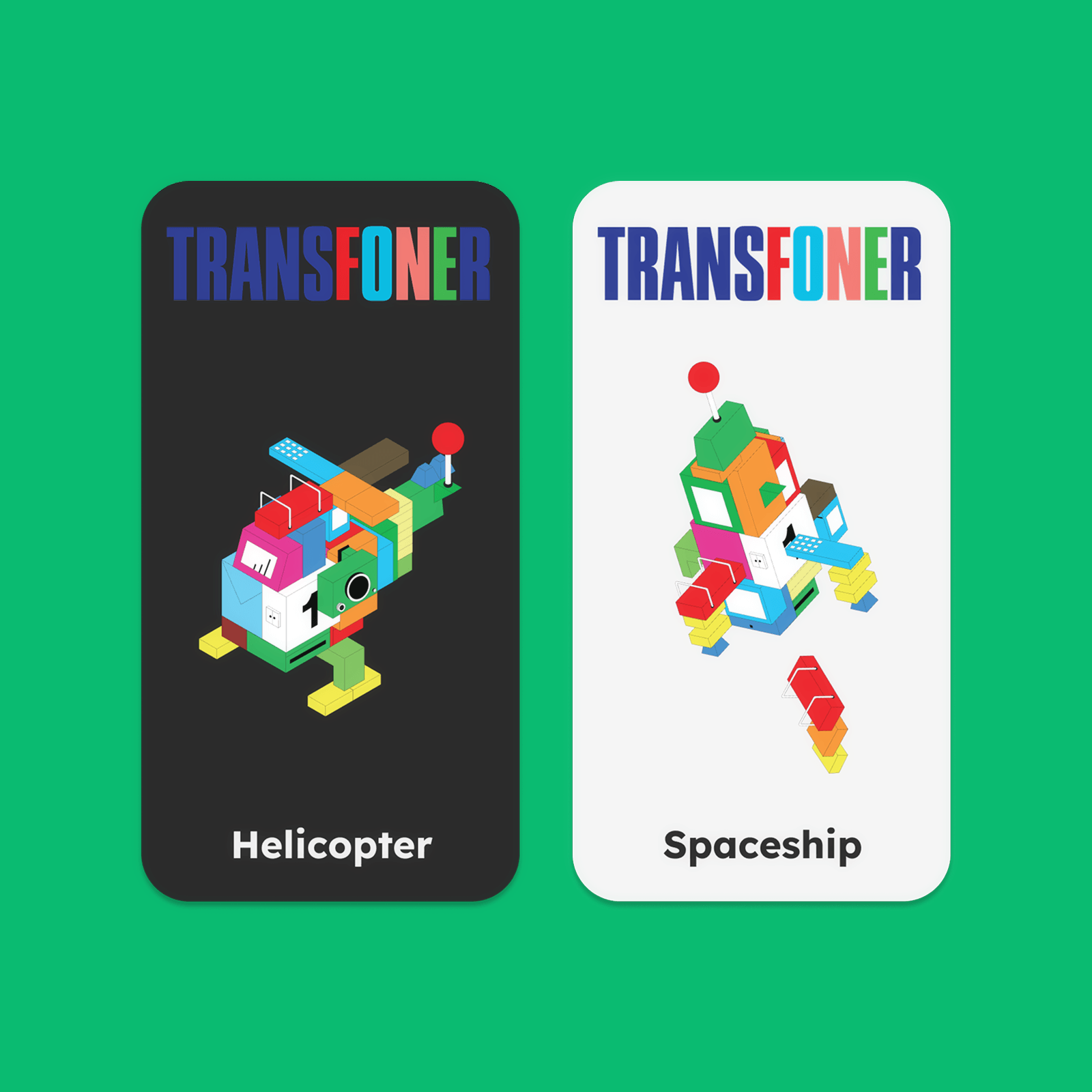
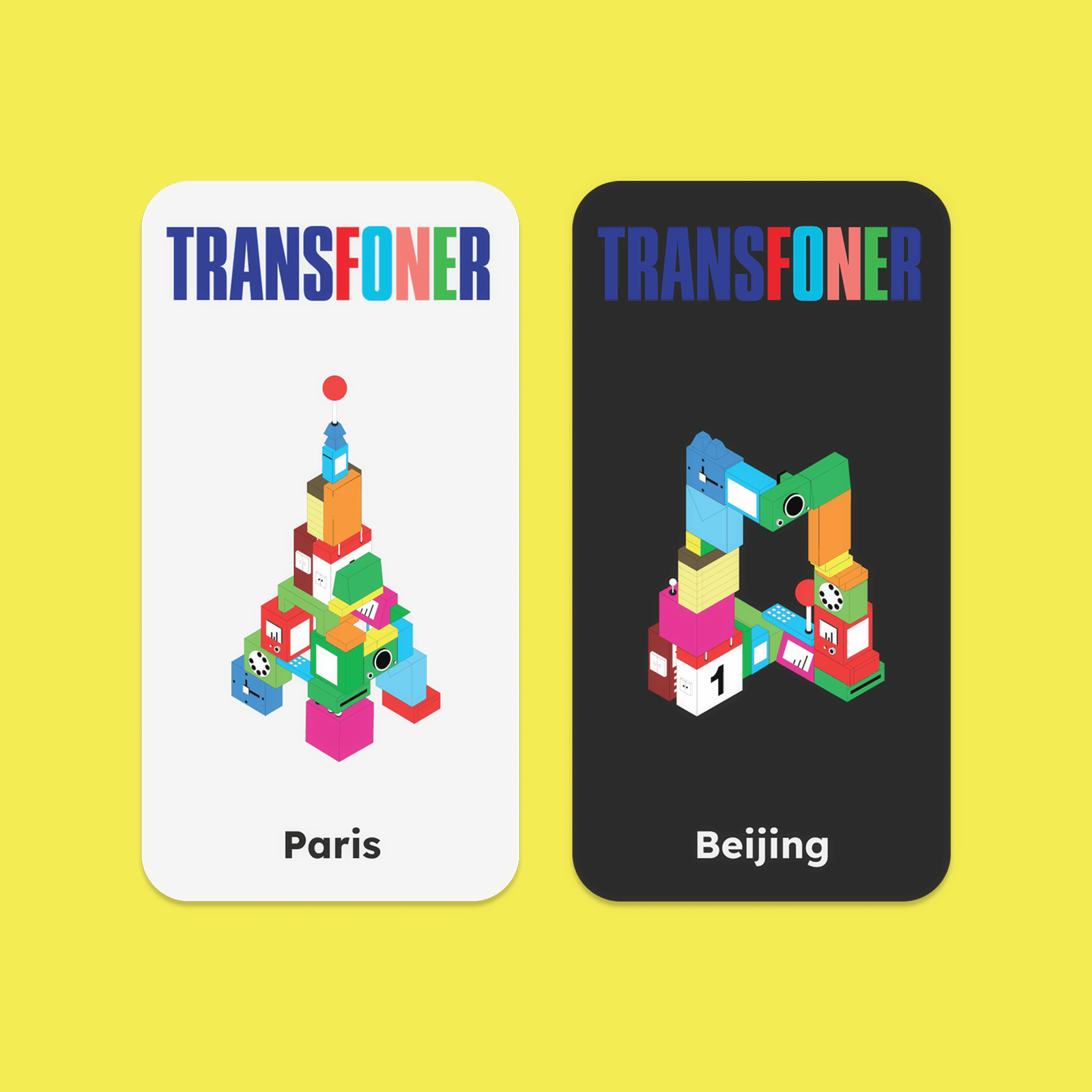
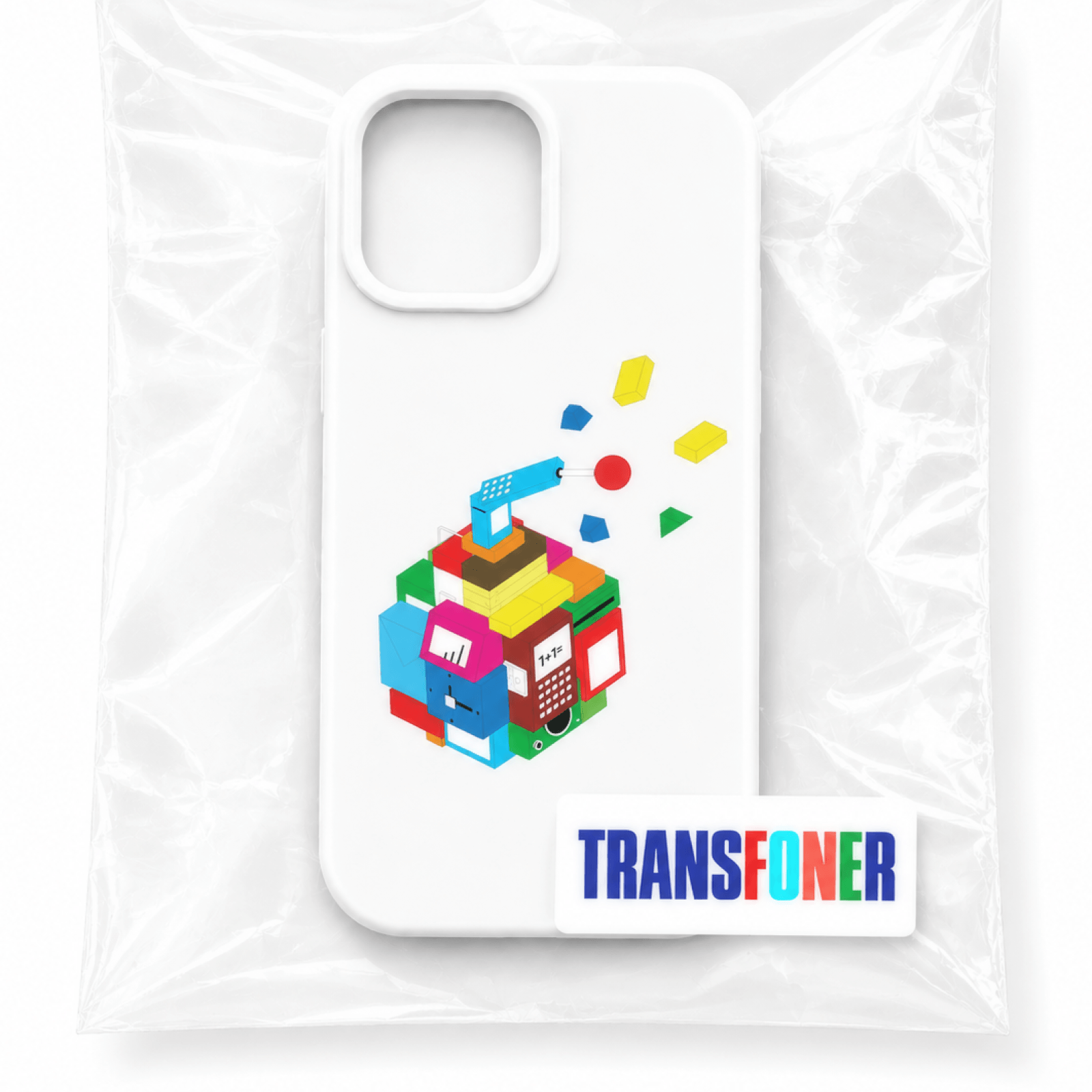
Transfoner reimagines the mobile home screen as a place where icons don't sit still. Each one carries its own character — transforming, shifting, breathing personality into the surface of the phone. I designed visual identity components for the project at njenworks, the studio of Natasha Jen, before she joined Pentagram as partner.

A home screen
with personality.

Phone home screens are static by default — rows of small rectangles that exist to be tapped, not to be looked at. Transfoner pushes against that. Each icon becomes a small character that breaks apart, transforms into objects, and reassembles. The phone surface stops being a grid of tools and starts behaving like a living scene.

Transfoner home screen with icons in their transformed statestransfoner/02.png · 21:9
Static home screen vs. Transfoner — before / after comparisontransfoner/03.png · 4:3
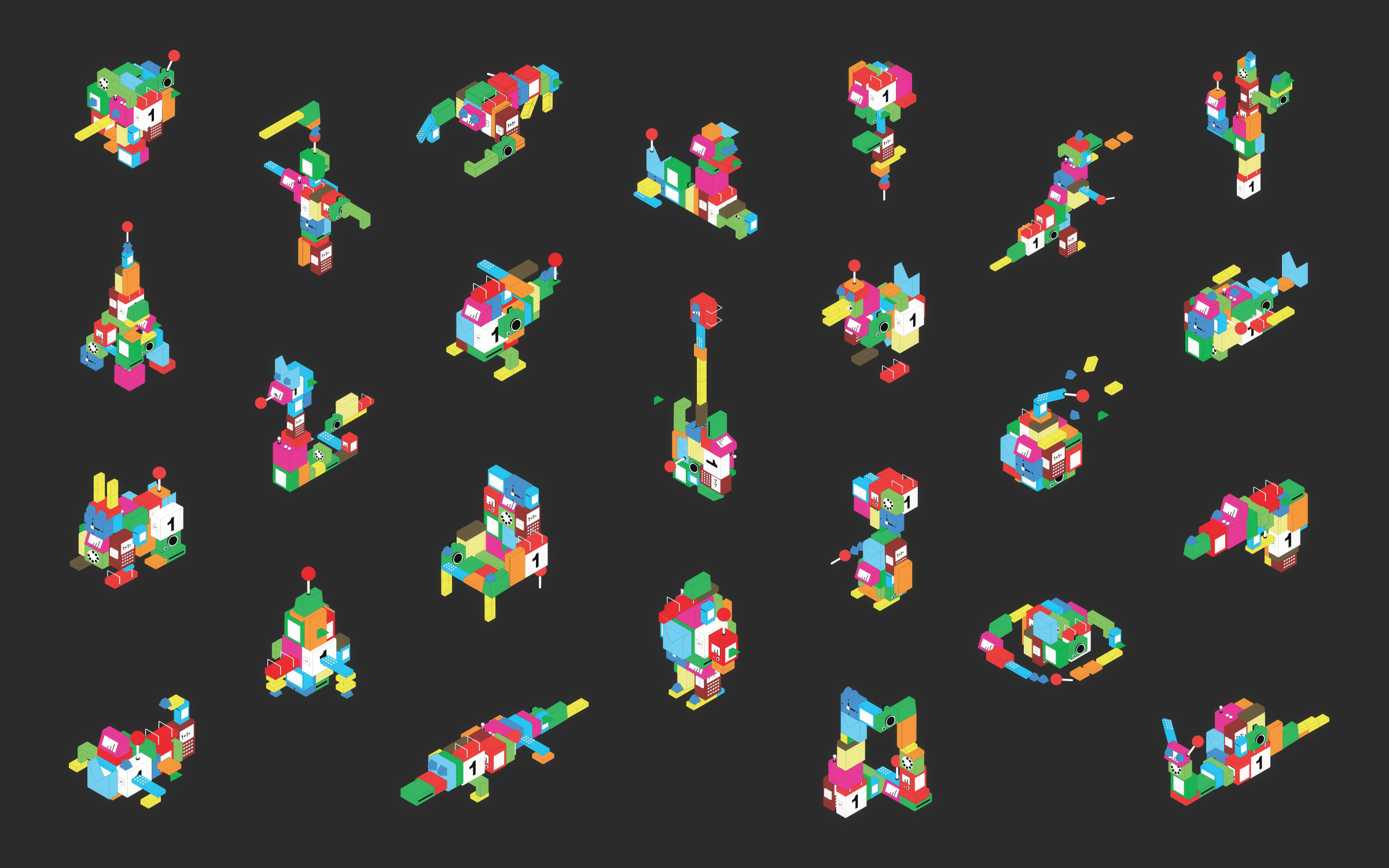
Icon character studies — personality variations, transformation statestransfoner/04.png · 4:3

Built within
the system.

The brand language was set; my work lived inside it. Icon character studies, identity components, the small but defining pieces of how the world looks.

Icon variations — individual character designs, full settransfoner/05.png · 1:1
Identity components — supporting visual elements, type, markstransfoner/06.png · 1:1
System detail — additional viewtransfoner/07.png · 1:1
System detail — additional viewtransfoner/08.png · 1:1
Full system view — icons and supporting visual language togethertransfoner/09.png · 16:10

njenworks Pentagram.

Transfoner now lives in Pentagram's archive.

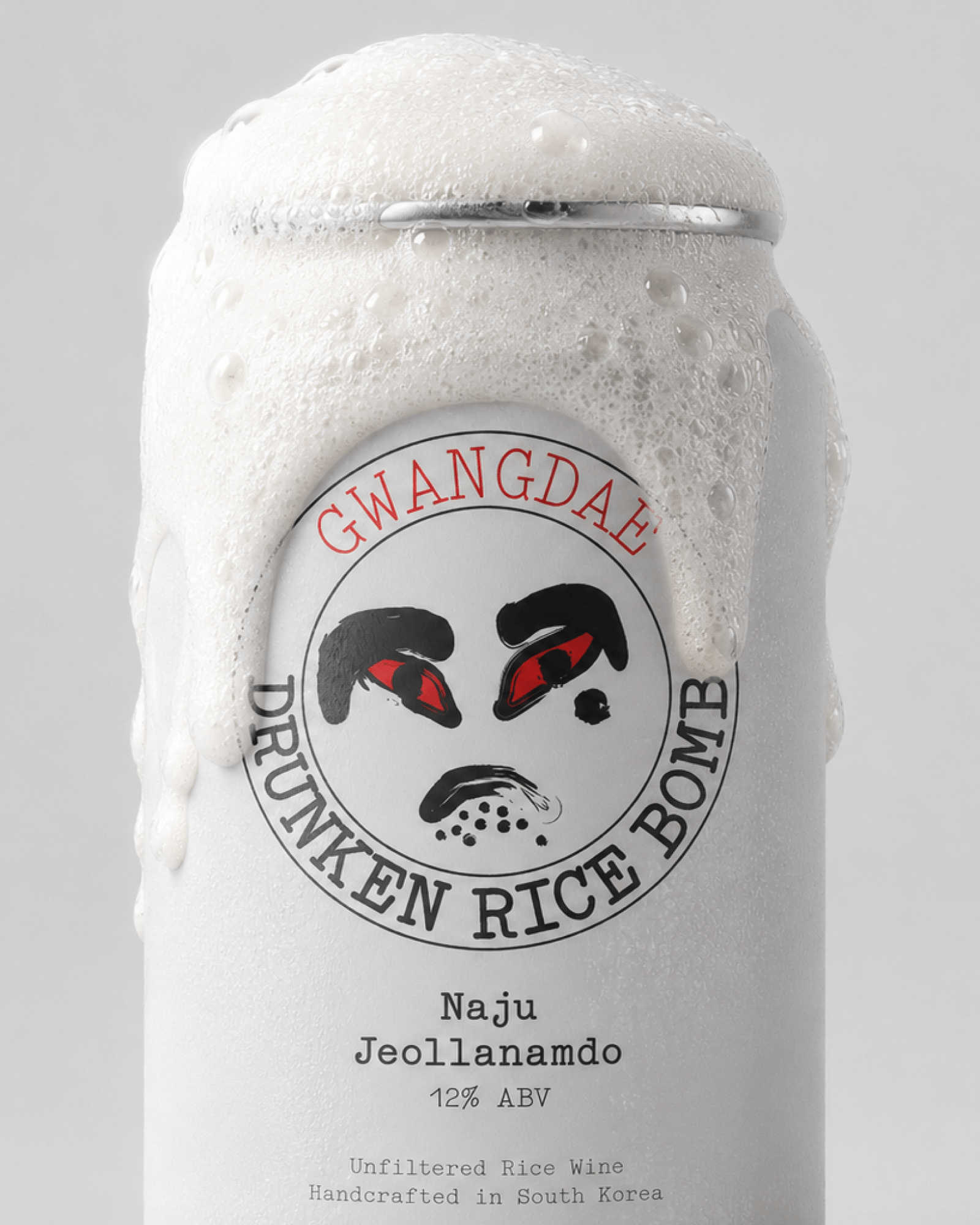
Drunken Rice Bomb — hero can shotdrunken/01.png · 21:9

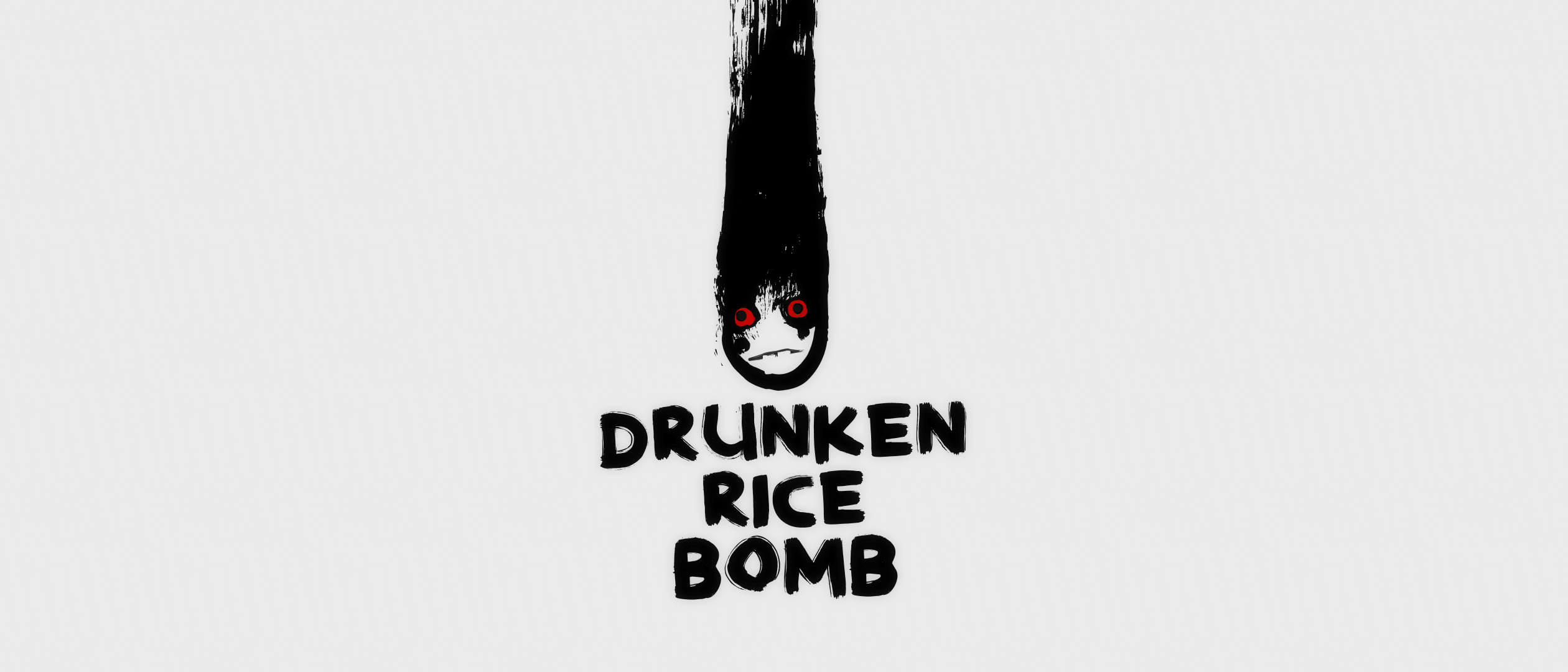
Ancient spirits, canned with a face.

Project
Drunken Rice Bomb · Self-initiated
Category
Brand Identity · Packaging
Scope
Identity · Art Direction

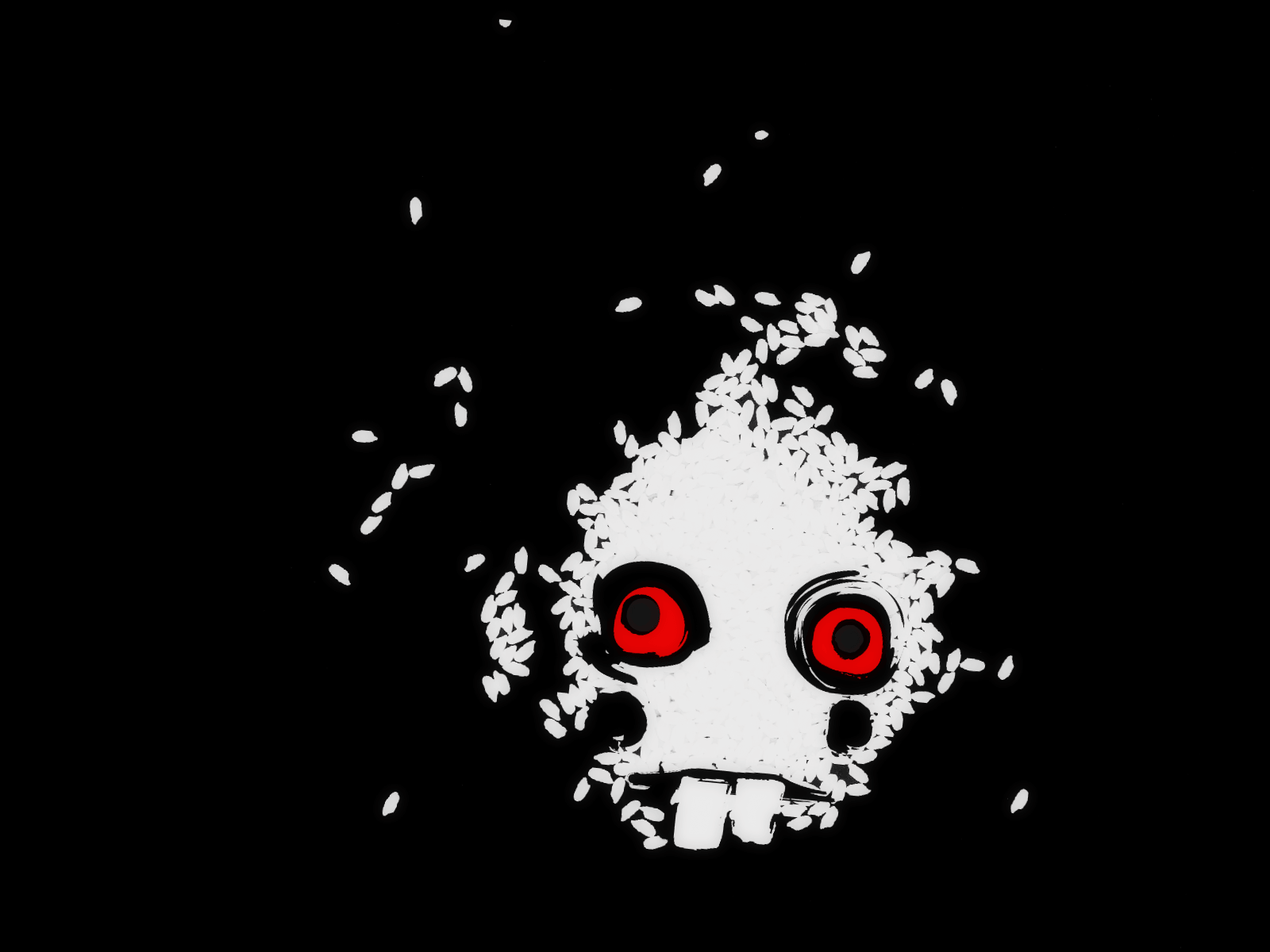
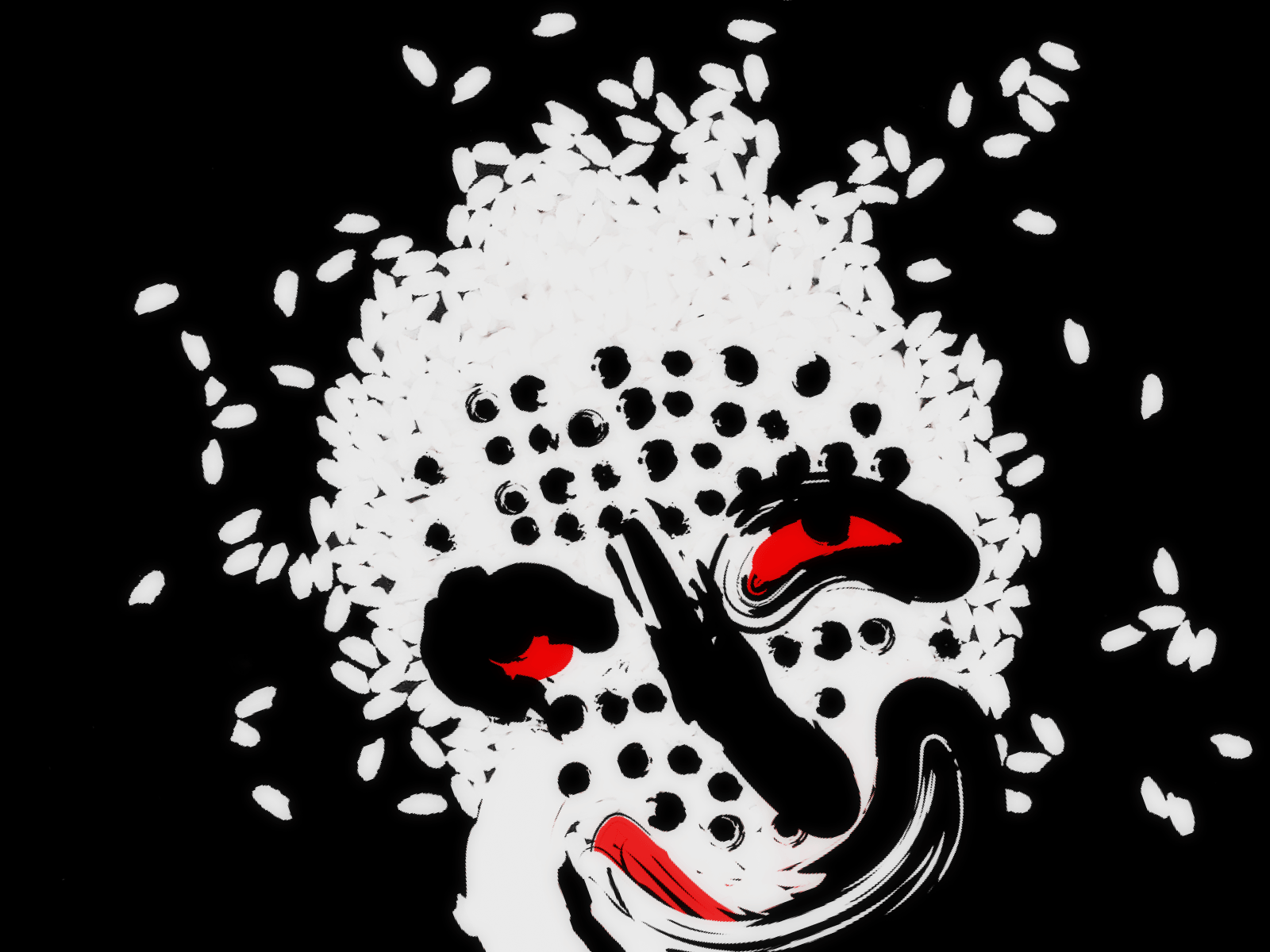
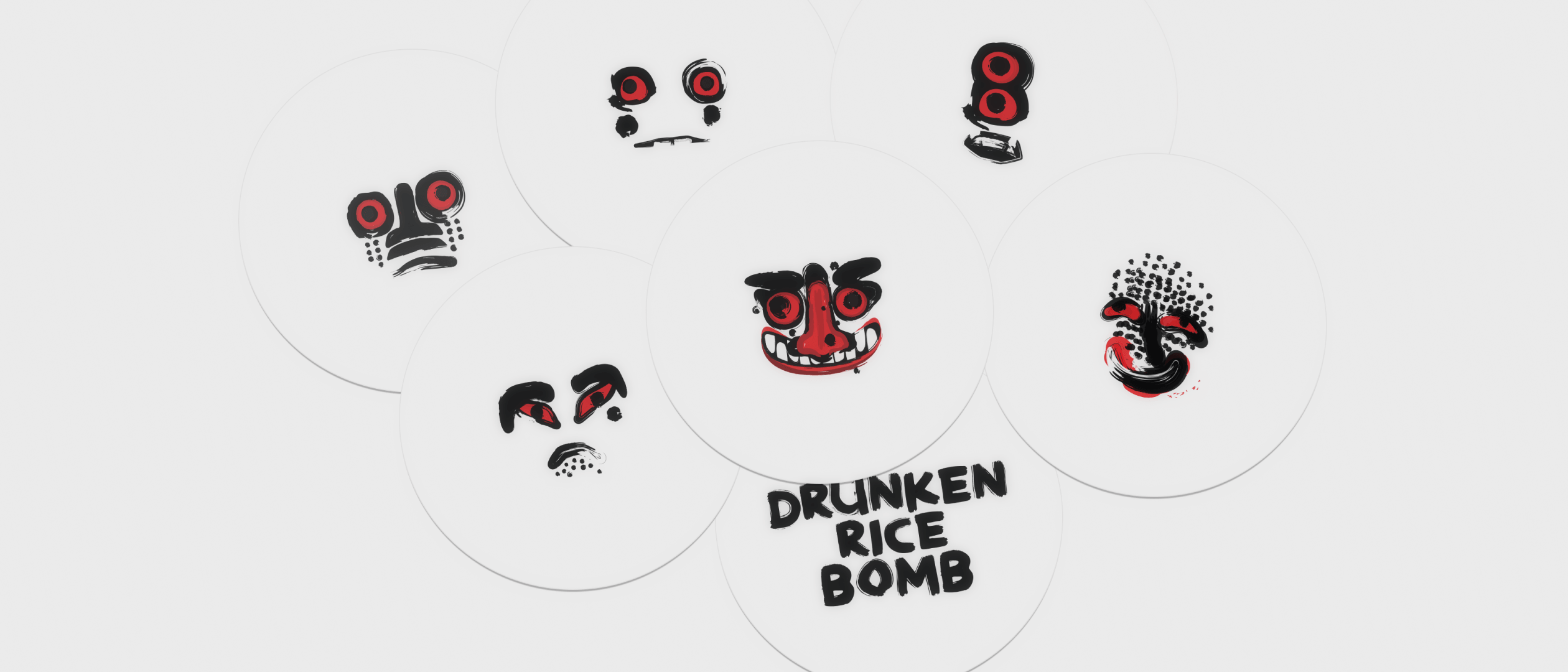
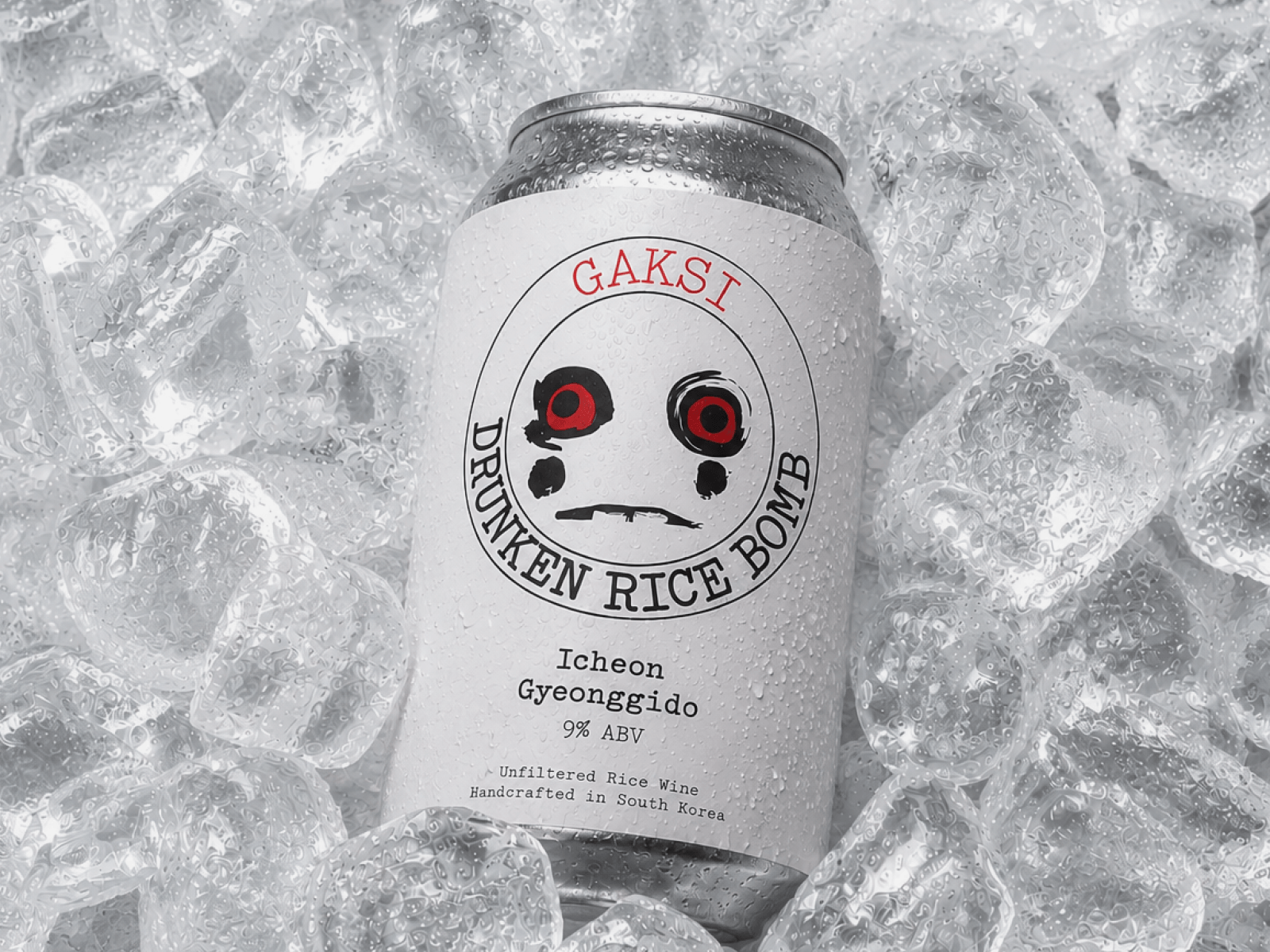
Drunken Rice Bomb is a self-initiated brand identity for makgeolli, Korea's oldest rice wine. The goal: introduce it to a global, younger audience without flattening what makes it Korean. Six cans, six rice-harvesting regions, six traditional folk spirits — one mask for each.

Masks made to scare,
and to protect.

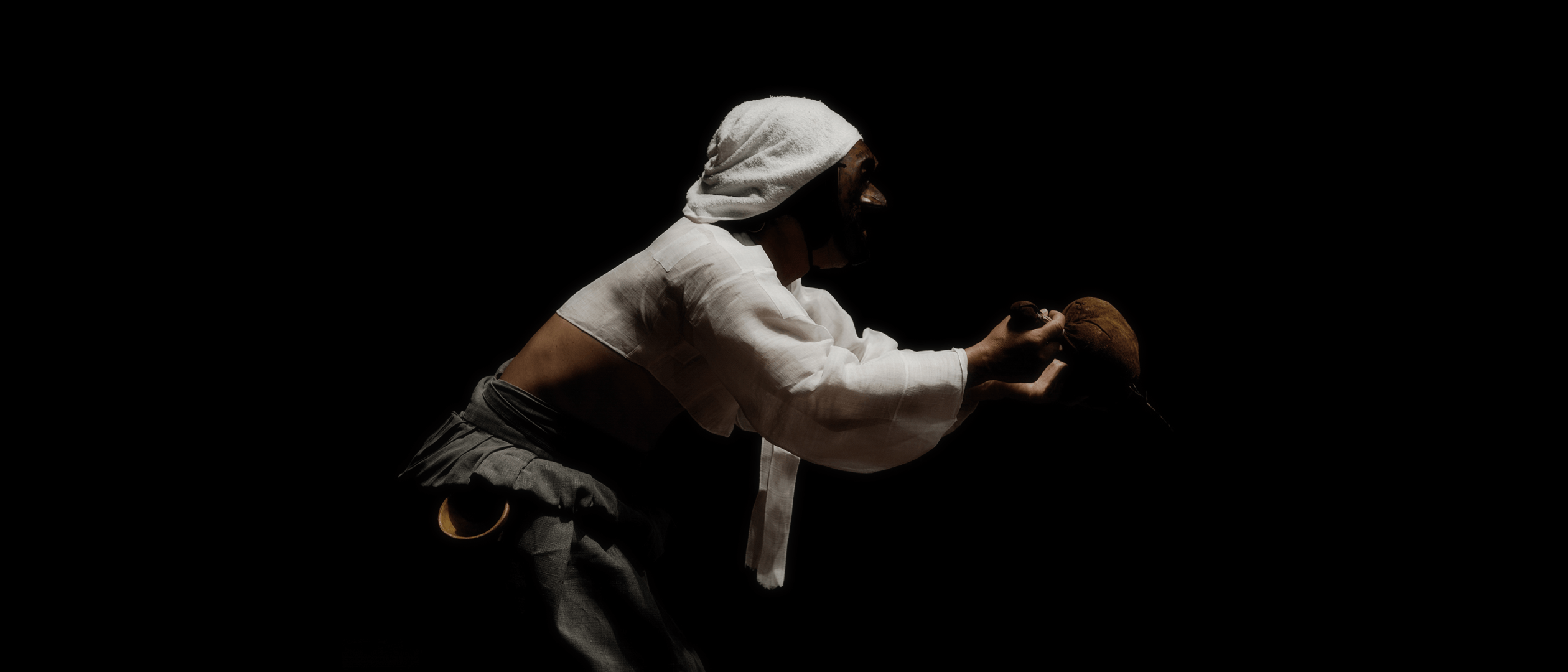
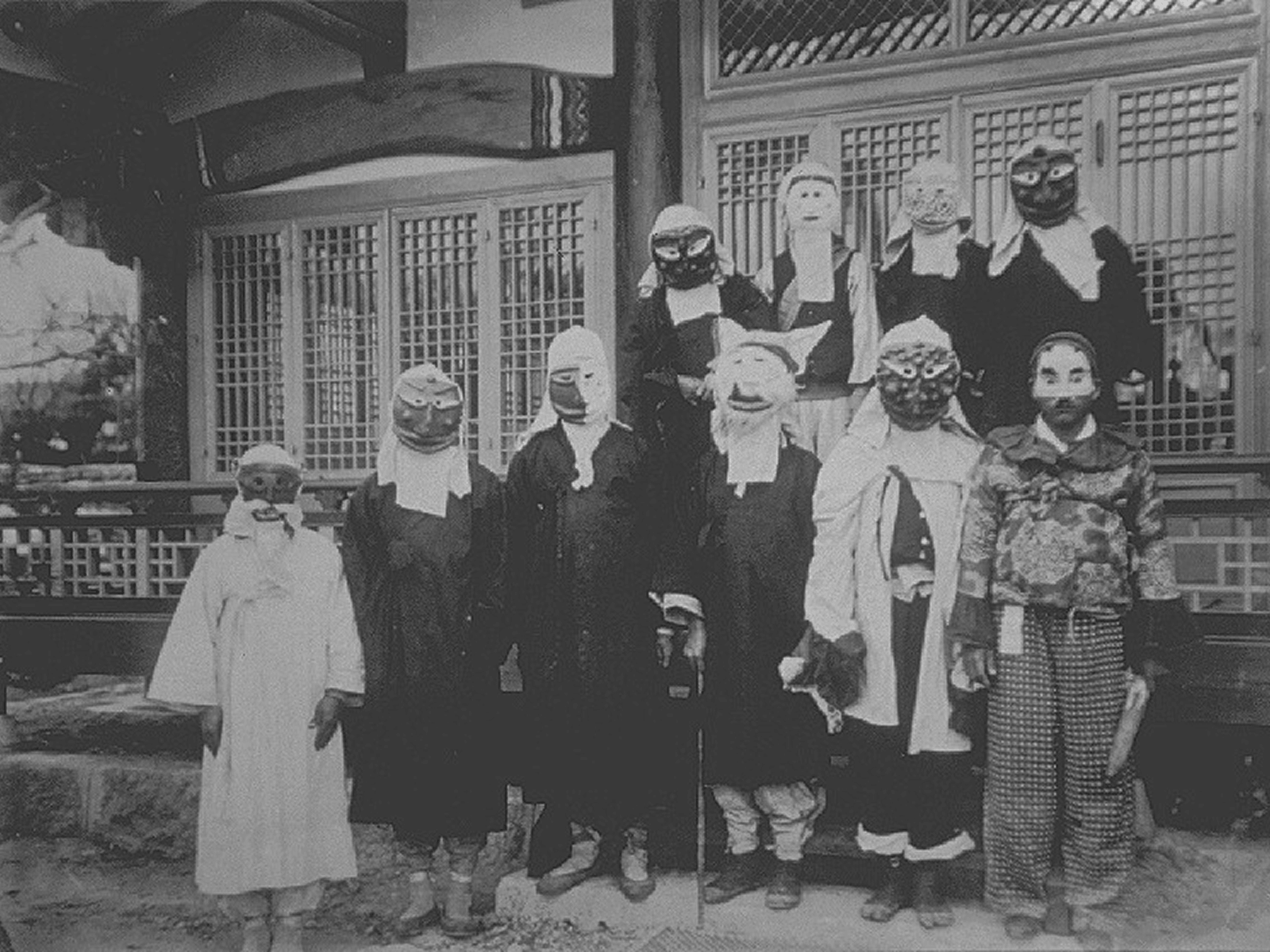
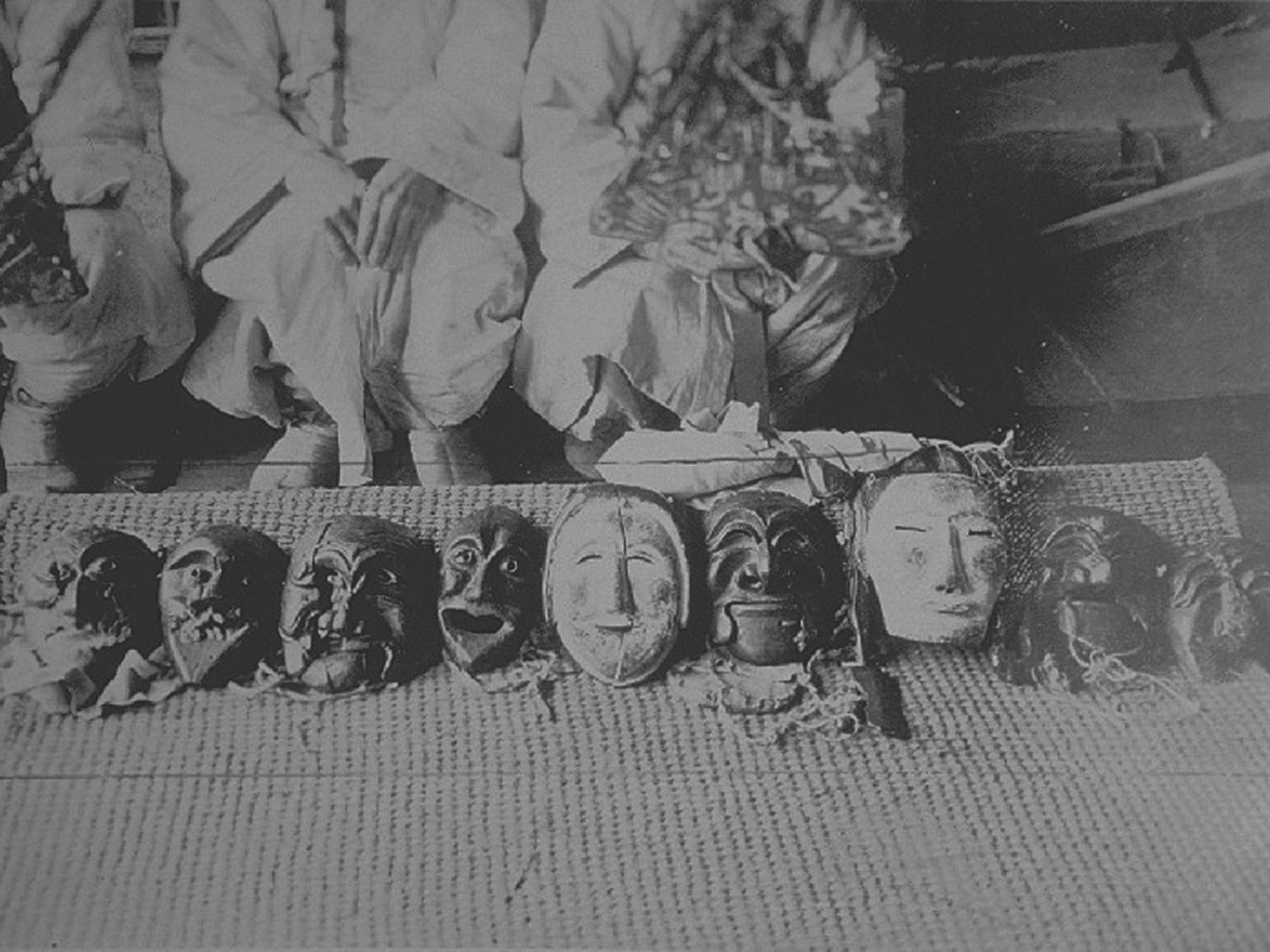
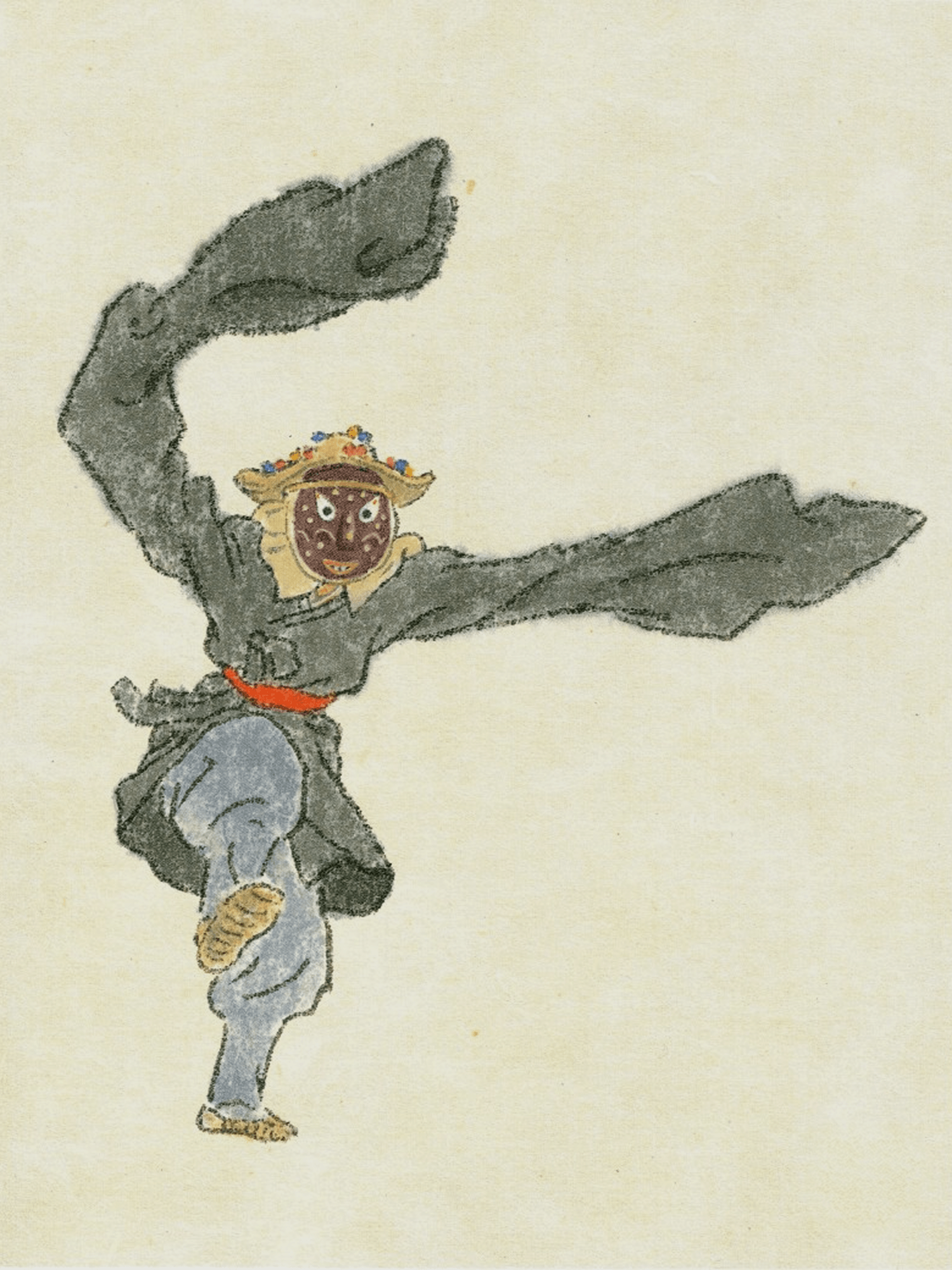
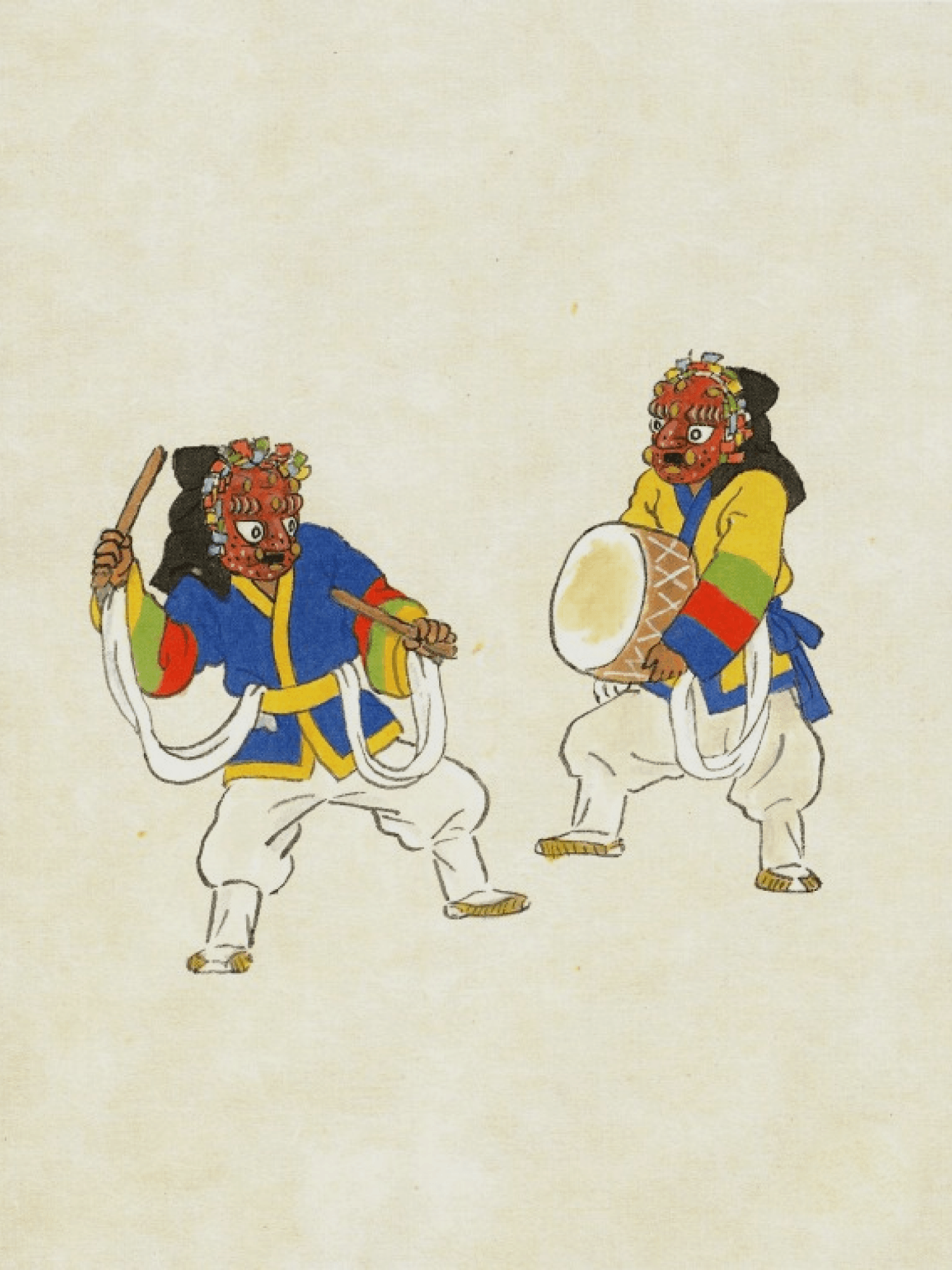
Like many other cultures, Korea has its share of superstitions and old beliefs — woven into villages, regions, the rhythms of the year. Ancient Koreans carved wooden masks of local spirit figures and wore them in ritual ceremonies and theatrical performances. The faces were extremely bizarre and grotesque on purpose — meant to ward off evil spirits, and to bring good fortune to families and neighbors. Drunken Rice Bomb borrows that same logic, pairing six rice-harvesting regions with six of their traditional folk spirits, one mask for each.

Traditional Korean folk masks — wooden, hand-carveddrunken/02.png · 21:9
Original mask photograph — bizarre, grotesque, beautifuldrunken/03.png · 4:3
Ritual or performance context — masks in usedrunken/04.png · 4:3
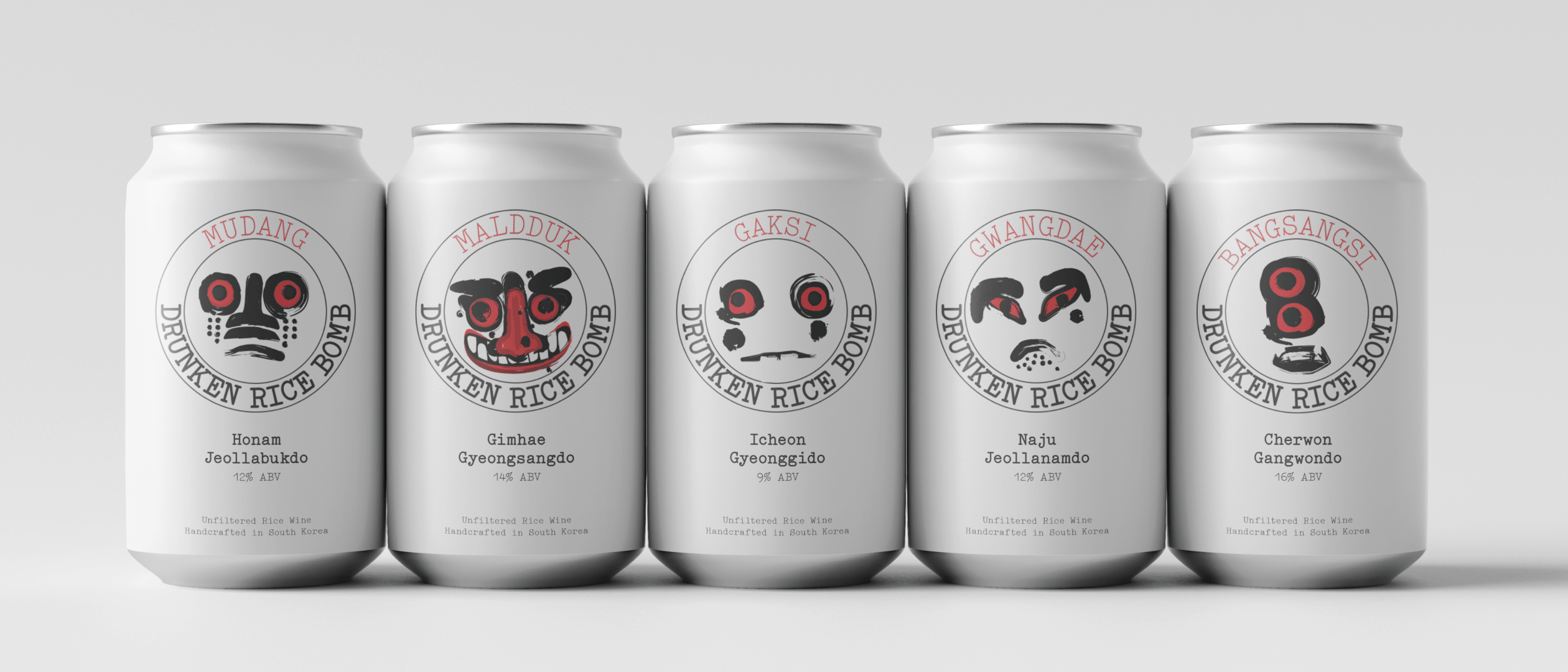
Can series — all six regional masks lined updrunken/05.png · 3:4
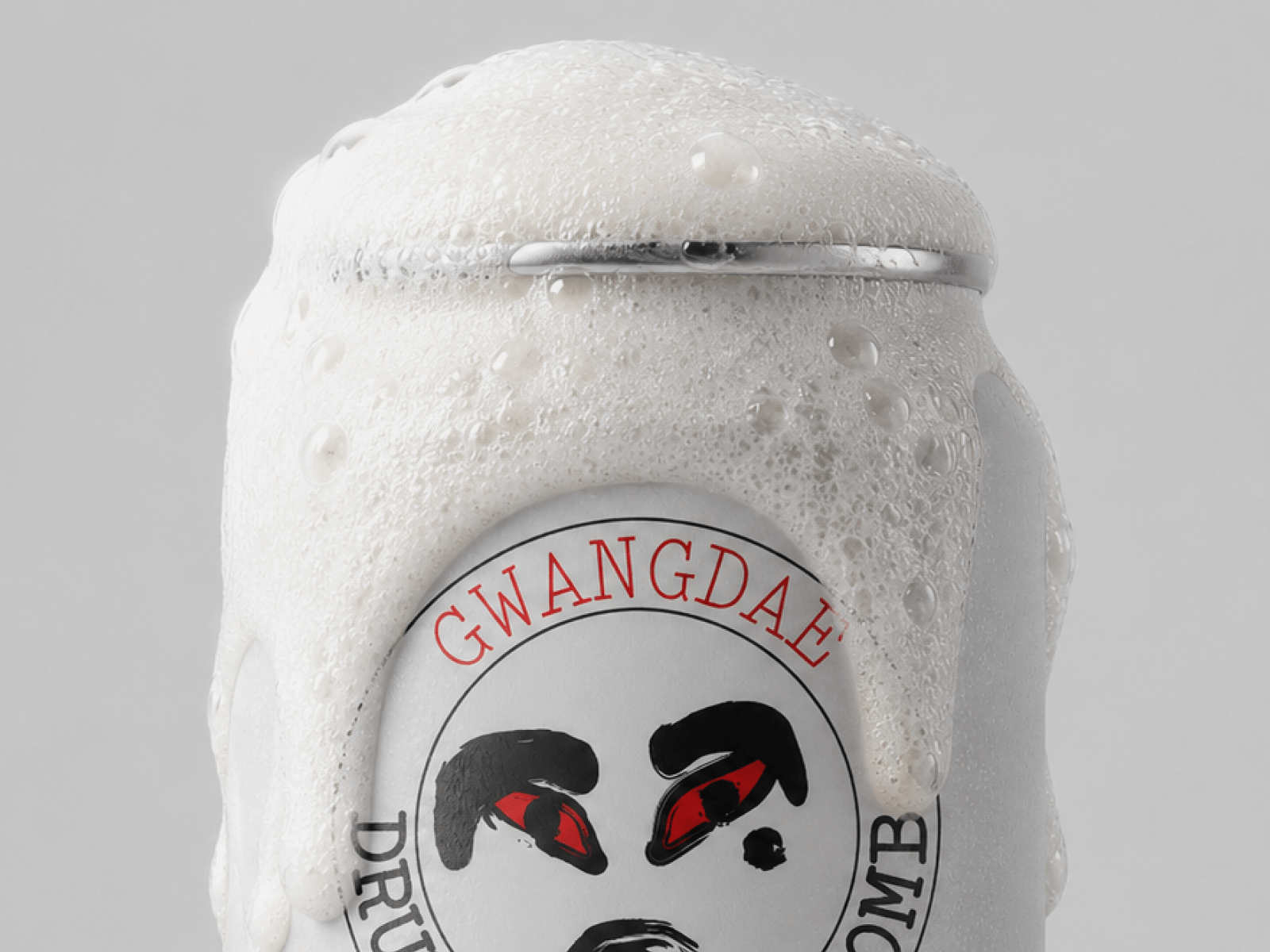
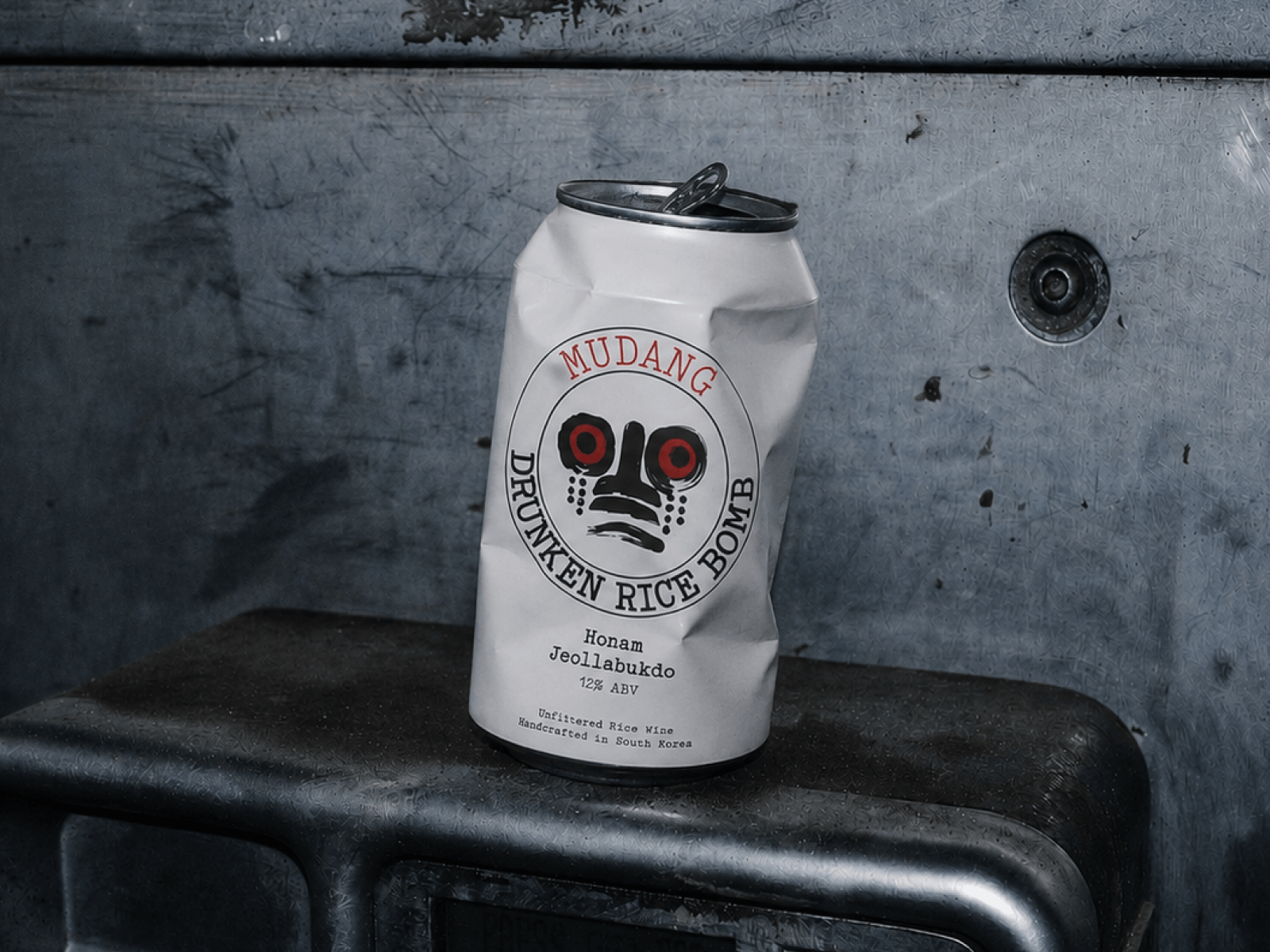
Individual can hero — close-up with full label detaildrunken/06.png · 3:4

Six regions,
six faces.

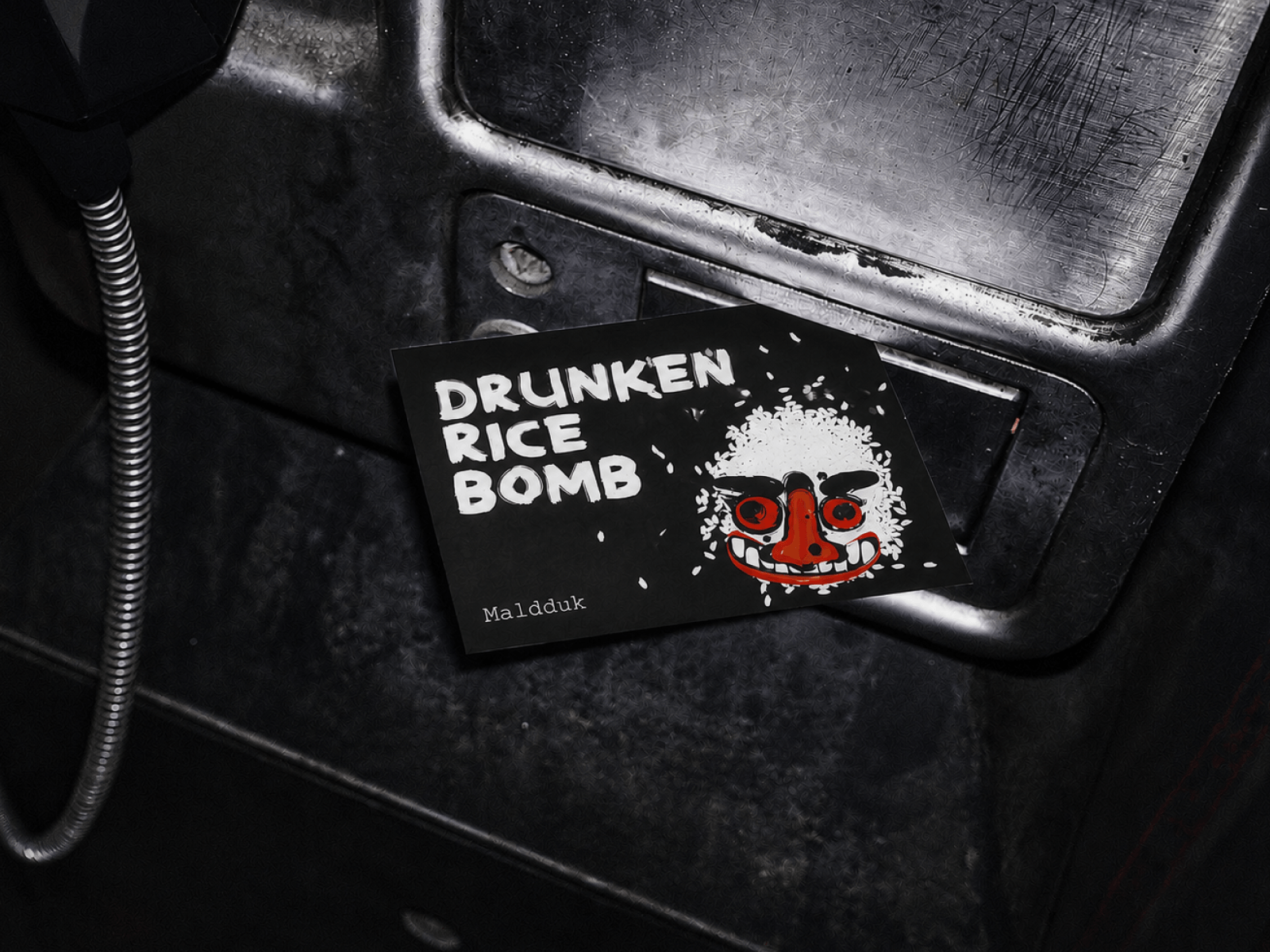
The system pairs one mask with one region with one rice. Gaksi for Icheon, Mabu for Nonsan, Bangsangsi for Cheorwon, Maldduk for Gimhae, Mudang for Honam, Gwangdae for Naju. Together the collection reads as one visual world — bold color, flat graphic language, masks that meet your eyes straight on. Apart, each one holds its own story.

Drunken Rice Bomb — detaildrunken/07.png · 4:3
Drunken Rice Bomb — detaildrunken/08.png · 4:3
Drunken Rice Bomb — wide shotdrunken/09.png · 21:9
Drunken Rice Bomb — wide shotdrunken/10.png · 21:9
Drunken Rice Bomb — detaildrunken/11.png · 4:3
Drunken Rice Bomb — detaildrunken/12.png · 4:3
Drunken Rice Bomb — wide shotdrunken/13.png · 21:9
Drunken Rice Bomb — detaildrunken/14.png · 4:3
Drunken Rice Bomb — detaildrunken/15.png · 4:3

A little good
fortune, with a buzz.

The masks did their job for centuries. Drunken Rice Bomb hopes to carry a little of that forward — warding off the bad and welcoming the good, with a little buzz along the way.

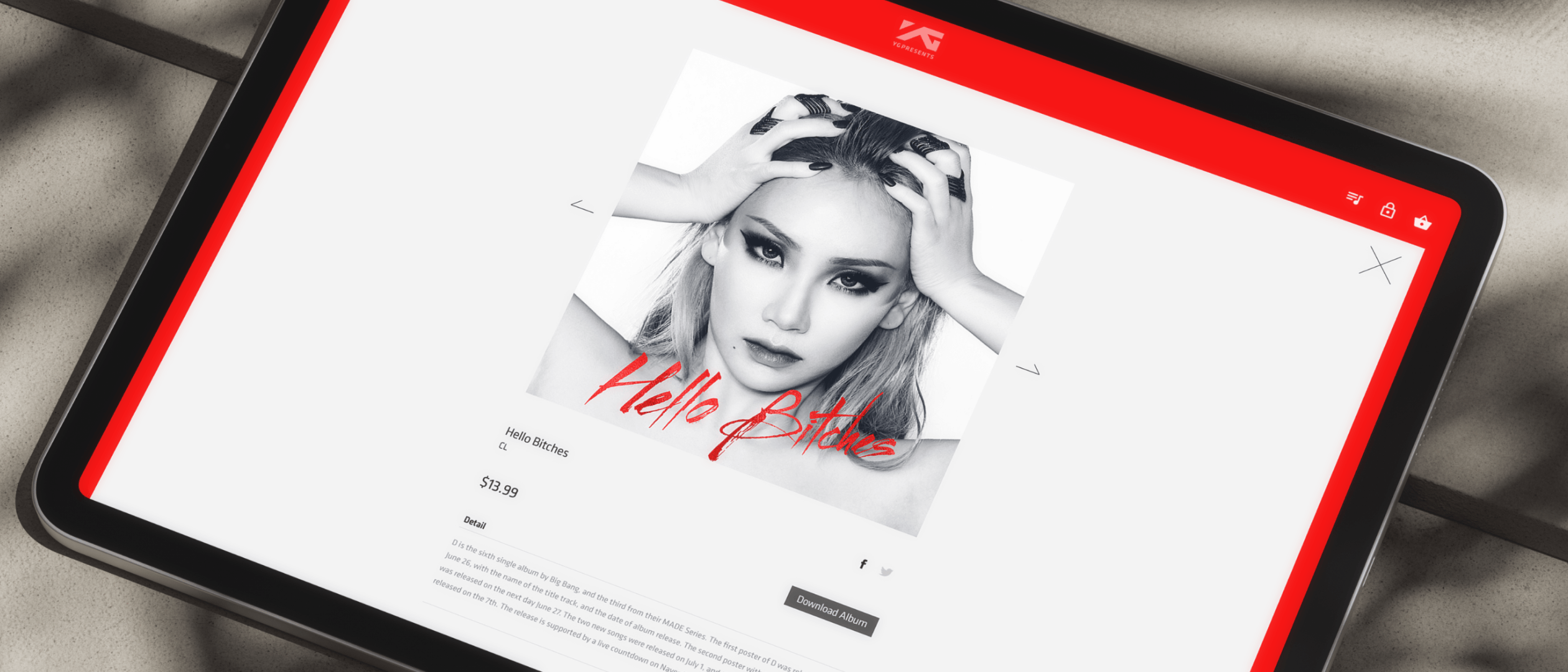
Miscellaneous brand work — hero compositionmisc/01.png · 21:9
Miscellaneous.

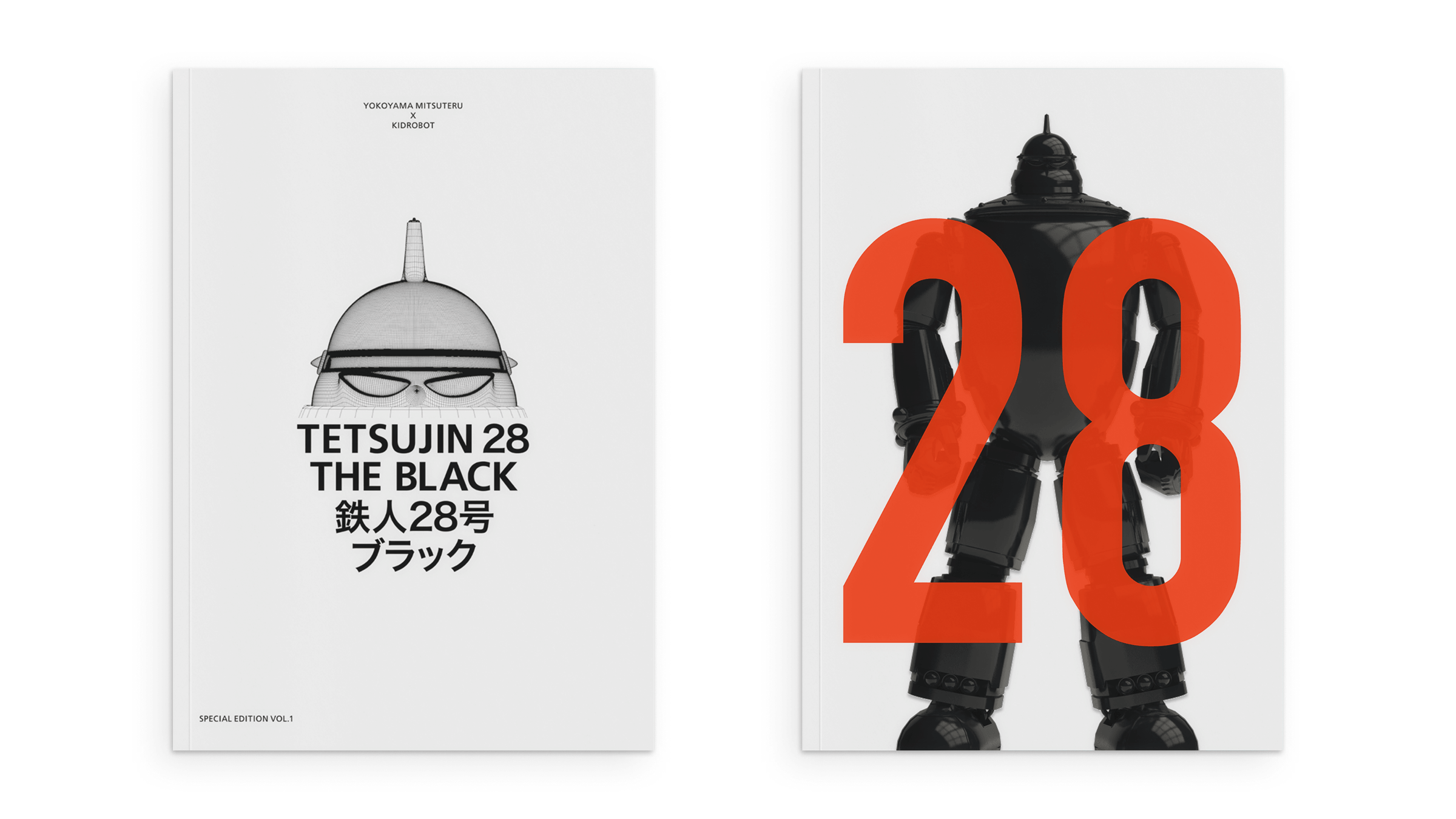
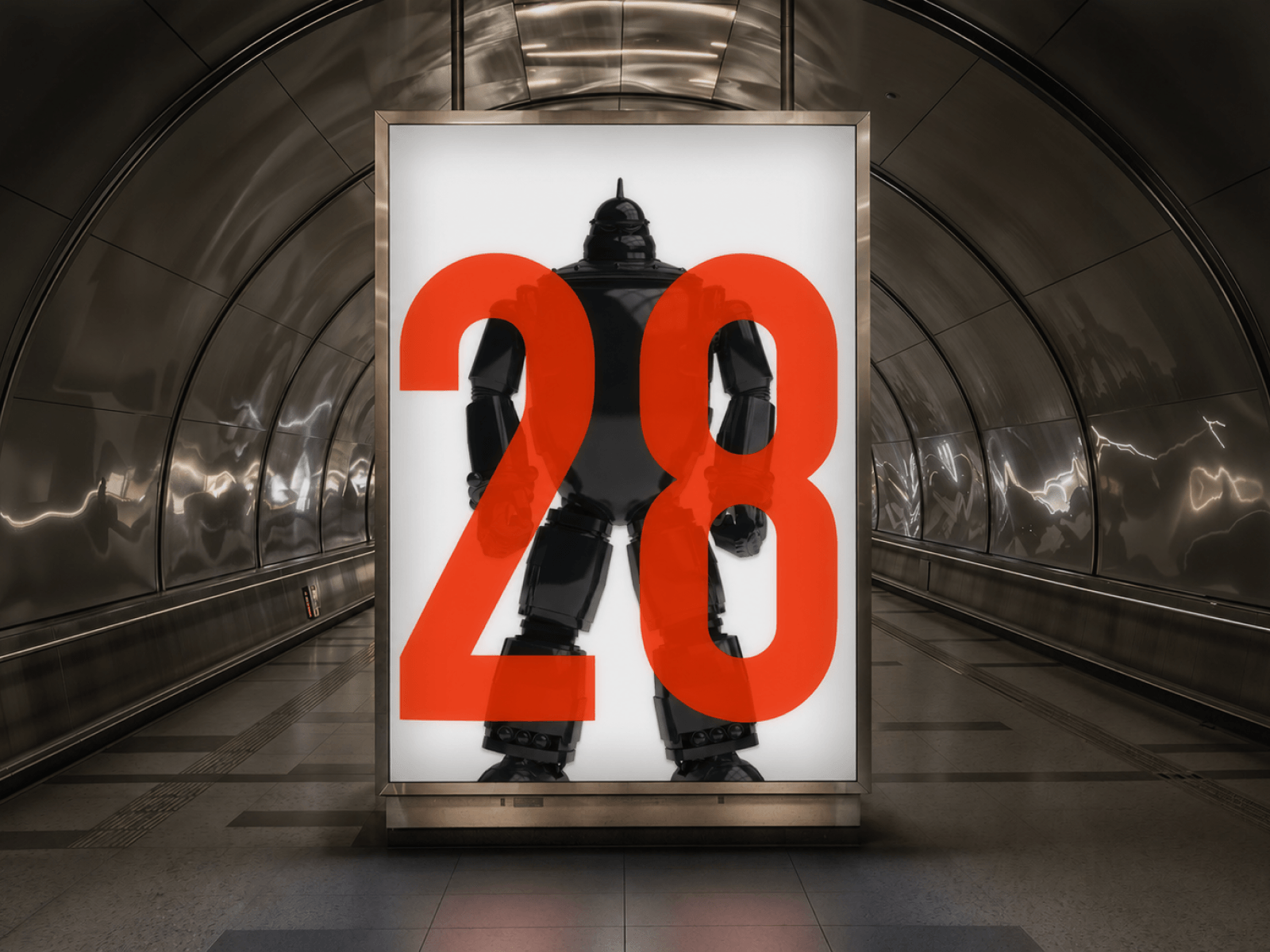
A wider look at brand work across industries — e-commerce, retail, advertising, hospitality, and publication. Different clients, different briefs, one approach: clear thinking, careful execution, a strong visual hand.

Featured brand work — full-widthmisc/02.png · 21:9
Brand work 02misc/03.png · 4:3
Brand work 03misc/04.png · 4:3
Brand work 04 — full-widthmisc/05.png · 3:1
Brand work 05 — full-widthmisc/06.png · 2:1
Brand work 06misc/07.png · 4:3
Brand work 07misc/08.png · 4:3
Brand work 08 — full-widthmisc/09.png · 16:9
Brand work 09misc/10.png · 4:3
Brand work 10misc/11.png · 4:3
Brand work 11 — full-width statement on darkmisc/12.png · 16:9
Brand work 12 — full-widthmisc/13.png · 21:9
Brand work 13misc/14.png · 4:3
Brand work 14misc/15.png · 4:3
Closing image — final strong piecemisc/16.png · 16:9

Always more to see
let's talk.

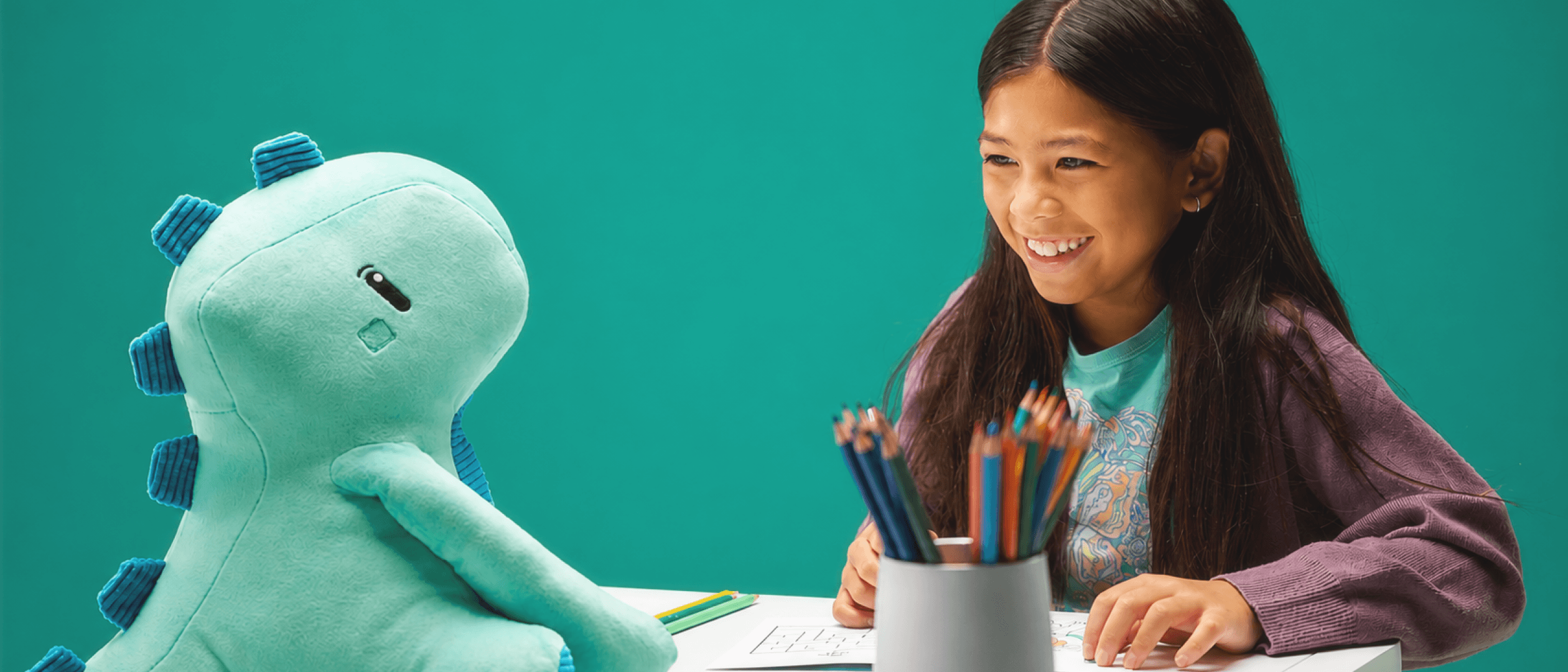
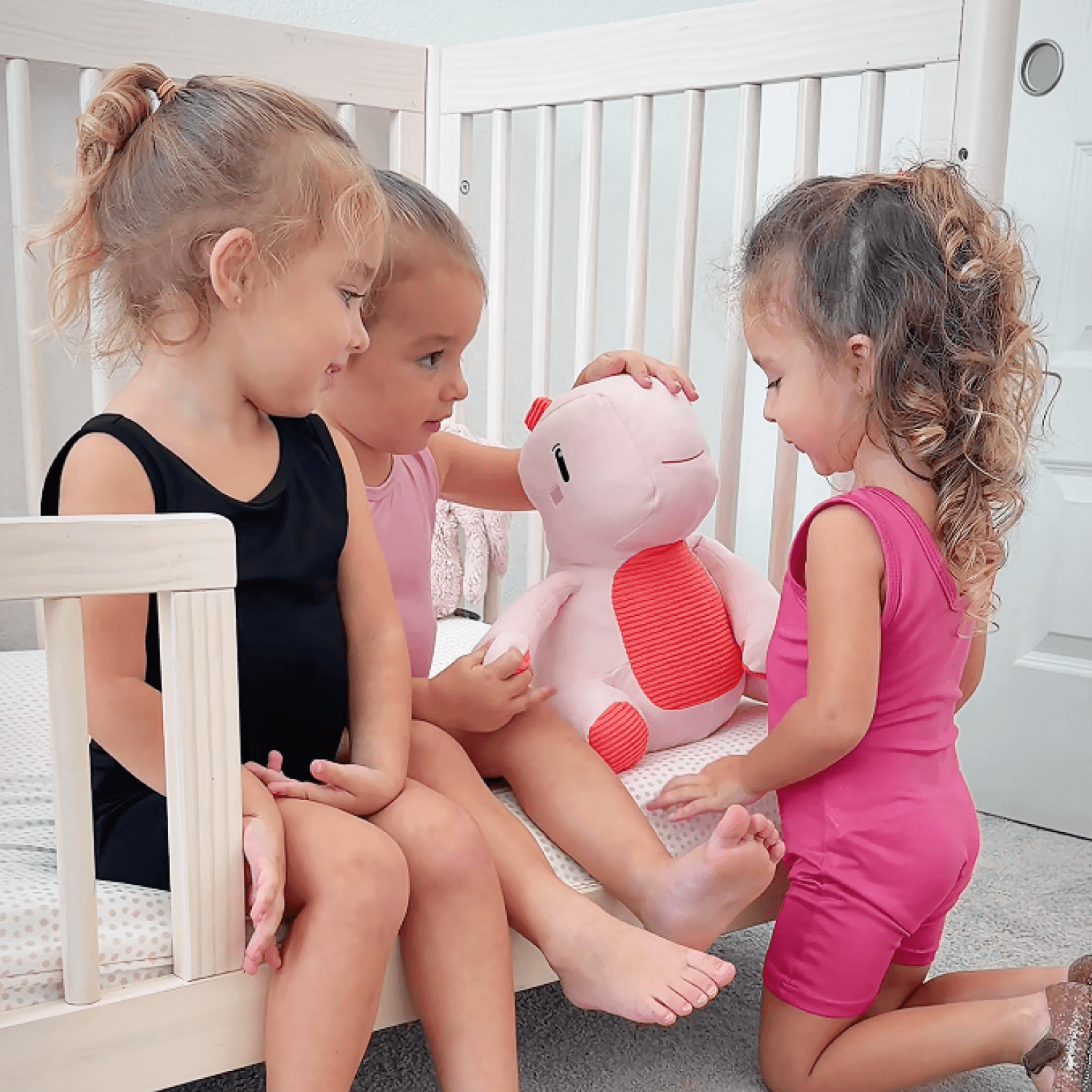
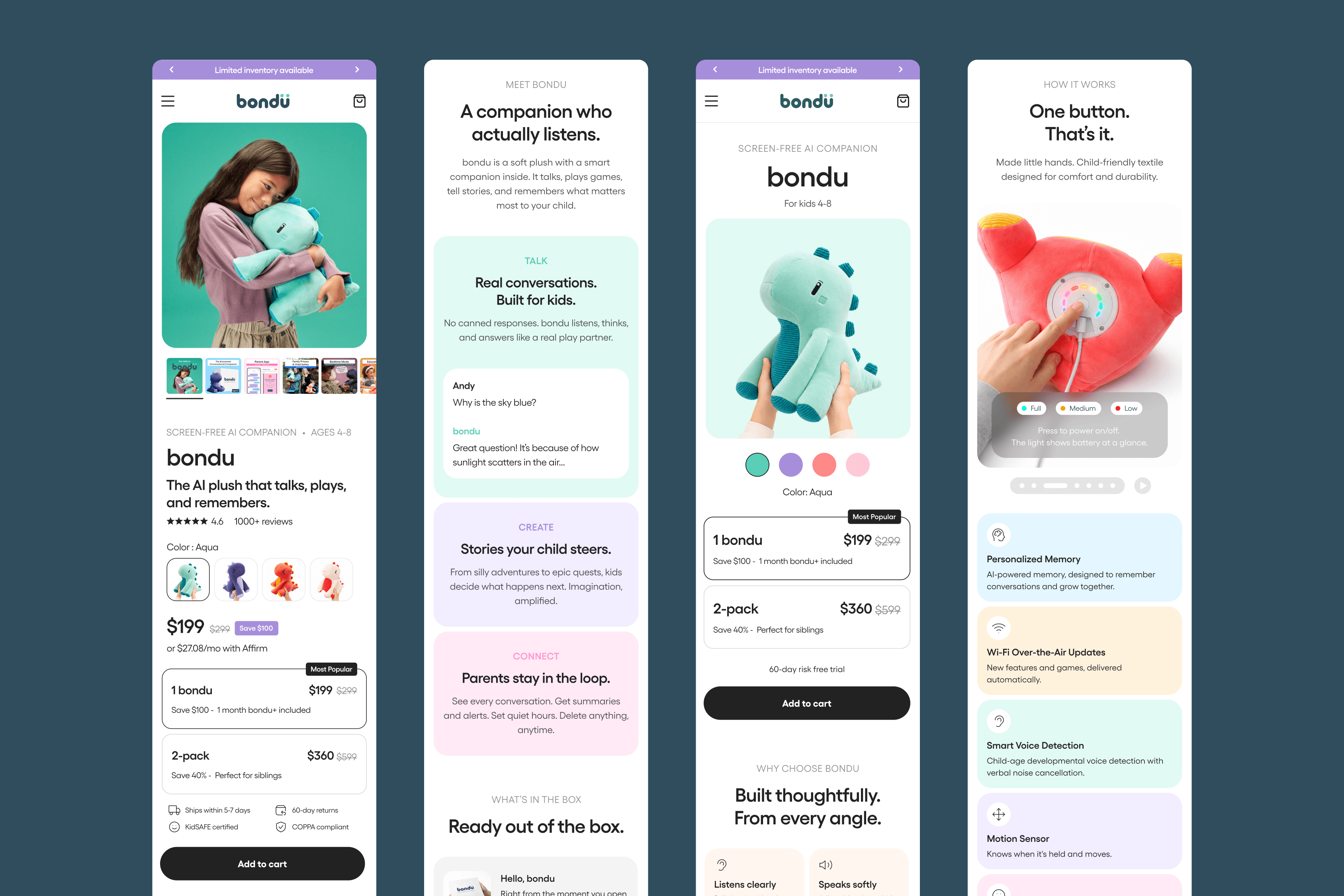
bondu toy and parent app in lifestyle contextbondu/01.png · 21:9

A parent's window into their child's first AI friend.

Year
2025 — 2026
Company
bondu · AI companion toy for kids 4–8
Role
Founding Designer · Design Lead
Scope
Mobile App · Brand · Web · Marketing

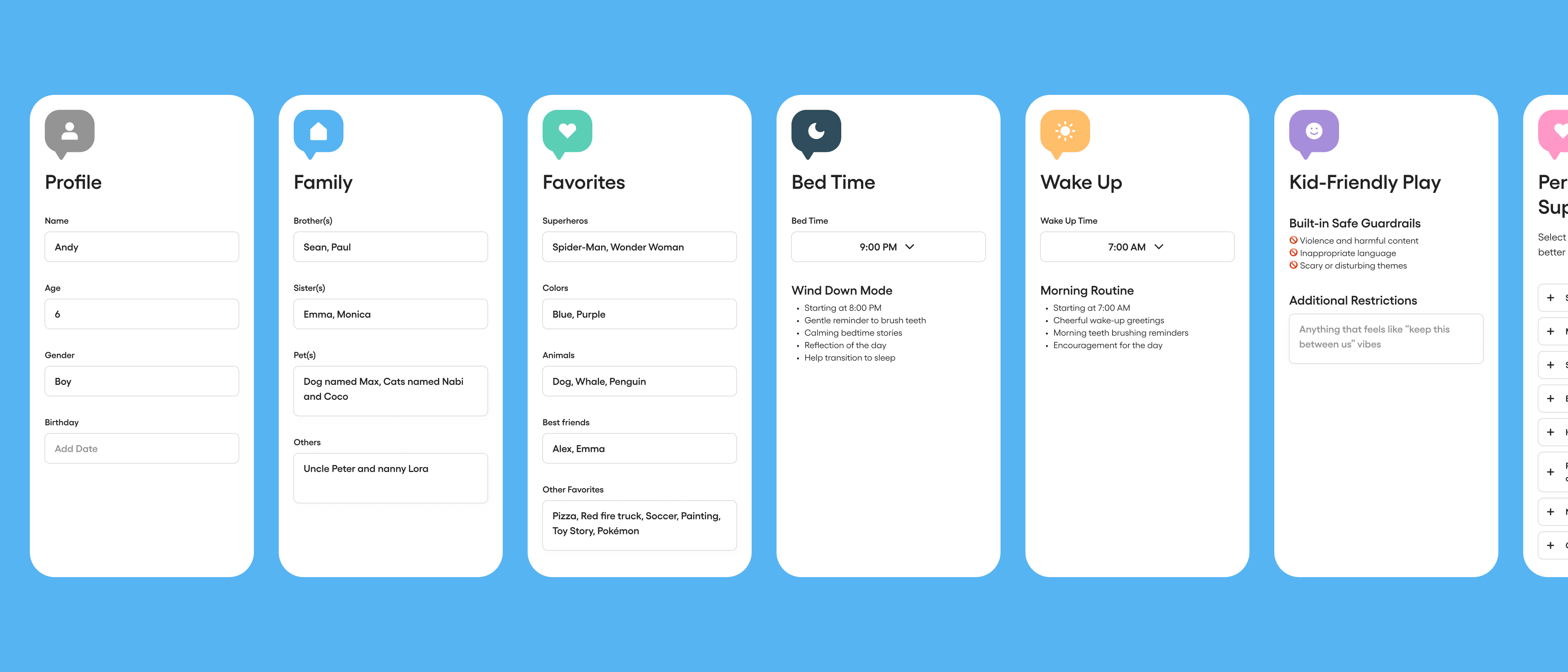
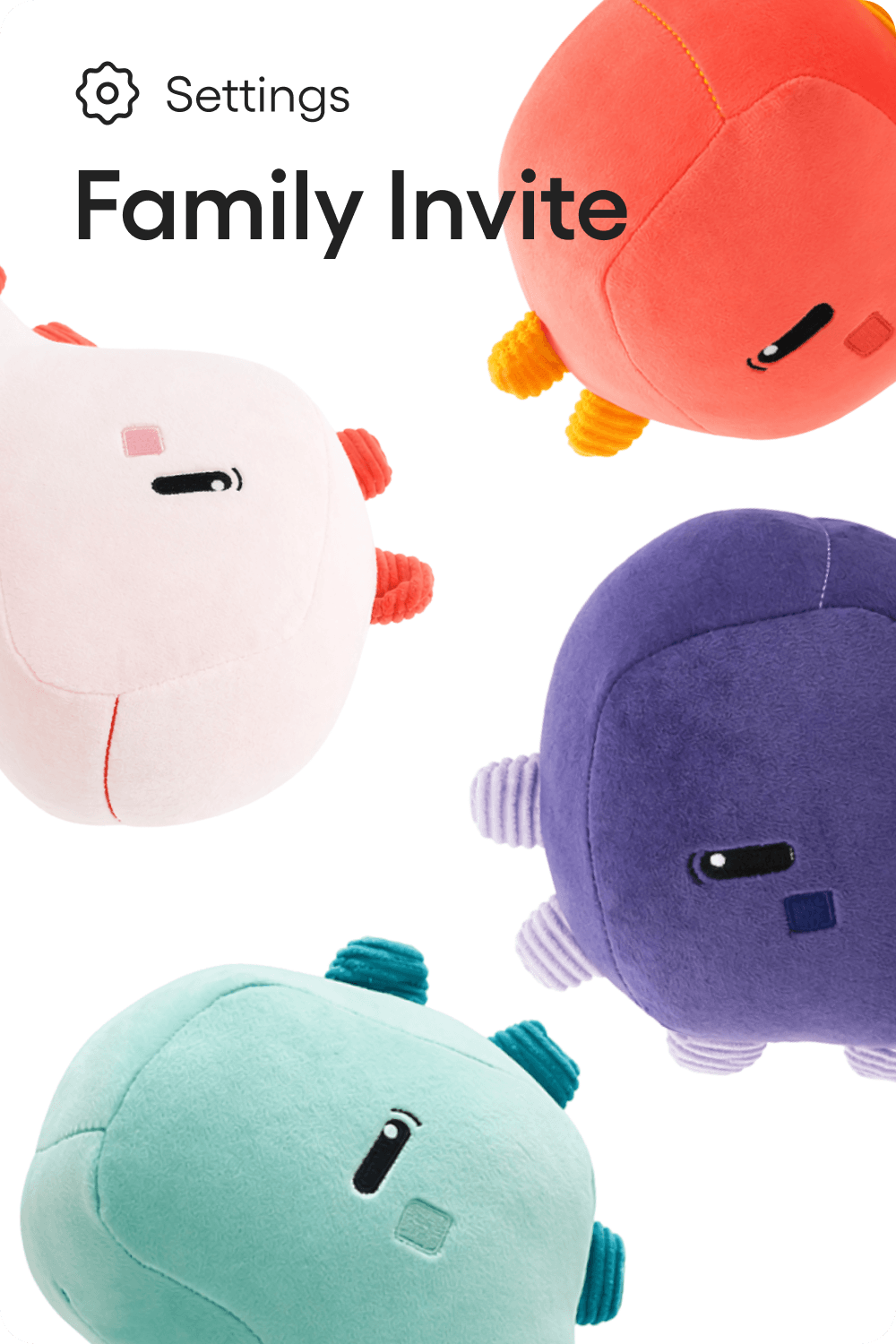
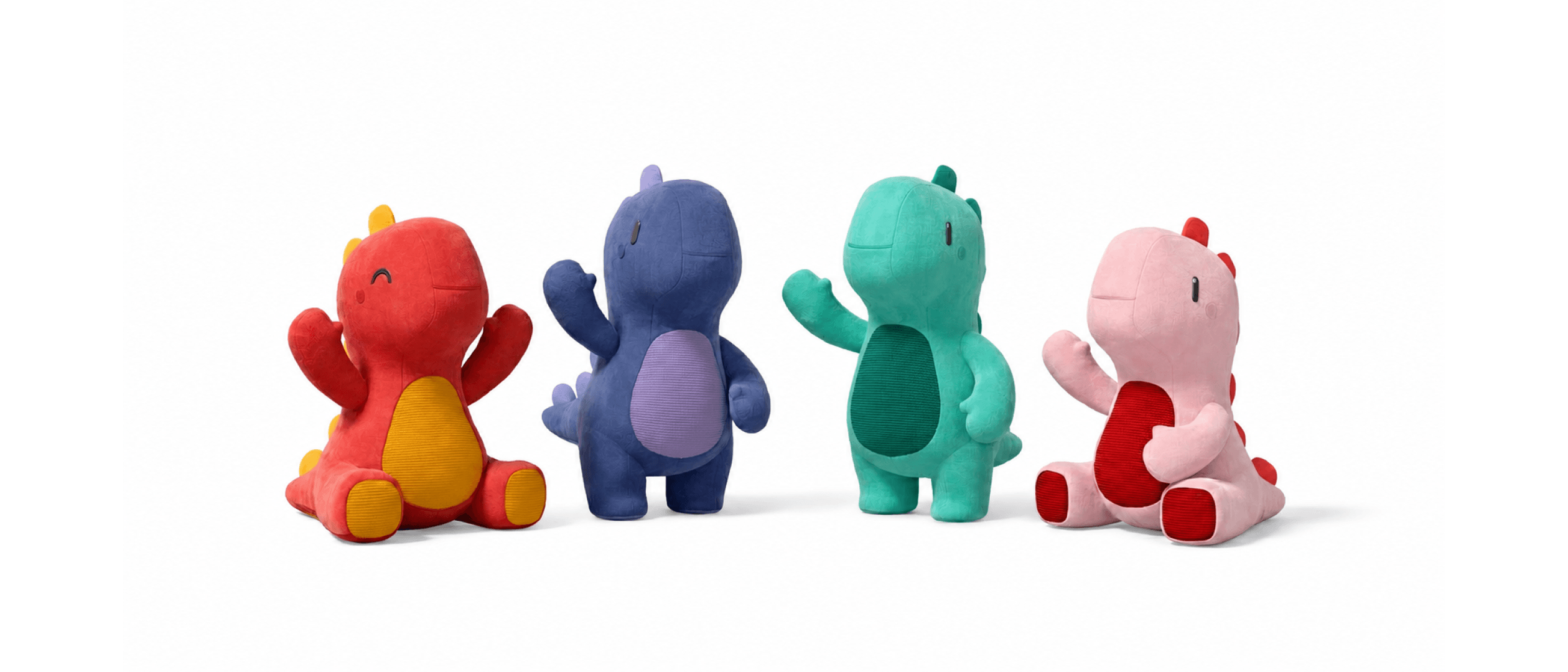
bondu makes an AI companion toy for kids ages 4–8, paired with a parenting app. The kid plays with the toy. The parent buys, sets up, watches, and guides. As founding designer, I led design across four phases of the business, end-to-end on every parent-facing surface: the app, the website, and beyond.

Launch. Sustain.
Build. Grow.

From a blank canvas to a subscription that 76.93% of users chose. Four phases shaped bondu's first chapter. Each one shipped one part of what bondu is today.

Phase 01
Launch
Parent app + design system, holiday shipping
Phase 02
Sustain
Subscription model, Free vs Plus
Phase 03
Build
North star research, habit-forming features
Phase 04
Grow
bondu.com redesign, marketing system
bondu overview — toy and parent app togetherbondu/02.png · 21:9

Building the bridge.

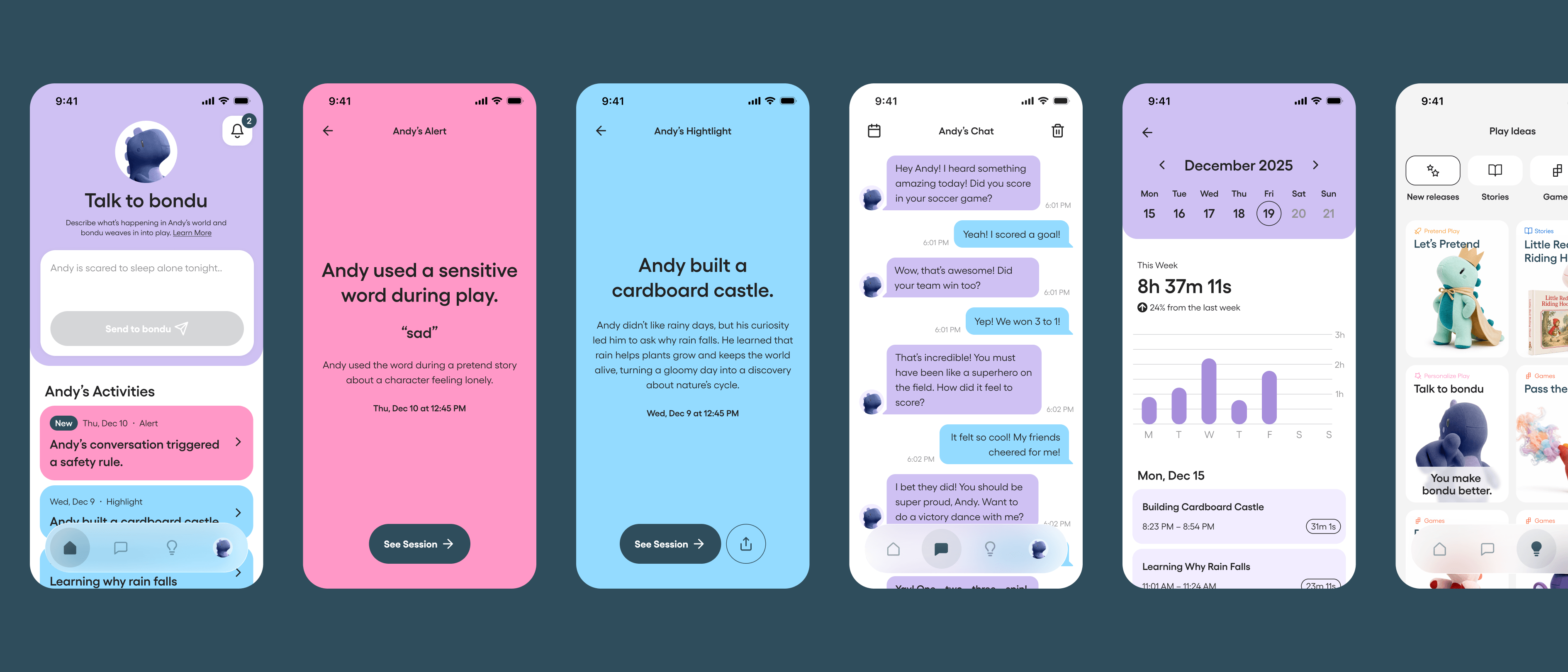
As the team's first designer, my main focus for the holiday launch was the parent app, end-to-end in four months. Onboarding, setup, dashboard, chat monitoring, settings, family sharing. The design foundation grew alongside — a system to tie every future feature together, so as bondu grew, it would still feel like one product.
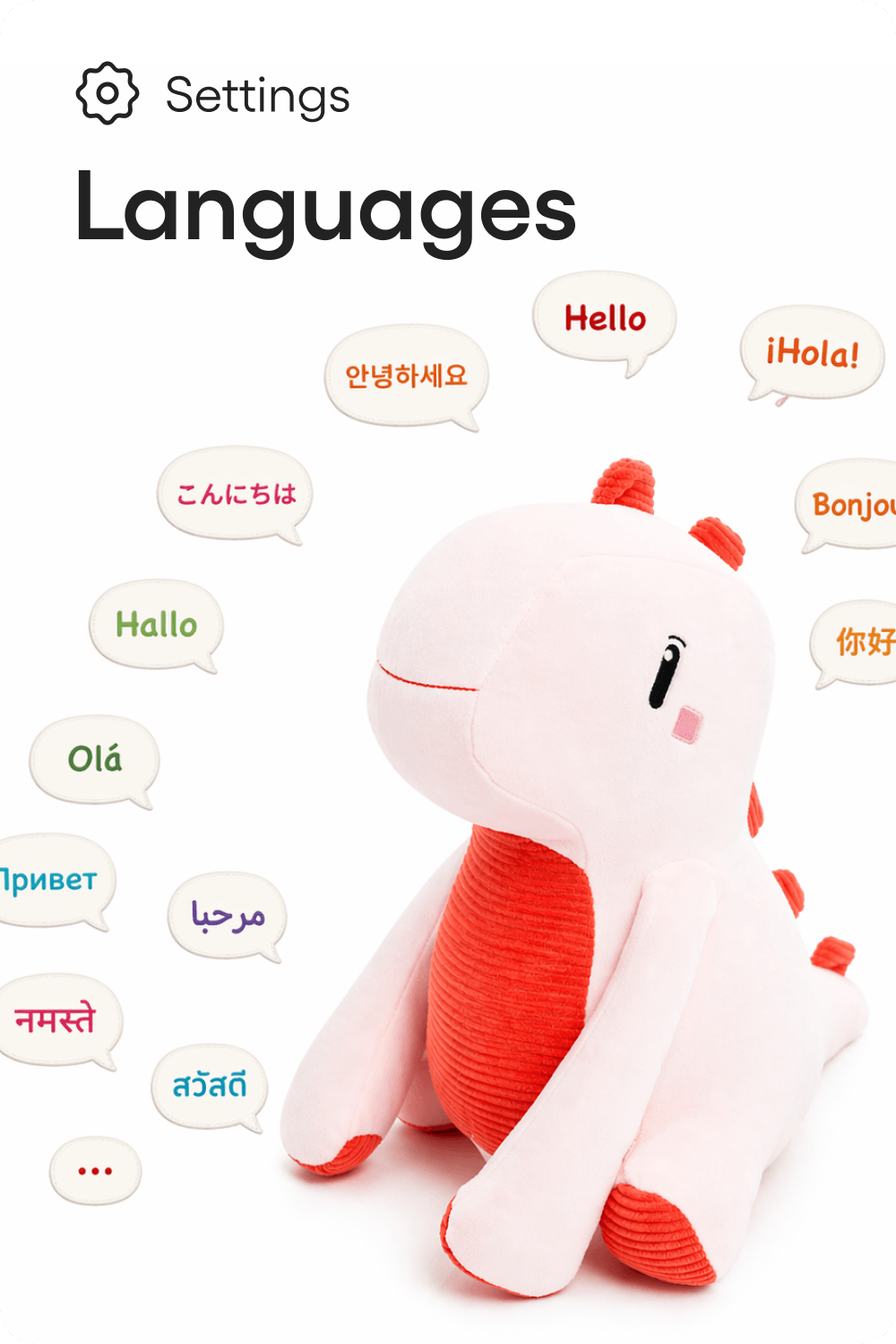
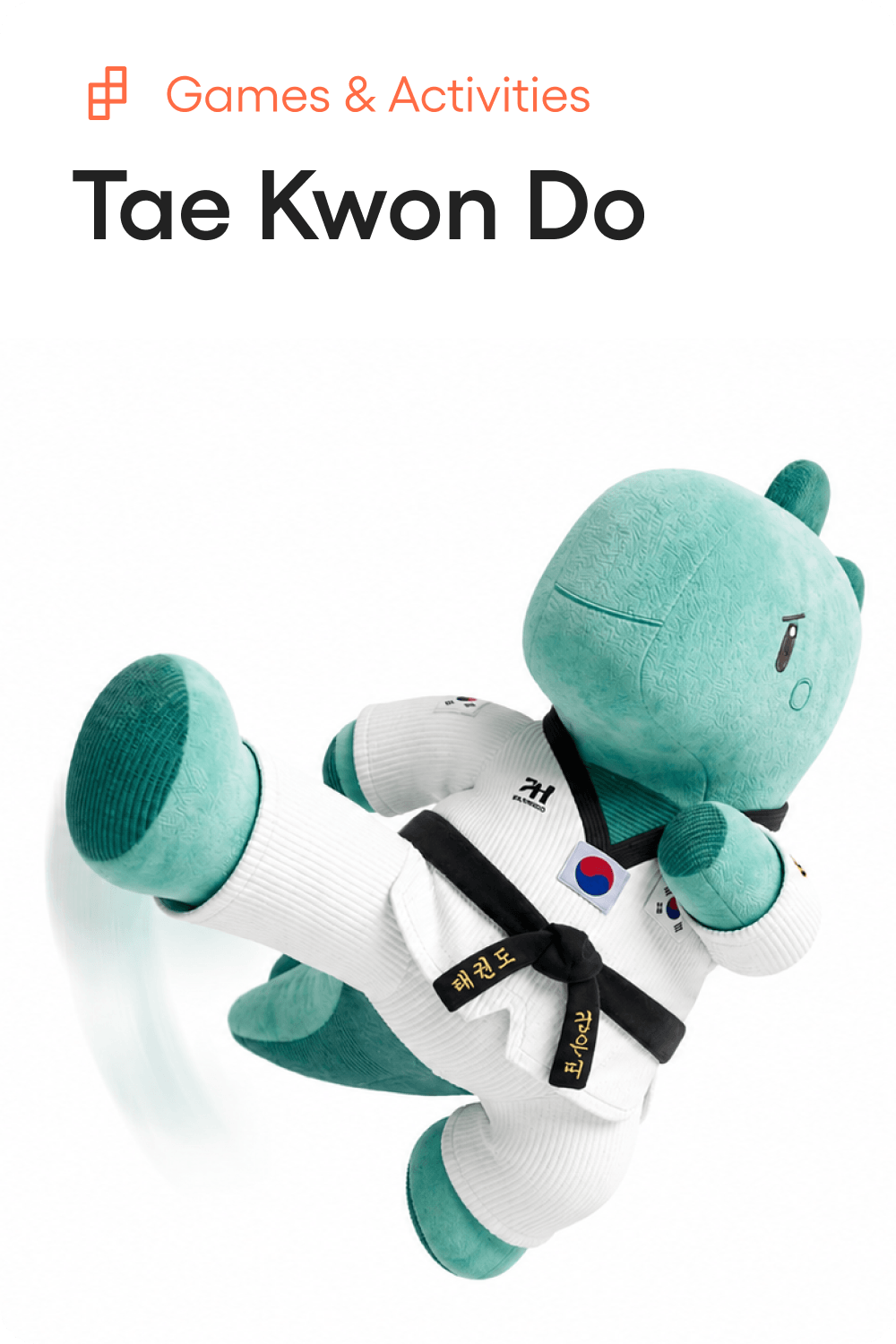
The entire bondu experience is COPPA-compliant, the US child-safety standard. Every play conversation runs through safety filters. And through the app, parents can monitor chat, get summaries and alerts, set guardrails, and delete anything anytime. Safety, accessibility, and usability — the three principles behind every design decision.

Parent app — onboarding flowbondu/03.png · 21:9
Parent app — chat monitoring + guidance UIbondu/04.png · 21:9
Family dashboardbondu/05.png · 21:9

A business that can
carry the cost of AI.

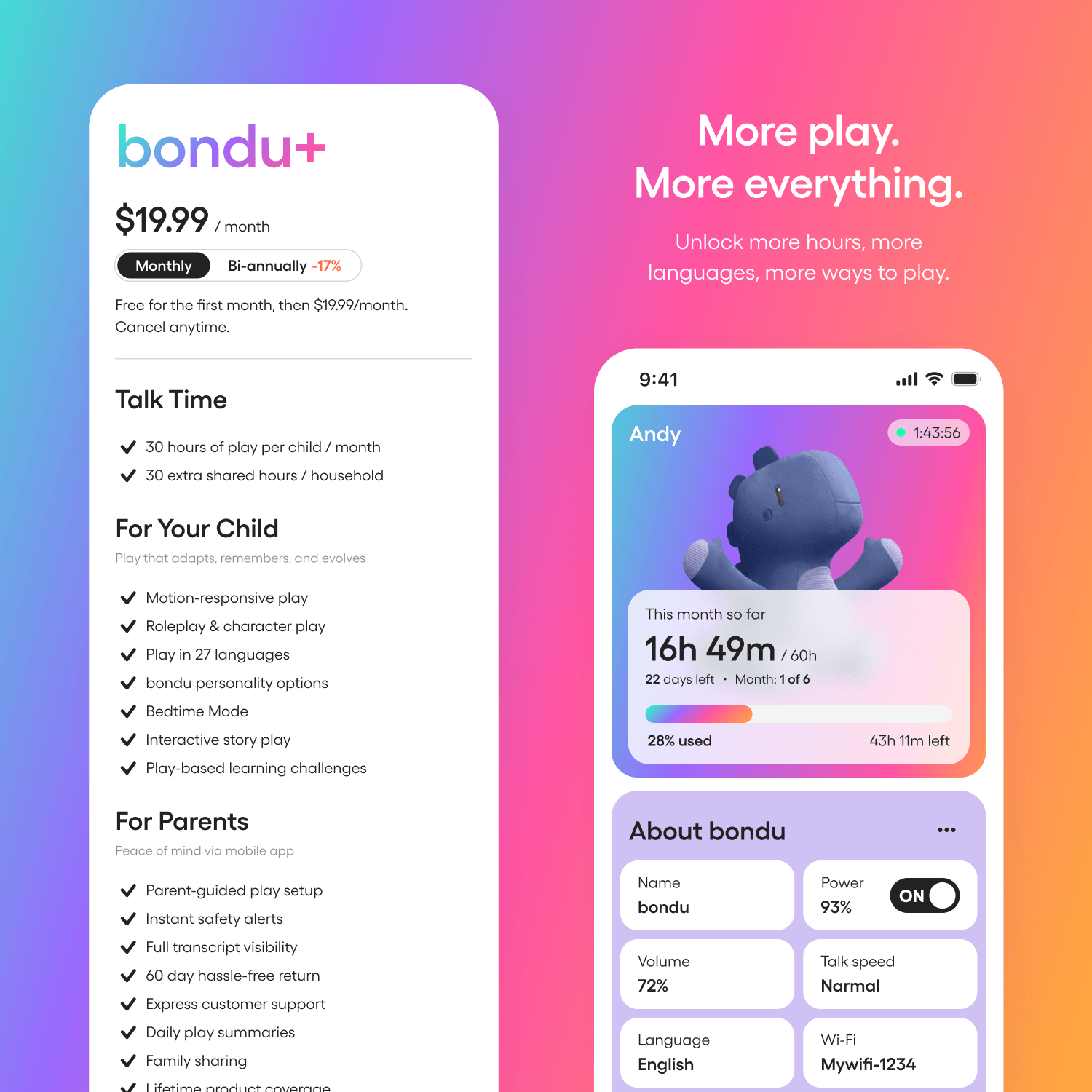
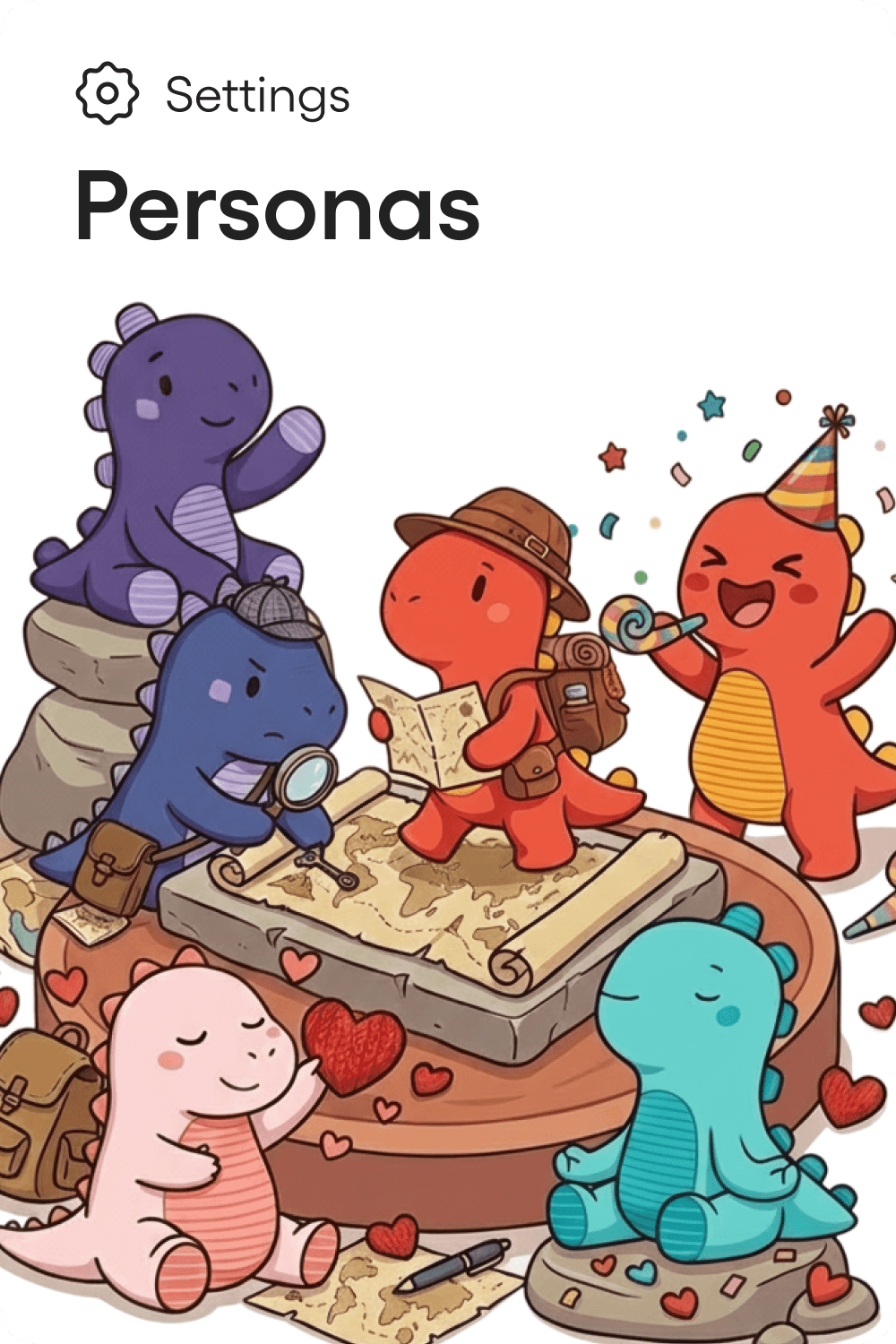
AI doesn't run for free. LLM costs are real, and runway is tight. Just weeks after launch, we shipped a subscription model: Free vs Plus, at $19.99 a month. Plus opened up more talk time, in 27 languages, and the full library of play features — Personas, Bedtime Mode, Immersive Stories, Motion-responsive play, and more.

"Scale" would imply natural growth. This was a deliberate bet to turn a one-time toy purchase into a recurring product, while keeping the toy itself accessible.

Subscription paywall — Free vs Plusbondu/06.png · 1:1
Upgrade flow and manage subscriptionbondu/07.png · 1:1

Built on why
kids stayed.

Kids that age churn for endless scattered reasons. They get bored, move on, get distracted. The default product question is to ask why they leave and try to fix it. We asked the opposite. Why do power users stay? We studied the kids who kept coming back — power users across different ages, energies, and usage shapes. Three patterns held across all of them. Each one shaped a feature to build.

— Personalization
266
emotional moments shared

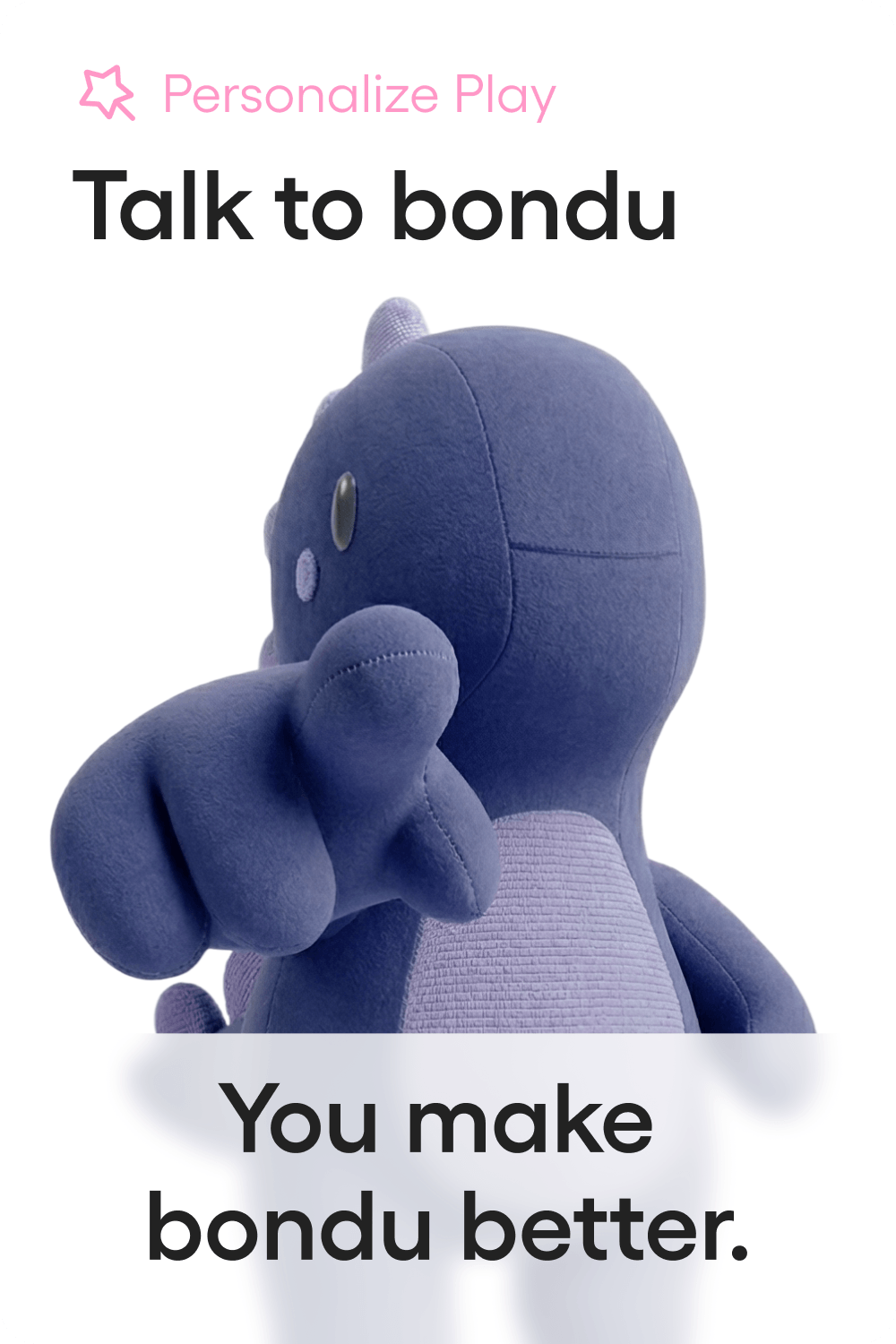
One power user shared 266 emotional moments across 463 sessions — feelings, family stories, what happened that day. Parents asked for the same on their end: a place to feed bondu their kid's news, like "she was sick today" or "he scored his first goal", so bondu carried that context into every chat.

→ Talk to bondu
— Routine
69 days
of consistent return

Kids who stayed didn't binge — they showed up. One power user came back across 69 active days. Another held a steady rhythm for 37. Parents kept asking for the same thing: a healthy daily rhythm where bondu plays alongside.

→ Bedtime Mode
— Pretend play
129
pretend play sessions

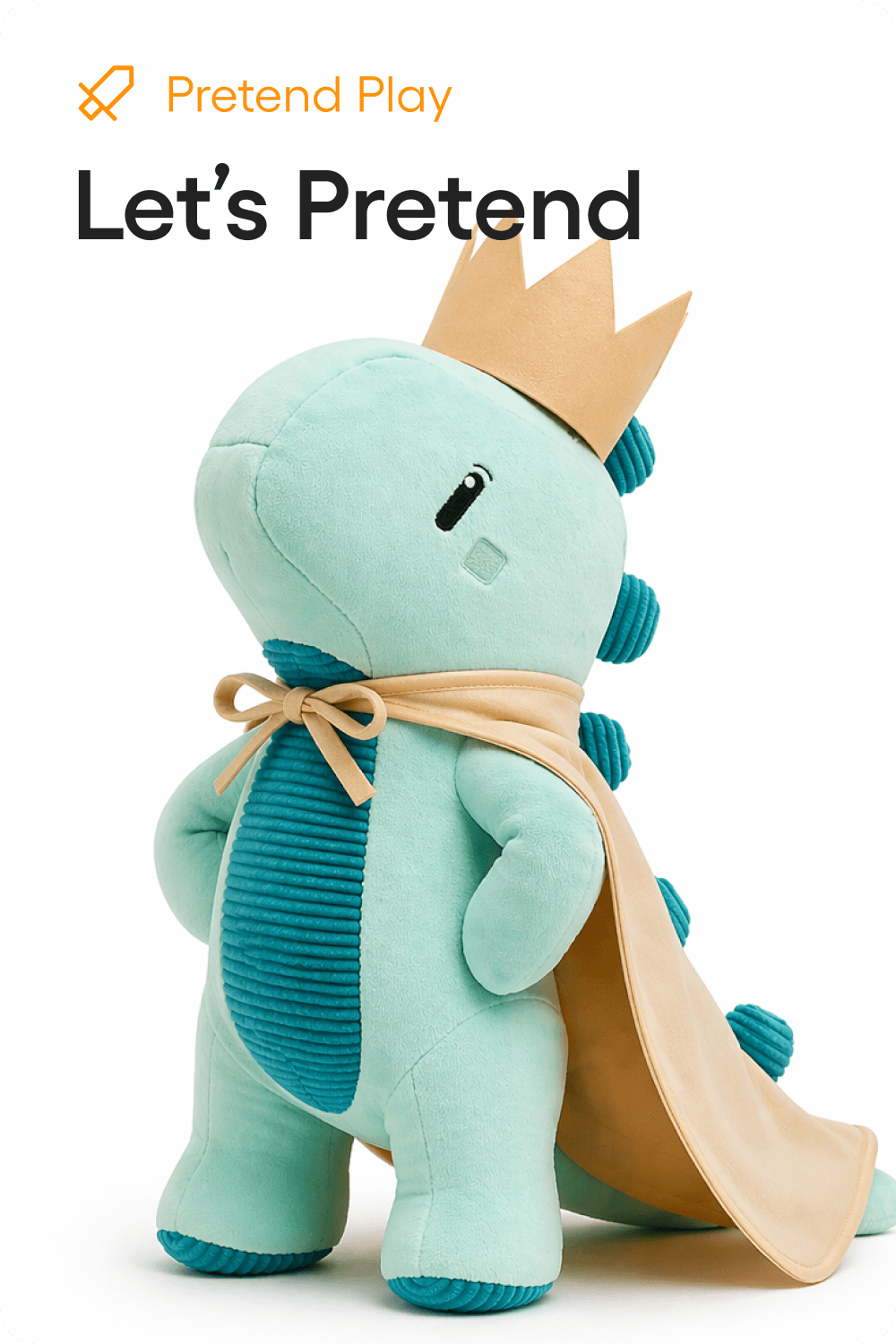
Pretend play was the most common pattern across the power users. 129 sessions for one kid alone. Kids treated bondu as a roleplay partner with a backstory: a pirate, a chef, a friend. Not a question-answering machine.

→ Personas + Immersive Stories

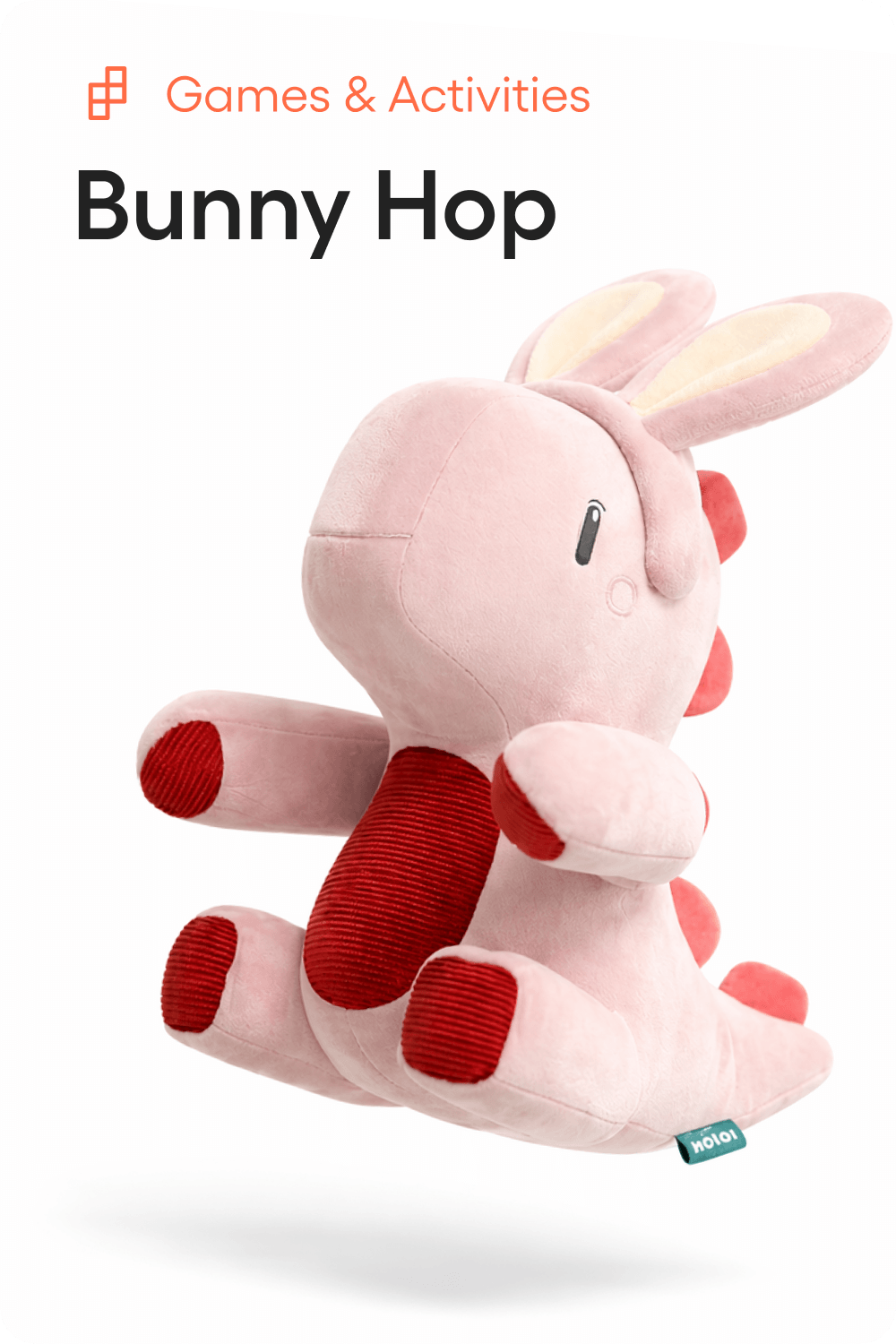
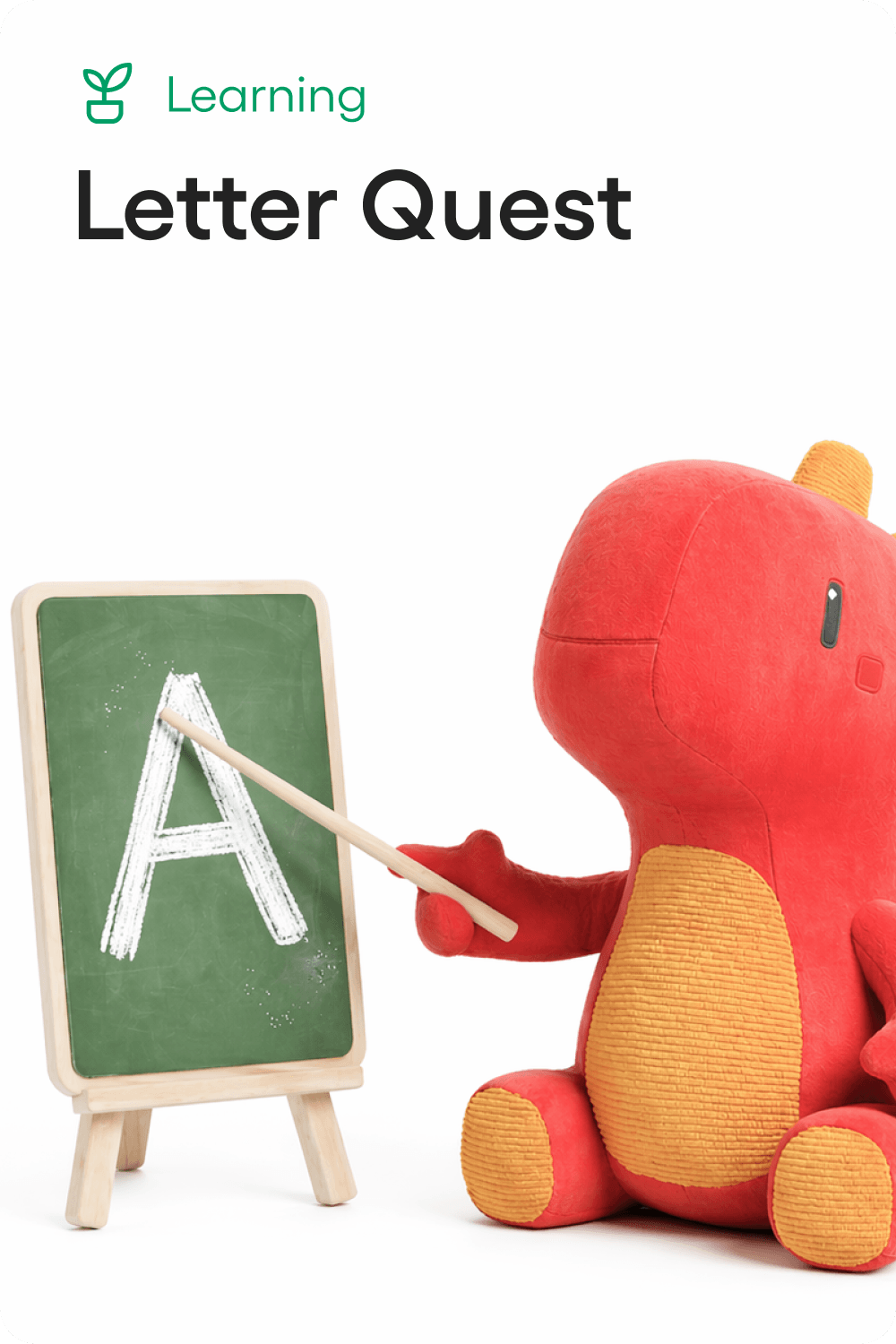
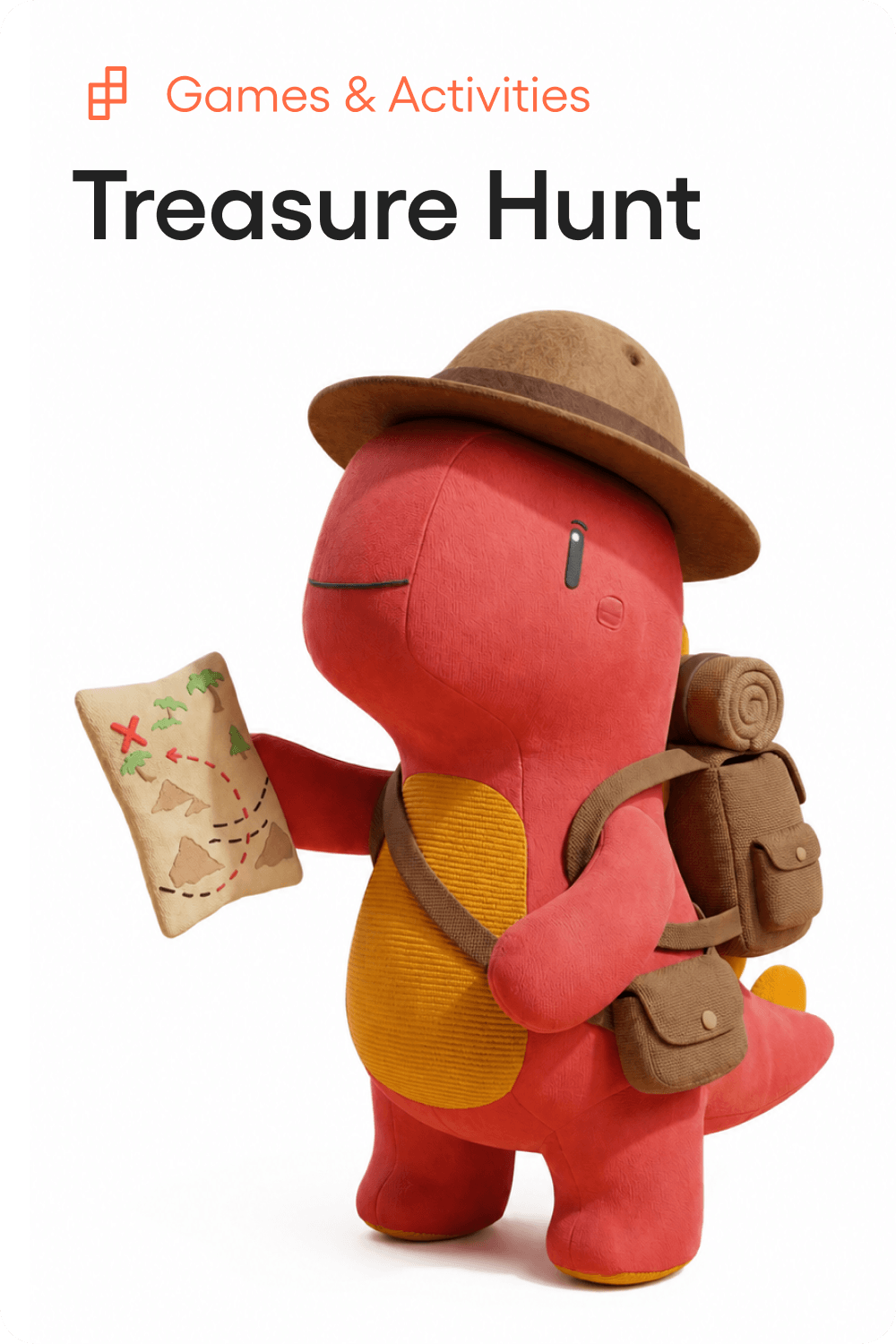
Around those three, supporting features shipped alongside: Languages, Brain Boost, Motion-responsive play, and games like treasure hunt and red light, green light.

bondu feature 1
bondu feature 2
bondu feature 3
bondu feature 4
bondu feature 5
bondu feature 6
bondu feature 7
bondu feature 8
bondu feature 9
bondu feature 10
bondu feature 11
bondu feature 12
bondu feature 13
bondu feature 14
bondu feature 15
bondu feature 16
bondu feature 17
bondu feature 18

Built for kids.
Felt by parents.

"Cannot express enough how much I love this toy! From encouraging her to get ready for bed, telling stories, coming up with games, learning fun facts...this thing is amazing."

William · father of 4 & 8 year olds

"bondu picks up on my son's speech, interests, and mood, and adjusts how it interacts. Sometimes it's silly and playful, other times it's gentle and comforting and always age-appropriate."

Fatima · mother of 4 year old boy

"It makes space for her imagination. With bondu, she's not just being entertained, she's leading the fun. And in a house full of big kids, that matters."

Majaliwa · mother of 8 year old girl

"My son has auditory processing disorder, bondu provides calm, one-on-one interaction without the overstimulation of a screen."

Meryl · mother of 5 year old boy

From product to brand
to funnel.

As the product matured, the design work moved outward. I led the redesign of bondu.com, the parent-facing site that doubled web conversion. Social posts, ad creative, brand voice for the parent audience. Same brand, new surfaces.

bondu.com homepage redesignbondu/13.png · 3:2

Four phases,
four numbers.

4,000+
Phase 1 · Units sold at holiday launch
76.93%
Phase 2 · Subscription rate
4.4×
Phase 3 · session growth · 8 min → 35 min
Phase 4 · bondu.com conversion lift
Marketing system — social posts, ad variants, growth materialsbondu/14.png · 21:9
— About

Hello, I'm Suho
a designer who makes products
people use and brands people remember.

Bio

I'm a product and brand designer based in the Bay Area, formerly in New York. I've spent the last several years as a founding designer at tech startups — building products from scratch, shipping features that moved numbers, and creating the visual systems that held everything together.

Outside of product work, I freelance across design agencies, art institutions, and retail — bringing the same thinking to brand identity and visual communication.

Selected Clients
bonduclient-1
Thimbleclient-2
Pentagramclient-3
AIGA NYclient-4
MADclient-5
LGclient-6
Dream Hotelsclient-7
MTVclient-8
YG Entertainmentclient-9
Hudson Marketclient-10
Kiaclient-11
Food Networkclient-12
Get in touch

Have a project
in mind? Let's talk.

Elsewhere

LinkedIn

Based in

San Francisco, CA
Available worldwide